English is full of words that sound alike but carry completely different meanings, and pear vs pare is a perfect example. These two words are pronounced the same way, yet they belong to entirely different contexts. One refers to a sweet fruit, while the other describes the act of trimming or cutting something down.
Because they sound identical, many people confuse them in writing. Whether you’re a student, content writer, or someone trying to improve grammar skills, understanding the distinction can help you avoid common mistakes and communicate more clearly.
In this guide, we’ll break down the meanings, usage, pronunciation, examples, and easy memory tricks so you never mix them up again.
What Does “Pear” Mean?
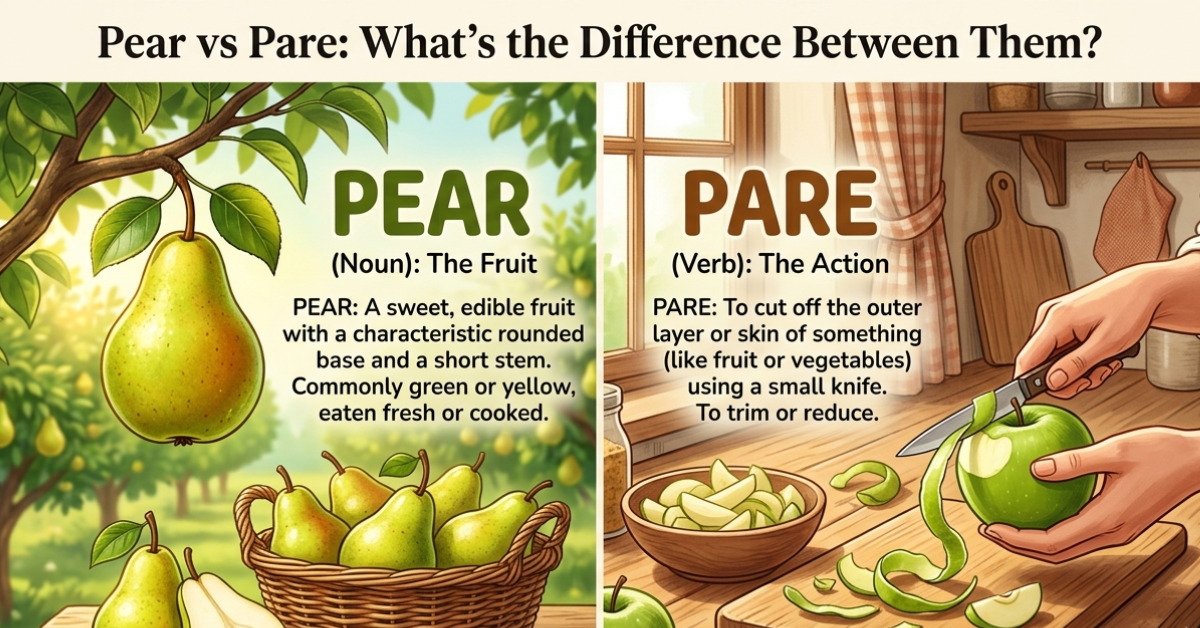
A pear is a fruit. It is usually green, yellow, or brown with a rounded bottom and a narrower top. Pears are sweet, juicy, and commonly eaten fresh or used in desserts and salads.
Examples of “Pear” in Sentences
- She packed a pear in her lunchbox.
- Pear trees grow well in cool climates.
- I made a smoothie with banana and pear.
Common Facts About Pears
- Pears are rich in fiber and vitamins.
- They belong to the rose family of plants.
- Popular varieties include Bartlett and Anjou pears.
Easy Memory Tip
Think of the letter “a” in pear as standing for apple-like fruit. If it’s something you can eat, you probably need pear.
What Does “Pare” Mean?
The word pare is a verb. It means to trim, peel, reduce, or cut away the outer layer or unnecessary parts of something.
People often use this word in cooking, budgeting, editing, or simplifying tasks.
Examples of “Pare” in Sentences
- Please pare the potatoes before cooking them.
- The company decided to pare down expenses.
- He pared the wood carefully with a knife.
Common Uses of “Pare”
Here are a few situations where the word is commonly used:
- Cooking
- Pare apples or vegetables by removing their skin.
- Reducing Something
- Pare down a budget or workload.
- Trimming
- Pare excess material from wood or fabric.
Easy Memory Tip
The word pare contains “re,” which can remind you of remove or reduce.
Pear vs Pare: Key Difference
Although the pronunciation is identical, the meanings are unrelated.
| Word | Meaning | Part of Speech | Example |
| Pear | A sweet fruit | Noun | I ate a ripe pear. |
| Pare | To trim or reduce | Verb | Pare the carrots carefully. |
This difference is important because using the wrong word can completely change the meaning of a sentence.
Why People Confuse These Words
There are a few reasons these words are commonly mixed up:
They Sound Exactly the Same
These are known as homophones, which are words with identical pronunciation but different meanings and spellings.
Spell Check Doesn’t Always Catch Errors
Since both are real English words, automatic grammar tools may not flag the mistake.
Context Matters
Without context, it can be difficult to know which word is correct.
For example:
- “She decided to pare the fruit.”
- “She decided to eat the pear.”
Both are grammatically correct but mean very different things.
Pronunciation of Pear and Pare
Both words are pronounced as:
/pair/
This is the same pronunciation used for the word “pair,” which means a set of two things.
Quick Pronunciation Tip
Say:
- pair
- pear
- pare
You’ll notice they sound identical in spoken English.
Common Mistakes to Avoid
Incorrect:
- I need to pear the potatoes.
Correct:
- I need to pare the potatoes.
Incorrect:
- She bought a fresh pare from the market.
Correct:
- She bought a fresh pear from the market.
Pear vs Pare in Everyday Writing
Understanding the correct word choice can improve:
- Academic writing
- Professional emails
- Blog posts
- Social media captions
- Everyday communication
Small grammar mistakes may seem harmless, but they can affect clarity and professionalism.
Simple Trick to Remember the Difference
Here’s a quick comparison trick:
- Pear = Fruit
- Pare = Cut or Reduce
Another helpful way:
- You can eat a pear.
- You can pare vegetables.
Keeping this association in mind makes the difference easier to remember.
Similar Homophones You Should Know
If you struggle with similar-sounding words, you’re not alone. English contains many confusing homophones, including:
- Their vs There
- Flour vs Flower
- Brake vs Break
- Principal vs Principle
- Allowed vs Aloud
Learning them gradually improves both writing confidence and vocabulary.
FAQs
Is pear a noun or verb?
Pear is a noun because it refers to a fruit.
Is pare always related to cutting?
Mostly yes. Pare usually means trimming, peeling, or reducing something.
Are pear and pare pronounced differently?
No. They are pronounced exactly the same.
Can “pare” mean simplify?
Yes. It can mean reducing something to a simpler or smaller form, such as “paring down expenses.”
Why are pear and pare confusing?
They are homophones, meaning they sound alike but have different meanings and spellings.
Conclusion
Understanding pear vs pare is easier once you focus on their meanings and usage. A pear is the fruit you eat, while pare means to trim, peel, or reduce something. Even though they sound identical, context makes the difference clear.
By learning a few memory tricks and practicing with examples, you can avoid common grammar mistakes and write with more confidence. If you enjoy improving your English vocabulary, keep exploring commonly confused words to sharpen your communication skills even further.