English is full of words that sound right but turn out to be incorrect once you look them up. One common example is indispensible or indispensable. Many people use both versions interchangeably, but only one is considered correct in standard English.
If you have ever paused while typing this word, wondering whether it should end in “-able” or “-ible,” you are not alone. This article explains the correct spelling, its meaning, pronunciation, grammar rules, and easy ways to remember it without confusion.
What Does Indispensable Mean?
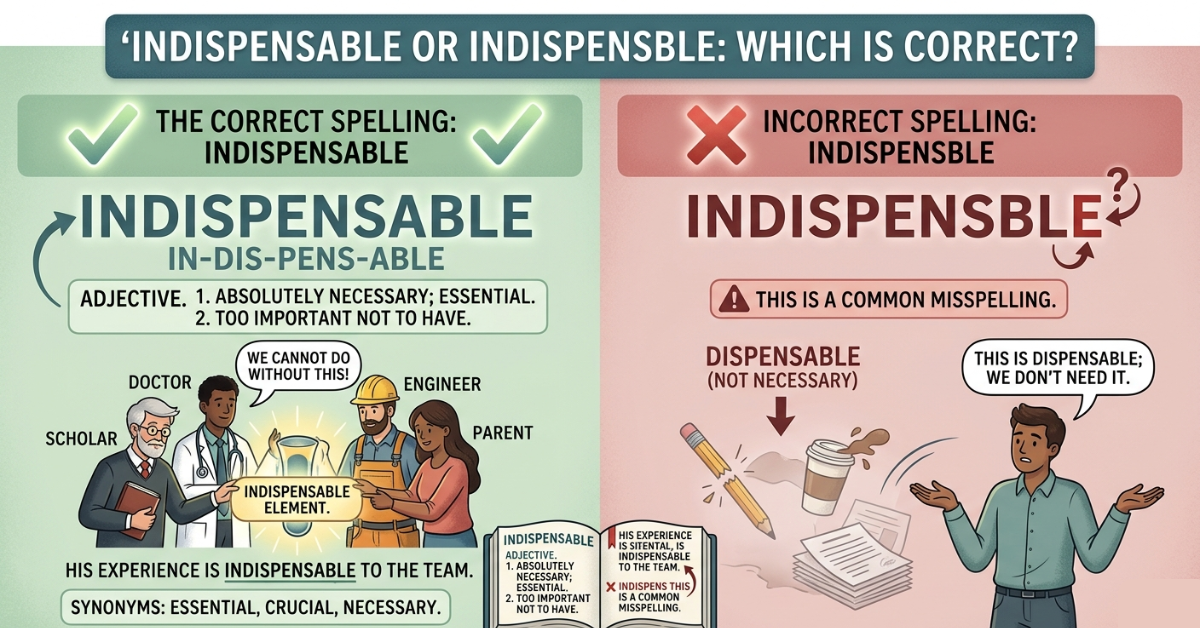
The word indispensable means something or someone that is absolutely necessary, essential, or impossible to do without.
It is often used to describe:
- Important tools
- Valuable people
- Essential skills
- Necessary resources
Examples in Sentences
- A reliable internet connection is indispensable for remote work.
- Good communication skills are indispensable in leadership roles.
- Water is indispensable to human survival.
- Her experience became indispensable to the team.
The word usually describes something that plays a critical role and cannot easily be replaced.
Indispensible or Indispensable: Which One Is Correct?
The correct spelling is indispensable.
The spelling indispensible is considered incorrect in modern English dictionaries and professional writing.
Correct:
- indispensable
Incorrect:
- indispensible
Although many people accidentally write “indispensible,” especially because of words like possible and visible, the accepted spelling uses -able, not -ible.
Why Do People Confuse These Words?
English spelling can be unpredictable, and many adjectives end with either “-able” or “-ible.” Because there is no universal rule that works every time, confusion happens naturally.
People often mistake the spelling because:
- The pronunciation sounds similar.
- Many English words use “-ible.”
- Spell-check errors are easy to overlook.
- The word is not used in everyday casual conversation very often.
This makes it one of the more commonly misspelled advanced vocabulary words.
The Origin of the Word
The term comes from the Latin word indispensabilis, which eventually entered Middle English and evolved into the modern spelling we use today.
Breaking the word down can help make sense of it:
- in- = not
- dispense = distribute or do without
- -able = capable of
Together, the word suggests something “not able to be done without.”
That is why the “-able” ending makes grammatical sense.
Easy Trick to Remember the Correct Spelling
A simple memory trick is to focus on the base word:
dispense → dispensable → indispensable
Since “dispensable” uses “-able,” the negative form keeps the same ending.
Think of it this way:
- dispensable = not necessary
- indispensable = absolutely necessary
This pattern makes the spelling easier to remember.
Common Situations Where the Word Is Used
The term appears frequently in both professional and academic writing.
In Business
Companies often describe key employees or systems as indispensable.
Example:
- Strong customer support is indispensable for business growth.
In Education
Teachers may refer to certain skills as essential for learning.
Example:
- Critical thinking is indispensable in higher education.
In Everyday Life
People also use it casually when talking about important items or relationships.
Example:
- My morning coffee feels indispensable during exams.
Synonyms of Indispensable
If you want variety in your writing, these alternatives can help:
- Essential
- Necessary
- Vital
- Crucial
- Fundamental
- Required
- Key
- Important
Each synonym carries a slightly different tone, but they all suggest importance.
Words Commonly Confused With Indispensable
English learners and native speakers alike often confuse similar-looking words. Here are a few examples:
| Incorrect Form | Correct Form |
| indispensible | indispensable |
| irresistable | irresistible |
| dependible | dependable |
| responsable | responsible |
These mistakes usually happen because English pronunciation does not always match spelling patterns.
How Dictionaries Define the Word
Major English dictionaries consistently recognize only one standard spelling.
The word is defined as:
“Absolutely necessary or essential.”
Whether you use American English or British English, the spelling remains the same.
Is “Indispensible” Ever Accepted?
In modern usage, “indispensible” is widely treated as a misspelling rather than a valid alternative.
You might occasionally find it in:
- Old texts
- Typographical errors
- Informal online writing
However, it should be avoided in:
- Academic work
- Professional emails
- Articles
- Business communication
Using the correct spelling improves credibility and writing quality.
Tips to Avoid Spelling Mistakes
Here are a few practical ways to remember difficult English spellings:
1. Learn the Root Word
Understanding the root often reveals the correct ending.
2. Read More Frequently
Exposure to proper spelling helps your brain recognize patterns naturally.
3. Use Writing Tools Carefully
Spell-checkers help, but proofreading is still important.
4. Practice Vocabulary in Sentences
Writing your own examples strengthens memory.
Frequently Asked Questions
Is indispensible a real word?
No. It is generally considered a misspelling of “indispensable.”
How do you spell indispensable correctly?
The correct spelling is:
- indispensable
What does indispensable mean?
It means something absolutely necessary or essential.
Why is the spelling confusing?
Many English adjectives end in either “-able” or “-ible,” which causes uncertainty.
Can I use indispensible in formal writing?
No. Professional and academic writing should always use “indispensable.”
What is the opposite of indispensable?
The opposite is usually:
- dispensable
- unnecessary
- nonessential
Conclusion
When comparing indispensible or indispensable, the correct spelling is clearly indispensable. While the incorrect version appears occasionally online, it is not accepted in standard English.
Understanding the root word “dispensable” makes the spelling much easier to remember. Whether you are writing an email, essay, article, or social media caption, using the correct form helps your writing look polished and professional.
If you often struggle with confusing English words, building vocabulary through regular reading and writing practice can make a huge difference over time.