Have you ever paused while writing and wondered whether to use by or bye? You are not alone. These two words sound alike, but they serve very different purposes in English, and mixing them up can make your writing look careless.
This guide to by vs bye breaks the difference down in a simple, practical way. You will learn what each word means, how to use it correctly, and how to remember the distinction without second-guessing yourself every time.
What Does “By” Mean?
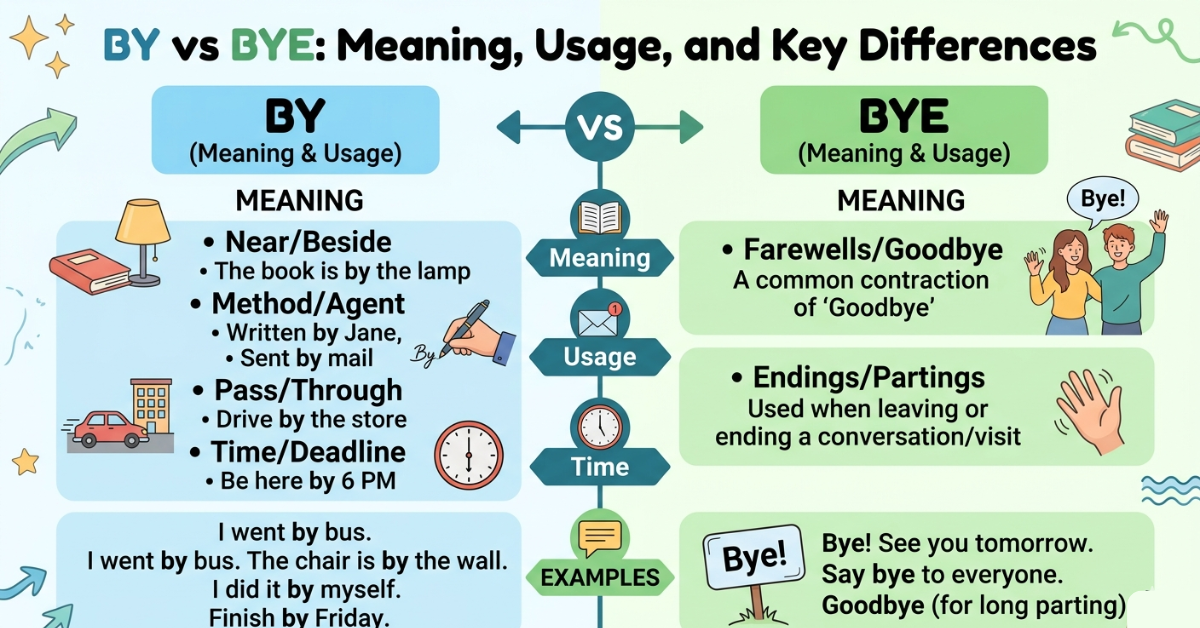
By is a very common word in English, and it has several uses. Most often, it works as a preposition, but it can also appear in expressions that show time, method, location, or authorship.
Common uses of “by”
- Time deadline:
Please submit the form by Friday. - Method or way:
We traveled by train. - Near or beside:
She sat by the window. - Who did something:
This book was written by a famous author.
Easy examples of “by”
- I got home by 7 p.m.
- The letter was sent by email.
- The car stopped by the roadside.
- The painting was made by her brother.
So, when you see by, think of connection, method, time, or location.
What Does “Bye” Mean?
Bye is a shortened, casual way of saying goodbye. It is usually used when ending a conversation, leaving a place, or signing off in a friendly way.
Common uses of “bye”
- Ending a conversation:
Bye! See you tomorrow. - Leaving a chat or call:
Okay, bye for now. - Casual farewell:
Bye everyone, take care.
Unlike by, this word does not show time, method, or location. It simply means farewell.
Easy examples of “bye”
- Bye, Mom. I am going to school.
- She waved and said bye.
- It was late, so we said bye and left.
By vs Bye: The Main Difference
The simplest way to remember by vs bye is this:
- By = a word that shows relationship, method, time, or location
- Bye = a word used to say goodbye
One tiny letter changes the meaning completely. That is why these spelling mistakes are so common in texts, emails, and casual writing.
Quick comparison
| Word | Part of Speech | Meaning | Example |
| by | preposition / adverb | near, through, before, using | She walked by the park. |
| bye | interjection / noun | goodbye | Bye! Talk to you later. |
How to Remember the Difference
A simple memory trick can save you time.
Try this:
- By has a y, and it helps you think of “way” or “place”.
- Bye has an e, like the last letter in “goodbye.”
You can also remember it this way:
- If you are talking about time, method, or location, use by.
- If you are ending a conversation, use bye.
Common Mistakes People Make
People often write the wrong word because both sound the same when spoken aloud. In fast texting, the mistake is even more likely.
Here are some common errors:
- In correct: I will see you bye Monday.
Correct: I will see you by Monday. - In correct: Bye the window, please sit here.
Correct: By the window, please sit here. - In correct: Bye! The report was written by her.
Correct: This one is correct only if you are saying farewell and using by in the second part.
A good habit is to reread the sentence and ask yourself:
“Am I saying goodbye, or am I describing how, when, or where something happens?”
Simple Rules for Correct Usage
Use this quick checklist whenever you are unsure:
- Use “by” when the sentence shows:
- a deadline
- a method
- a location
- authorship
- Use “bye” when:
- you are saying goodbye
- ending a message or conversation
- Read the sentence aloud
- If the meaning is farewell, bye is probably correct.
- If the meaning is “near,” “before,” or “through,” by is the better choice.
Real-Life Examples in Sentences
Here are some practical examples to make the difference even clearer.
Sentences with “by”
- The restaurant is just by the mall.
- Finish your homework by 9 p.m.
- We came by bus.
- The article was written by a student.
Sentences with “bye”
- Bye, have a great day!
- She said bye and closed the door.
- Bye for now. I will call later.
These examples show that by vs bye is not just about spelling; it is about meaning and context.
Why This Confusion Matters
Using the wrong word may seem small, but it can affect how clear and professional your writing looks. In schoolwork, emails, and online messages, accuracy matters.
A correct choice shows:
- strong attention to detail
- better communication
- more polished writing
- confidence with everyday English
That is especially helpful if English is not your first language or if you often write in formal and informal settings.
FAQs
1. Is “bye” always informal?
Yes, bye is usually informal and friendly. In formal writing, people often use goodbye instead.
2. Can “by” and “bye” ever mean the same thing?
No. They sound similar, but their meanings are different.
3. Which one is used in emails?
Use by when giving a deadline or describing something. Use bye only when ending the email casually, such as in a friendly message.
4. What is the easiest way to remember them?
Think of by as the word for time, place, or method, and bye as the word for farewell.
5. Is “bye” a noun or interjection?
It can function as an interjection when used in speech and also as a noun in some contexts, though it is most commonly used as a farewell.
Conclusion
Understanding by vs bye is easy once you know the purpose of each word. By is used for time, method, location, and authorship, while bye is simply a way to say goodbye. That small difference can make a big improvement in your writing.
The next time you pause before typing, remember the context first. Are you describing how, when, or where? Use by. Are you ending the conversation? Use bye. For more grammar clarity, keep exploring similar word pairs and build your confidence one simple rule at a time.