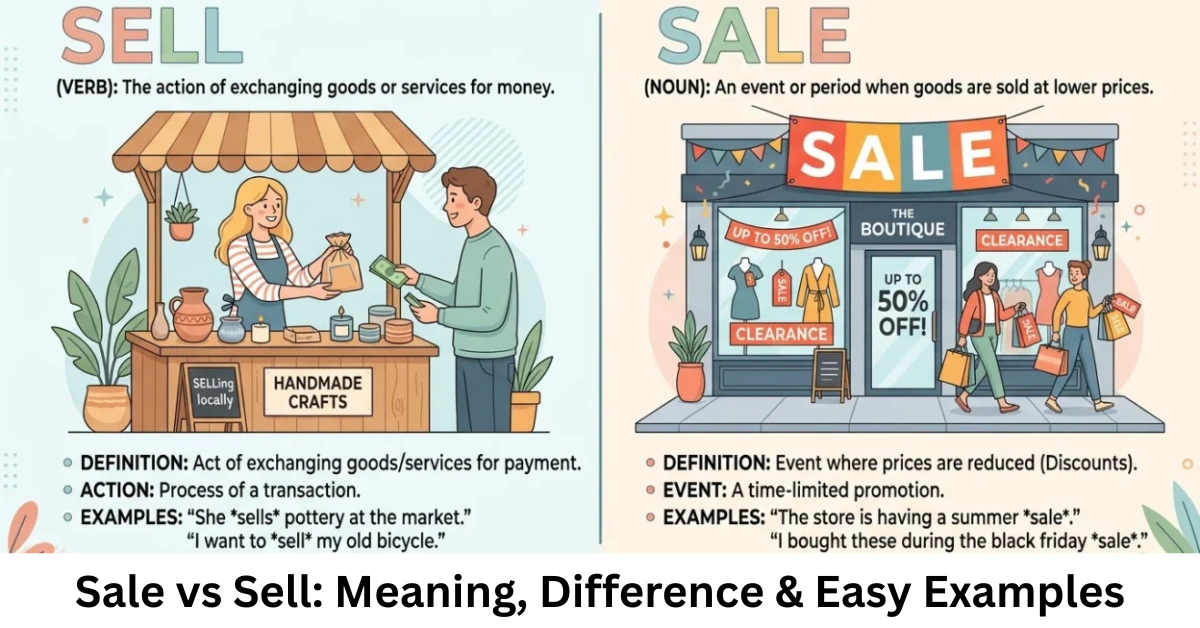
Many English learners and even native speakers confuse sale vs sell because the words look similar and relate to buying and selling. But they are not used the same way. One is usually a noun, and the other is a verb. Knowing the difference can instantly improve your grammar, business writing, and daily conversations.
In this guide, you’ll learn the meanings, grammar rules, and real-life examples so you always know which word to choose.
What Is the Difference Between Sale and Sell?
The simplest way to understand these words is this:
- Sale = a noun (thing/event/result)
- Sell = a verb (action)
Quick Comparison Table
| Word | Part of Speech | Meaning | Example |
|---|---|---|---|
| Sale | Noun | Exchange of goods for money / discount event | The store had a big sale. |
| Sell | Verb | To give something in exchange for money | I want to sell my bike. |
This is the core sale vs sell difference that causes confusion.
Sale Meaning Explained
Sale refers to the act or result of selling something. It can also mean a promotional event where prices are reduced.
Examples of Sale
- The house sale was completed yesterday.
- Our summer sale starts Friday.
- That phone is on sale this week.
- Ticket sales increased this month.
Here, sale names a thing, event, or outcome.
Sell Meaning Explained
Sell means to exchange something for money. It describes the action performed by a person, company, or seller.
Examples of Sell
- I want to sell my old laptop.
- They sell handmade furniture online.
- She can sell products very well.
- We plan to sell the car next month.
This action-based use makes it easy to identify.
Sale vs Sell Meaning in Simple Terms
If you can replace the word with event, transaction, or discount, use sale.
If you can replace it with trade, offer, or exchange, use sell.
Easy Trick to Remember
- Sell has action energy → doing something
- Sale is the result or event → something happening
When to Use Sale vs Sell
Use sale when talking about:
- Store promotions
- Completed transactions
- Revenue numbers
- Purchase events
Use sell when talking about:
- Offering goods or services
- Convincing someone to buy
- Transferring ownership for money
- Marketing products
This is the easiest way to know when to use sale vs sell correctly.
Common Sale vs Sell Examples
Correct Usage in Sentences
- The store is having a clearance sale.
- I need to sell my unused camera.
- Their online sales grew this year.
- She knows how to sell luxury items.
- The property sale closed today.
Incorrect Usage
- I want to sale my phone.
- They will sale shoes tomorrow.
Correct version:
- I want to sell my phone.
- They will sell shoes tomorrow.
- Grammar Rules You Should Know
Sale as a Noun
It usually comes after articles like:
- a sale
- the sale
- this sale
Sell as a Verb
It changes tense like other verbs:
- sell
- sells
- sold
- selling
Examples:
- I sell clothes.
- She sells books.
- They sold everything.
- We are selling tickets.
Same Day Sale vs Sell to Cover
These terms are common in stock compensation and employee share plans.
Same Day Sale
A transaction where shares are exercised and sold immediately on the same day.
Sell to Cover
Some shares are sold to cover taxes, fees, or exercise costs, while remaining shares may be kept.
This topic appears in finance, but the grammar still follows the same noun/verb pattern.
Sale vs Sell Definition for Business English
In professional settings:
- Sale often refers to revenue, deal completion, or promotion campaigns.
- Sell refers to the process of persuading customers and closing deals.
Examples:
- Monthly sales increased by 20%.
- Our team sells software to small businesses.
Common Mistakes to Avoid
1. Using Sale as a Verb
Wrong: I will sale it tomorrow.
Right: I will sell it tomorrow.
2. Using Sell as a Noun
Wrong: The store has a big sell.
Right: The store has a big sale.
3. Confusing Spoken English
Because they sound similar, many learners mix them up in writing.
How to Remember the Difference Fast
Use this memory trick:
- Sell = action
- Sale = result
Think:
“You sell items during a sale.”
FAQs
Is sale and sell the same?
No. One is usually a noun, and the other is a verb.
Which is correct: for sale or for sell?
For sale is correct because it describes something available to buy.
Can sale be used as a verb?
In standard English, no. Use sell as the verb.
What is the past tense of sell?
The past tense is sold.
Why do people confuse these words?
They have similar spelling, pronunciation, and both relate to commerce.
Conclusion
Understanding sale vs sell is simple once you know the grammar rule: sale names a thing or event, while sell shows an action. Use sale for promotions, transactions, or results, and use sell when someone is offering something for money.
Mastering this small difference can make your English sound clearer and more professional. If you often mix up similar words, keep practicing with daily examples and short sentences.