We’ve all heard the phrase “time flies or time flys” in conversations, captions, or even songs—but have you ever stopped to wonder which spelling is actually correct? It’s one of those small grammar doubts that can quietly confuse even confident English speakers.
In this article, we’ll break it down in a simple, human way so you’ll never second-guess it again. We’ll explore the correct spelling, meaning, grammar rule behind it, and how you can use it naturally in writing and speech.
Time Flies or Time Flys: What’s the Correct Spelling?
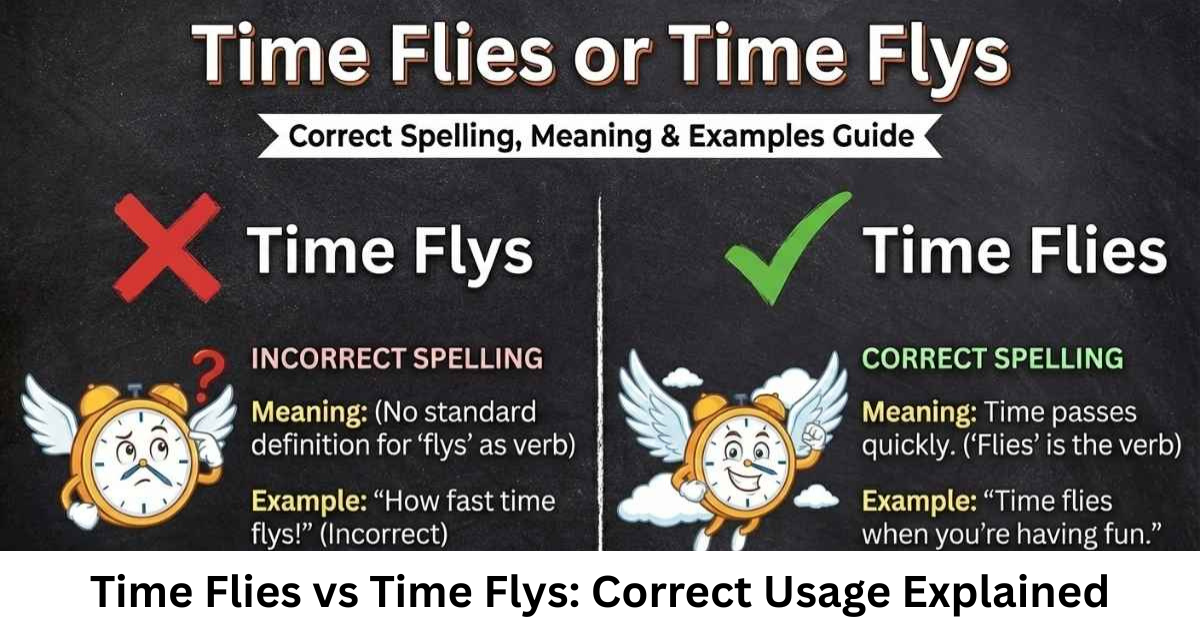
The correct form is “time flies”, not “time flys.”
The confusion happens because English spelling doesn’t always follow simple rules, especially when turning verbs into third-person singular form.
So when people ask is it time flies or time flys, the answer is straightforward:
- Correct: time flies
- Incorrect: time flys
Why “Time Flies” Is the Correct Form
The phrase time flies uses the verb “fly” in its third-person singular present tense form. In English grammar, when a verb ends in a consonant + “y,” the “y” changes to “i” and we add “es.”
That’s why:
- fly → flies
- cry → cries
- try → tries
So grammatically, time flies is correct because “time” is singular and acts like the subject of the sentence.
Is It Time Flies or Time Flys? Grammar Explained Simply
To understand is it time flies or time flys, think of it like this:
When we say “time flies,” we are not talking about actual flying. It’s a metaphor meaning that time passes quickly.
Examples:
- Time flies when you’re having fun.
- Time flies during holidays.
- Time flies in good company.
The incorrect spelling “flys” doesn’t follow English grammar rules and is not recognized as standard usage.
Meaning of “Time Flies” in Everyday Life
The expression “time flies” is an idiom. That means its meaning is not literal—it’s symbolic.
It describes:
- How quickly time seems to pass
- How moments feel shorter when you enjoy them
- How life feels fast-paced in busy routines
This is why you’ll often hear it in emotional or reflective contexts.
Common Mistakes People Make
Even native speakers sometimes get confused. Here are a few common errors:
- Writing “time flys” in captions or essays
- Using it in plural form incorrectly
- Confusing it with literal flying actions
Quick tip: if it sounds like a natural phrase, always stick with “flies.”
Easy Memory Trick to Remember the Correct Spelling
Here’s a simple trick:
- If the subject is singular (time), use “flies”
- Think: “One time = one flies ending”
- Remember verbs change, not nouns
This small rule helps you avoid confusion forever.
Why This Phrase Is So Popular
The phrase time flies is widely used because:
- It’s emotionally relatable
- It fits in casual and formal writing
- It’s short, catchy, and meaningful
- It appears in speeches, books, and social media captions
It perfectly captures how humans experience time emotionally rather than scientifically.
FAQs
1. What is correct: time flies or time flys?
The correct spelling is time flies.
2. Why do people write “time flys”?
It’s usually a spelling mistake caused by confusion with verb forms.
3. What does “time flies” actually mean?
It means time passes very quickly, especially when you are enjoying something.
4. Is “time flies” a metaphor?
Yes, it is a metaphor describing the fast perception of time.
5. Can I use “time flies” in formal writing?
Absolutely. It is grammatically correct and widely accepted in both formal and informal English.
Conclusion
Now you know the clear answer to time flies or time flys—the correct form is time flies. It follows standard English grammar rules and is used to express how quickly time passes in life.
Understanding small grammar details like this not only improves your writing but also boosts your confidence in communication. The next time you come across this phrase, you’ll know exactly how to use it correctly—no hesitation needed.