Have you ever paused while writing and wondered whether to use offerred or offered? It’s a common spelling confusion, especially because many English verbs double their final consonant before adding endings. But in this case, only one version is correct.
If you’ve searched this question, you’re not alone. Many writers, students, and professionals make this mistake. In this guide, you’ll learn the correct spelling, why it works that way, and how to remember it confidently in future writing.
The Correct Spelling: Offered
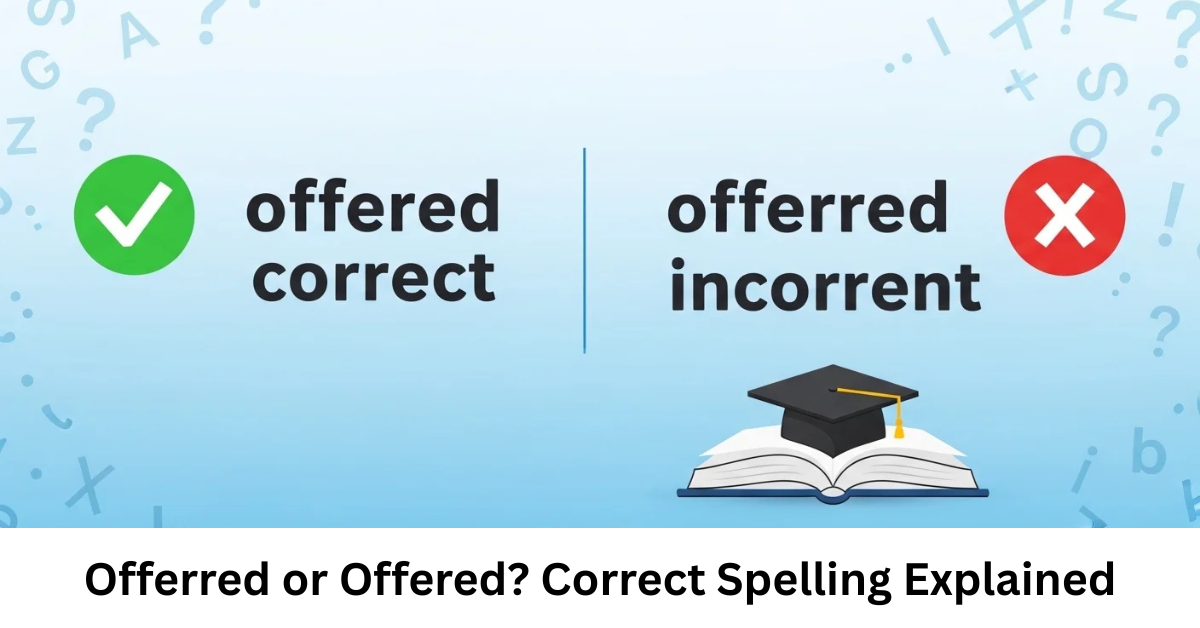
The correct word is offered.
Example: She offered to help with the project.
Incorrect: She offerred to help with the project.
“Offered” is the past tense and past participle form of the verb offer, which means to present, provide, suggest, or propose something.
Why “Offerred” Is Incorrect
The mistake happens because some English verbs double the last consonant before adding -ed. For example:
- Stop → Stopped
- Plan → Planned
- Admit → Admitted
However, offer does not follow that rule.
That’s because the stress in the word offer falls on the first syllable:
OF-fer
Since the stress is not on the last syllable, the final r is not doubled before adding -ed.
Simple Grammar Rule to Remember
When adding -ed to a verb ending in consonant-vowel-consonant (CVC), the last consonant is usually doubled only when the final syllable is stressed.
Examples:
- Prefer → Preferred
- Refer → Referred
- Offer → Offered
This rule explains why many people confuse similar-looking verbs.
Meaning of Offered
The word offered can have several meanings depending on context:
1. Presented Something
He offered me a cup of tea.
2. Proposed Help or Service
They offered free delivery.
3. Suggested an Idea
She offered a solution during the meeting.
4. Made Available
The university offered new courses this semester.
Common Sentences Using Offered
Here are natural examples:
- The store offered discounts on weekend sales.
- He offered his seat to the elderly passenger.
- They offered support during difficult times.
- She offered to drive us home.
Why People Type “Offerred”
Spelling mistakes often come from pattern memory. Since words like preferred and referred use double r, many people assume this one should too.
Other reasons include:
- Fast typing
- Autocorrect confusion
- Uncertainty about grammar rules
- Similar-looking verb patterns
Quick Memory Trick
Think of this sentence:
Offer keeps one R, even in the past.
So:
- Offer
- Offering
- Offered
No extra r needed.
Offered vs Similar Words
Here are some words that may confuse learners:
| Base Verb | Correct Past Form |
|---|---|
| Offer | Offered |
| Refer | Referred |
| Prefer | Preferred |
| Suffer | Suffered |
Notice that not every word ending in -er follows the same pattern.
Tips to Avoid This Mistake
1. Check Stress in Pronunciation
Say the word aloud. If stress is on the first syllable, doubling may not happen.
2. Use Spell Check
Modern writing tools often catch errors quickly.
3. Read More Often
Seeing correct spelling repeatedly improves memory.
4. Practice in Sentences
Use the word naturally until it feels automatic.
FAQs
Is offerred ever correct?
No. It is considered a spelling mistake in standard English.
Why is offered spelled with one r?
Because the stress is on the first syllable of offer, so the final consonant is not doubled.
Is offered past tense?
Yes. It is both the past tense and past participle of offer.
How do I remember the correct spelling?
Remember: Offer already has enough letters—just add ed.
Do British and American English spell it differently?
No. Both use offered.
Conclusion
If you’re unsure about offerred or offered, the answer is simple: offered is always the correct spelling. Understanding stress patterns in English verbs can help you avoid similar mistakes in the future.
The next time you write emails, essays, or captions, you’ll know exactly which form to use. Keep learning these small grammar details—they make a big difference in polished writing.