A questionaire or questionnaire is one of the most widely used tools for collecting information, opinions, and feedback. Whether it’s used in education, research, business, or healthcare, this simple yet powerful method helps gather structured data efficiently.
In this guide, we’ll break down what a questionaire or questionnaire really means, how it works, its types, and why it plays such an important role in decision-making and research. If you’ve ever filled out a survey online or on paper, you’ve already experienced it in action.
What is a Questionaire or Questionnaire?
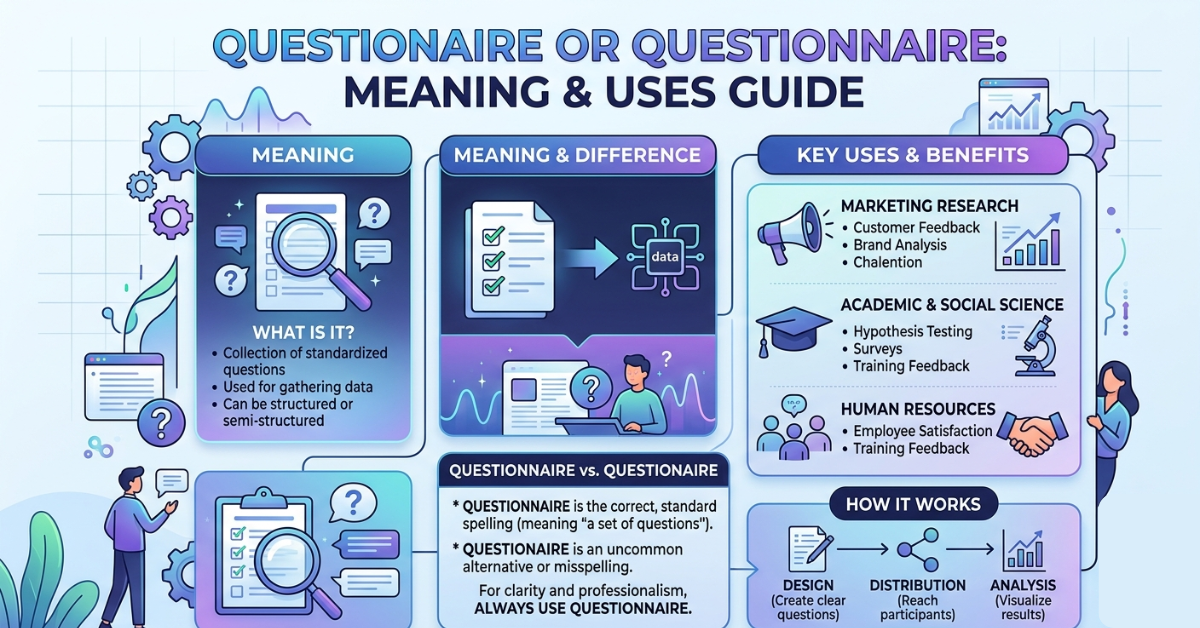
A questionaire or questionnaire is a set of written or digital questions designed to collect information from individuals. These questions can be open-ended, close-ended, or a mix of both depending on the purpose.
In simple terms, it’s a structured way of asking people for their opinions, experiences, or factual details.
Key points:
- Used for surveys and research studies
- Can be paper-based or online
- Helps in collecting large amounts of data quickly
- Often used in marketing, education, and social research
Types of Questionnaire
Understanding the types of a questionaire or questionnaire helps in choosing the right format for your purpose.
1. Structured Questionnaire
This type contains fixed questions with predefined answers like multiple choice or yes/no questions. It is easy to analyze and widely used in surveys.
2. Unstructured Questionnaire
These include open-ended questions that allow respondents to answer freely. They provide deeper insights but are harder to analyze.
3. Mixed Questionnaire
A combination of both structured and unstructured questions, offering balanced data collection.
Importance of Questionnaires in Data Collection
A questionaire or questionnaire is important because it helps collect reliable and organized data.
Benefits include:
- Saves time and resources
- Reaches a large audience quickly
- Provides measurable and comparable data
- Reduces interviewer bias
- Useful for statistical analysis
Businesses use it to understand customer satisfaction, while researchers use it to study human behavior and trends.
How to Design an Effective Questionnaire
Creating a strong questionaire or questionnaire requires planning and clarity. Here are some simple steps:
- Define your goal – Know what information you want
- Keep questions simple – Avoid confusion or technical language
- Use logical order – Start with general questions
- Avoid bias – Don’t lead respondents toward an answer
- Test before use – Always pilot your questionnaire
A well-designed questionnaire leads to better and more accurate responses.
Common Mistakes to Avoid
When creating a questionaire or questionnaire, people often make avoidable mistakes:
- Asking too many questions
- Using unclear or complex language
- Mixing multiple ideas in one question
- Ignoring the target audience
- Not testing before distribution
Avoiding these errors improves the quality of your results significantly.
FAQs
1. What is the main purpose of a questionnaire?
The main purpose is to collect structured information from individuals for research, surveys, or decision-making.
2. What is the difference between a survey and a questionnaire?
A questionnaire is the tool (set of questions), while a survey is the entire process of collecting and analyzing data.
3. Can questionnaires be used online?
Yes, most modern questionnaires are created and distributed online using digital tools for faster responses.
4. Why is a questionnaire important in research?
It helps gather accurate, organized, and large-scale data efficiently, making analysis easier.
5. What makes a good questionnaire?
A good questionnaire is clear, concise, unbiased, and aligned with the research objective.
Conclusion
A questionaire or questionnaire is a powerful tool that simplifies the process of collecting and analyzing information. When designed properly, it delivers valuable insights that help in research, business decisions, and understanding human behavior.
By keeping your questions clear, relevant, and well-structured, you can significantly improve the quality of your data. If you’re planning your own survey, start with a clear goal and build your questionnaire step by step for the best results.