Have you ever stopped while writing and asked yourself whether it should be warn or worn? This confusion happens often because both words sound almost identical. However, they carry completely different meanings and play different roles in English sentences.
In simple terms, warn vs worn is a common grammar confusion where one word expresses caution, while the other describes something old, used, or tired. Therefore, understanding the difference helps you write clearly and avoid mistakes in both speaking and writing.
In this guide, you will learn the meanings, examples, and practical tips so you never mix them up again.
Quick Meaning Breakdown of Warn vs Worn
To begin with, let’s simplify both words:
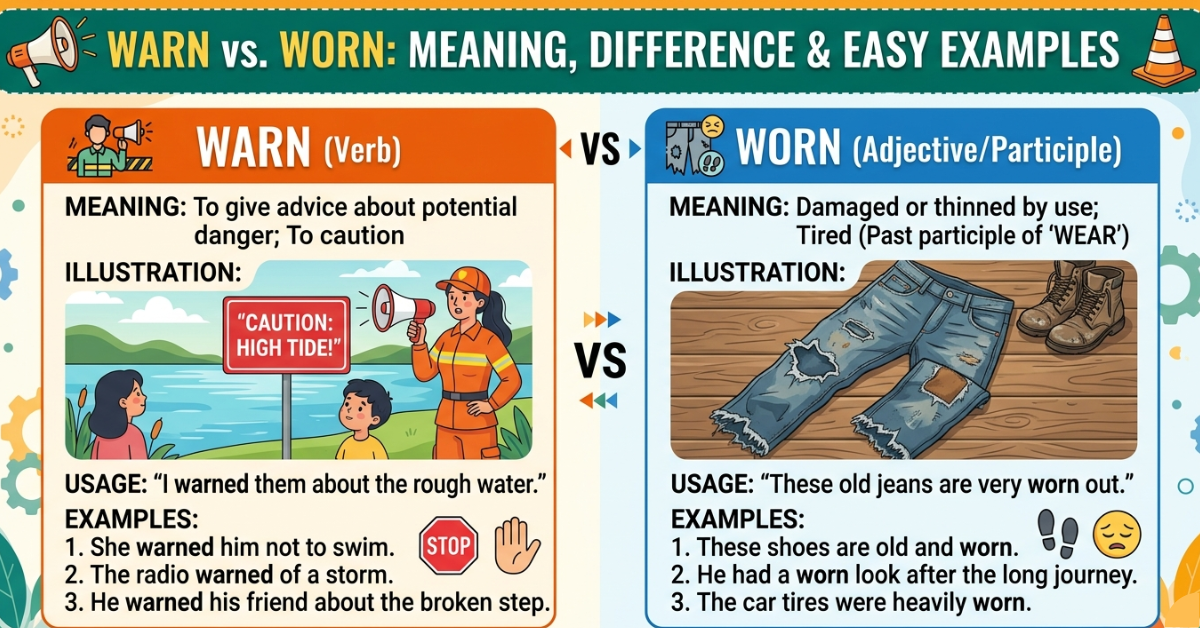
- Warn → to tell someone about danger or risk
- Worn → used, damaged, or exhausted (from wear)
Moreover, one word shows an action, while the other shows a condition. This distinction makes all the difference.
What Does “Warn” Mean? (With Examples)
The word warn works as a verb. It describes the action of telling someone to be careful or alert.
Examples of “Warn”
- The police warned people about the heavy rain.
- The teacher warned students before the test.
- My friend warned me about the slippery floor.
When to use “warn”
You should use warn when you:
- Give safety advice
- Alert someone about danger
- Try to prevent a problem
In addition, warn often appears with prepositions such as:
- warn about
- warn against
- warn someone
For example, doctors often warn against eating too much sugar because it harms health.
What Does “Worn” Mean? (With Examples)
On the other hand, worn comes from the verb wear. It describes something that has been used so much that it looks old or damaged.
Examples of “Worn”
- His shoes looked worn after months of use.
- The carpet appeared worn and faded.
- She felt worn out after a long day.
When to use “worn”
You should use worn when:
- Something looks old or damaged
- A person feels tired or exhausted
- You describe long-term use
Meanwhile, common expressions include:
- worn out
- worn down
- worn edges
For instance, a worn-out chair clearly shows years of heavy use.
Warn vs Worn: Key Differences at a Glance
To make things clearer, here is a simple comparison:
| Word | Type | Meaning | Example |
| Warn | Verb | To alert or caution | She warned me about traffic |
| Worn | Adjective / past participle | Used, damaged, or tired | The bag looks worn |
Therefore, if you describe an action, choose warn. However, if you describe a condition, choose worn.
How to Remember Warn vs Worn Easily
To avoid confusion, you can use simple memory tricks:
- Warn = Alert (both start with A sound association of danger)
- Worn = Old (think “old and used”)
- Additionally, link worn with wear, because both come from the same root
Moreover, if you remember that warn involves action, you will rarely make mistakes.
Common Mistakes in Warn vs Worn Usage
Many learners mix these words because they sound similar. However, once you understand their meanings, the errors become easy to fix.
Mistake 1:
He worn me about the storm.
Correct: He warned me about the storm.
Mistake 2:
My shoes look warn.
Correct: My shoes look worn.
Mistake 3:
She worn us about the danger.
Correct: She warned us about the danger.
In addition, always remember that worn is never used as a verb for warning someone.
Real-Life Usage of Warn vs Worn
Let’s see how both words appear in everyday situations:
Safety and Alerts
- The lifeguard warned swimmers about strong waves.
- The app warns users before deleting files.
Objects and Appearance
- The old sofa looks worn but still comfortable.
- His jacket is completely worn out.
Emotions and People
- She looked worn after a stressful week.
- He felt worn out from studying all night.
Meanwhile, both words help describe very different situations in real life.
Pronunciation Tip for Warn vs Worn
Interestingly, both words sound almost the same in many accents. However, writing makes the difference clear.
- Warn → rhymes with “born”
- Worn → also sounds like “born” but has a different spelling and meaning
Therefore, rely on meaning instead of sound when writing.
Grammar Shortcut: Action vs Condition Rule
To simplify everything:
- If someone does something, use warn
- If something looks or feels used, use worn
In addition, this rule works in almost every sentence and prevents confusion.
FAQs about Warn vs Worn
1. Is worn the past tense of warn?
No. Worn comes from wear, not warn. The correct past tense of warn is warned.
2. What is the main difference between warn vs worn?
Warn means to alert someone, while worn means used, damaged, or tired.
3. Can worn describe people?
Yes. It describes tired or exhausted people, such as “He looked worn after work.”
4. Why do people confuse warn and worn?
People confuse them because they sound very similar in spoken English.
5. How can I remember warn vs worn easily?
Think: warn = action (alert) and worn = condition (old or tired).
Conclusion
To sum up, the difference between warn vs worn becomes simple once you understand their roles. Warn helps you express caution and safety messages, while worn describes something old, damaged, or exhausted.
Moreover, if you focus on meaning instead of sound, you will avoid most mistakes. Finally, practice using both words in sentences, and soon the confusion will disappear completely.