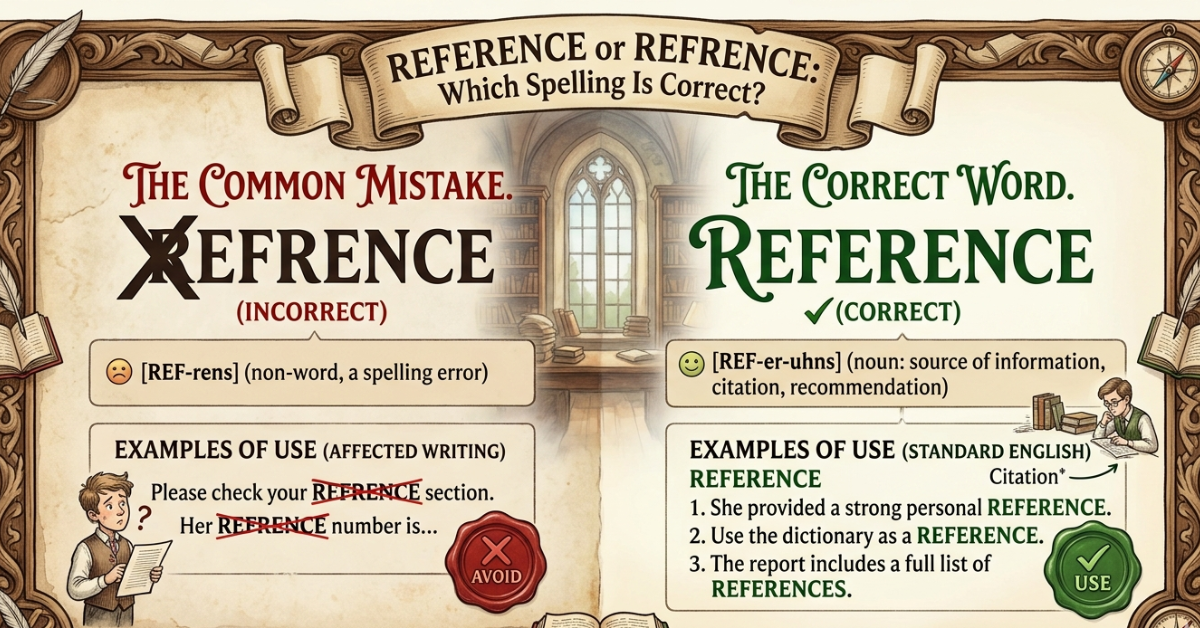
Have you ever typed a word and suddenly wondered whether it looks right? One of the most common spelling mix-ups people search for is refrence or reference. Since both versions appear similar, it’s easy to understand why many writers, students, and professionals get confused.
The simple answer is that “reference” is the correct spelling, while “refrence” is a common misspelling. Still, there’s more to understand about why this mistake happens and how to avoid it in academic, professional, and everyday writing.
In this guide, you’ll learn the correct usage, meaning, pronunciation tips, examples, memory tricks, and frequently asked questions related to this spelling confusion.
What Does “Reference” Mean?
The word “reference” is used when mentioning, citing, or directing someone to a source of information. It can also describe a recommendation, comparison, or note connected to a topic.
Common meanings include:
- Mentioning a source in writing
- Referring to something for information
- A recommendation from an employer or teacher
- A citation in research or academic work
Example sentences:
- Please include a reference at the end of your report.
- She used several books as reference material.
- The company asked for two professional references.
Why Do People Spell It as “Refrence”?
The incorrect version usually happens because people pronounce the word quickly and accidentally skip the second “e” sound in the middle.
English spelling can sometimes be tricky because pronunciation does not always perfectly match written form. In fast typing or casual writing, letters are often omitted without the writer realizing it.
Common reasons for the mistake:
- Typing too quickly
- Mishearing the pronunciation
- Confusion with similar-looking words
- Lack of proofreading
- Autocorrect not catching the error
Correct Spelling Breakdown
Here’s an easy way to remember the proper spelling:
Word Structure
- Refer + ence = Reference
The word comes from the verb “refer,” which means to direct attention to something.
Pronunciation Tip
It is pronounced as:
REF-er-uhns
Hearing the middle syllable clearly can help you remember the missing “e.”
Examples in Everyday Writing
Understanding real-world usage makes spelling easier to remember.
Academic Writing
Students often use citations and bibliographies in assignments.
Example:
- Every research paper should contain proper references.
Professional Communication
Employers may ask for recommendation letters or contact details.
Example:
- The applicant provided three job references.
Digital and Online Content
Writers and bloggers use source citations for credibility.
Example:
- The article included references from medical journals.
Easy Tricks to Remember the Correct Version
Spelling mistakes are normal, but small memory tricks can help prevent them.
1. Think of the Word “Refer”
Since the word begins with “refer,” the spelling naturally becomes “reference.”
2. Read It Slowly
Break it into parts:
- Ref-er-ence
3. Use Spell Check Carefully
Spell check tools help, but proofreading is still important because some errors can slip through.
4. Practice Commonly Misspelled Words
Repeated exposure improves spelling memory over time.
Commonly Confused Words Similar to This
Many English words are misspelled because of silent vowels or pronunciation shortcuts.
Examples include:
| Incorrect | Correct |
| Definately | Definitely |
| Occured | Occurred |
| Seperate | Separate |
| Refrence | Reference |
| Recieve | Receive |
Learning patterns in spelling can improve overall writing skills.
Importance of Correct Spelling in Writing
Using the proper spelling matters more than many people realize. A small mistake can affect credibility, especially in professional or academic settings.
Correct spelling helps with:
- Better communication
- Professional appearance
- Academic accuracy
- SEO and online visibility
- Reader trust
Even a minor typo in resumes, reports, or emails can create a negative impression.
How Search Engines Interpret Misspelled Keywords
Interestingly, search engines usually understand typing mistakes and still show relevant results. However, using the proper version in published content is important for professionalism and readability.
Search engines recognize spelling variations through semantic understanding, but correctly written content tends to perform better for user trust and engagement.
Grammar and Usage Tips
Here are some practical grammar tips for using the word naturally in sentences.
As a Noun
- The book is a useful reference.
- I lost my list of references.
In Academic Context
- Include references in APA format.
- Use scholarly references in your thesis.
In Job Applications
- References are available upon request.
Difference Between Citation and Reference
People sometimes confuse these terms, although they are related.
Citation
A short mention within the text showing where information came from.
Reference
The full source information listed at the end of a document.
Both are important in research and formal writing.
FAQs
Is “refrence” ever correct?
No, it is considered a spelling mistake in standard English writing.
Why do people commonly misspell the word?
The error usually happens because the middle vowel sound is skipped during pronunciation or typing.
How can I remember the correct spelling?
Think of the base word “refer” and then add “ence.”
Is the word used differently in British and American English?
No, the spelling remains the same in both forms of English.
Does spelling matter for SEO?
Yes. Correct spelling improves readability, professionalism, and search engine trust.
Can autocorrect fix this mistake?
Usually yes, but proofreading is still important because not all tools catch every typo.
Conclusion
The confusion between refrence or reference is extremely common, especially among students, writers, and non-native English speakers. However, the correct spelling is always reference.
Understanding the meaning, pronunciation, and structure of the word makes it much easier to remember. Whether you are writing an academic paper, professional email, blog post, or job application, correct spelling helps your writing look polished and trustworthy.
Improving spelling habits may seem small, but it can make a big difference in communication quality and confidence. Keep practicing, proofread carefully, and pay attention to commonly confused words to strengthen your writing skills over time.