If you’ve ever stopped mid-sentence wondering about sence or sense, you’re definitely not alone. This is one of those English spelling doubts that confuses both learners and native speakers.
The confusion usually happens because the word sense sounds like “sence” when spoken. In this guide, we’ll clear up the correct spelling, explain the meaning, and show you simple ways to remember it forever.
What Does “Sense” Actually Mean?
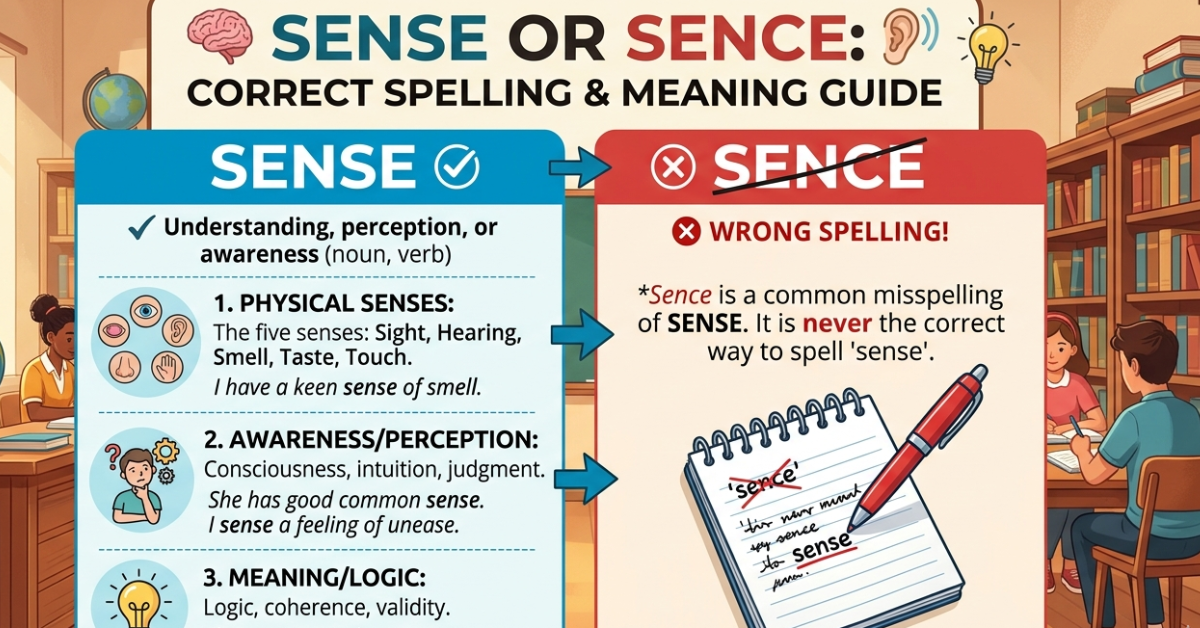
The correct word is sense, not the incorrect spelling often seen as sence.
The word sense can mean:
- The ability to perceive things (sight, hearing, smell, etc.)
- Logical understanding or judgment
- A feeling or awareness of something
Examples:
- “It makes sense to study daily.”
- “She has a strong sense of direction.”
- “I could sense something unusual.”
Whenever you come across sence or sense, remember that only sense is correct in English usage.
Why Do People Get Confused?
Many learners struggle with sence or sense because English pronunciation can be misleading.
Here are the main reasons:
1. Sound vs spelling mismatch
The word sense is pronounced like “sence,” which causes spelling mistakes.
2. Fast typing habits
People often write what they hear instead of what is correct.
3. Similar word patterns
English has many words ending in “-ence,” which makes learners mix them up.
So, when people search sence or sense meaning, they are usually trying to confirm the correct spelling.
How to Spell It Correctly
Let’s make it simple:
- sence
- sense
A quick memory trick:
Think of the phrase “common sense”—it is always spelled sense.
Whenever you’re unsure about sence or sense, just rely on this phrase.
Simple Ways to Remember the Correct Spelling
Here are easy tricks to avoid mistakes in the future:
Use repetition
Write the word sense a few times to build memory.
Link it with logic
If something “makes sense,” it must be spelled correctly as sense.
Say it slowly
Break it into sound and spelling: sen-se, not sence.
These small habits can help eliminate confusion quickly.
Real-Life Usage of “Sense”
Understanding the word becomes easier with examples:
- “Her sense of humor is amazing.”
- “It doesn’t make sense to argue.”
- “I lost my sense of direction during the trip.”
- “He could sense danger ahead.”
Every sentence shows how sense is used in everyday communication.
Why Correct Spelling Matters
Using the correct form instead of mistakes like sence improves:
- Academic writing quality
- Professional communication
- Clarity in messages
- Overall English confidence
Even small errors can affect how polished your writing looks.
FAQs
1. What is correct: sence or sense?
The correct spelling is sense. “Sence” is incorrect.
2. What does sense mean?
Sense refers to understanding, perception, or awareness of something.
3. Why do people write sence instead of sense?
Because the pronunciation sounds like “sence,” leading to spelling confusion.
4. Is “sence” a real English word?
No, it is not a valid English word.
5. How can I remember the correct spelling?
Use the phrase “common sense” and remember it is always spelled sense.
Conclusion
The confusion around sence or sense is very common, but the rule is simple: only sense is correct in English.
Once you understand the meaning and practice the spelling, you’ll stop making this mistake naturally. If you ever forget sence or sense meaning, just remember—it always comes back to sense.
Clear writing starts with small details, and getting this one right makes your English look much more confident and professional.