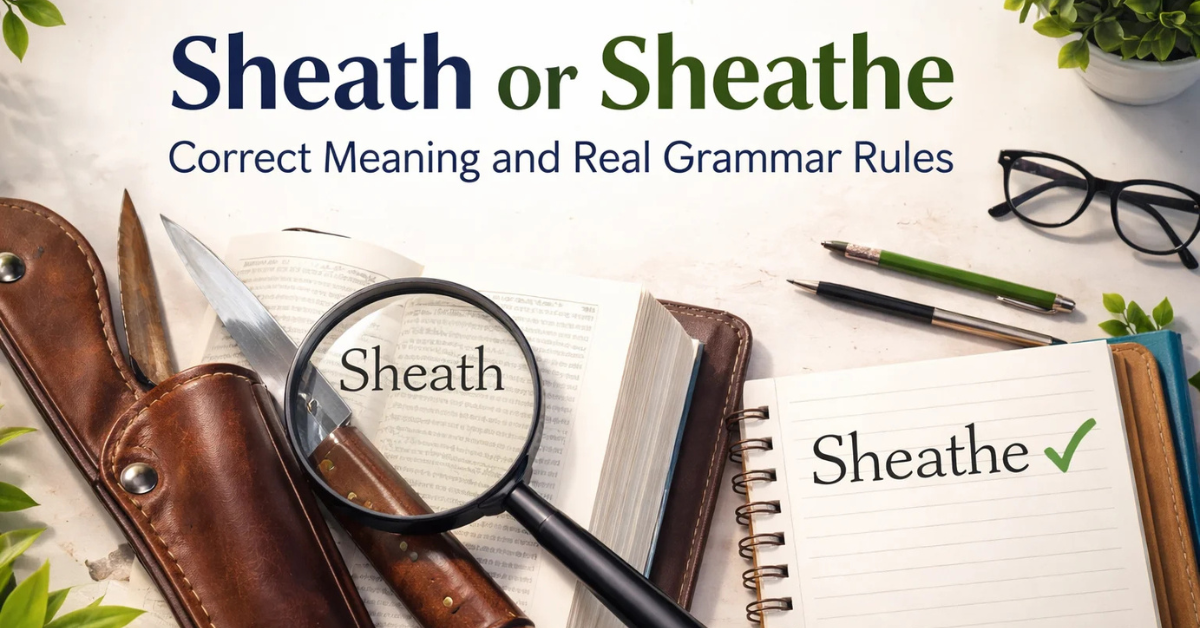
The confusion between sheath vs sheathe is more common than you might think. These two words look almost identical, but they play completely different grammatical roles in English.
In simple terms, sheath is a noun, while sheathe is a verb. Understanding sheath vs sheathe helps you avoid one of the most frequent spelling and usage mistakes in writing, especially in academic and professional contexts.
Let’s break it down in a clear, practical way so you never mix them up again.
What is a Sheath?
A sheath is a noun that refers to a cover, case, or protective layer. It is commonly used for objects like knives, swords, or even biological structures.
Common meanings of “sheath”:
- A cover for a blade (like a sword or knife)
- A protective casing for cables or wires
- A biological covering around certain plant or animal parts
Examples:
- The warrior placed his sword back into the sheath.
- The electrical wires are protected by a plastic sheath.
Here, sheath always represents something physical that covers or protects.
What Does Sheathe Mean?
To sheathe is a verb. It means the action of putting something into a sheath or covering it for protection.
Simple definition:
- Sheathe = to insert or cover something in a protective case
Examples:
- He carefully sheathed his sword after the battle.
- The guard sheathed his knife before entering the building.
So, while sheath is a thing, sheathe is the action of using that thing.
Sheath vs Sheathe: Key Differences
Understanding sheath vs sheathe becomes easier when you compare them side by side.
1. Word Type
- Sheath = noun (object)
- Sheathe = verb (action)
2. Function
- Sheath = the covering itself
- Sheathe = the act of putting something inside a covering
3. Usage Context
- Sheath is used when talking about physical protection
- Sheathe is used when describing an action
Quick Comparison:
- The sword is in its sheath.
- He will sheathe the sword.
Common Mistakes People Make
Many learners confuse spelling because both words are almost identical. Here are frequent errors:
- In correct: “He put the sword in its sheathe.”
Correct: sheath - In correct: “The warrior sheath his weapon.”
Correct: sheathe
Remember: if it’s a thing, use sheath; if it’s an action, use sheathe.
Easy Tips to Remember Sheath vs Sheathe
Here are some simple tricks:
- Think “E” in sheathe = action (verb)
- Think “A” in sheath = object (noun)
- A sheath exists, you sheathe something
You can also link it to “breathe/breath” style grammar patterns for easier memory recall.
Real-Life Usage Examples
Let’s see sheath vs sheathe in natural sentences:
- The chef kept his knife in a leather sheath.
- Soldiers are trained to sheathe their weapons safely.
- The phone comes with a protective sheath to avoid scratches.
- He forgot to sheathe the blade after cleaning it.
These examples show how both words naturally appear in everyday English.
FAQs
1. What is the main difference between sheath and sheathe?
Sheath is a noun meaning a cover, while sheathe is a verb meaning to put something into a cover.
2. Is it correct to say “sheath the sword”?
No, the correct form is “sheathe the sword.”
3. Can sheath be used as a verb?
No, sheath is only used as a noun in standard English.
4. Why are sheath and sheathe often confused?
They are spelled very similarly and are used in related contexts involving protection or covering.
5. How do I remember sheath vs sheathe easily?
Remember: sheath = thing (noun), sheathe = action (verb).
Conclusion
Understanding sheath vs sheathe is simple once you know the rule: one is an object and the other is an action. Sheath refers to a protective covering, while sheathe describes the act of placing something inside it.
Mastering this small but important difference improves your grammar accuracy and writing confidence. Keep practicing with real examples, and soon it will become second nature.