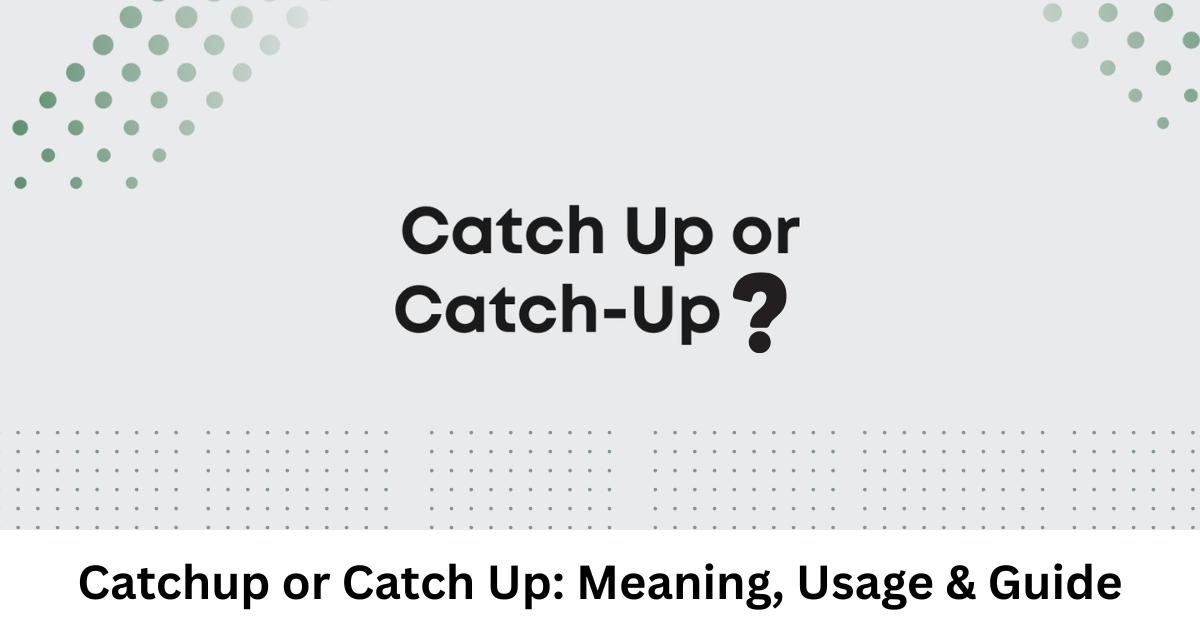
The confusion between catchup or catch up is more common than you might think, especially for English learners and even native speakers. Whether you’re talking about meeting a friend or updating yourself on missed work, this phrase plays an important role in everyday communication.
At its core, this phrase refers to the idea of reaching the same level of progress, information, or connection as someone else. In this article, we’ll break down the meaning, correct usage, and real-life examples so you never get confused again.
Catchup or Catch Up: What Does It Mean?
To understand this expression, we first need to look at how it is used in English.
The correct form in most cases is “catch up” (two words), which is a phrasal verb. It generally means to reach the same level, recover missed progress, or reconnect after a gap.
For example, people often say they need to catch up on sleep, work, or conversations they missed.
In informal writing or branding, you may also see “catchup,” but in standard grammar, the two-word form is preferred.
Catch Up in Daily Conversations
In everyday English, this expression is used in a variety of situations, especially social and professional ones.
Here are some common ways it appears:
- Meeting a friend after a long time: “Let’s catch up soon.”
- Getting updated on news: “I need to catch up on emails.”
- Recovering lost progress: “I have to catch up with my studies.”
People often use it casually to refer to conversations where they share updates about life, work, or personal experiences.
Catch Up vs Other Similar Phrases
This phrase is sometimes confused with other expressions, but it has a slightly different meaning.
- Update: One-way information sharing
- Briefing: Formal information session
- Catch up: Two-way exchange of updates
Unlike more formal terms, it feels personal and conversational, which is why it is widely used in both social and professional settings.
Why It Matters in Communication
Using this expression correctly can improve how naturally you speak or write English.
It helps in:
- Building stronger personal relationships
- Staying informed in work environments
- Maintaining social connections over time
In fast-paced lifestyles, people often rely on quick conversations to stay connected, making it even more useful in daily communication.
Common Mistakes to Avoid
Many learners make small mistakes when using this expression:
- Using it as a single word in formal writing
- Forgetting the preposition in phrasal use
- Mixing it with unrelated expressions
A simple rule: when in doubt, use the two-word form catch up.
FAQs
1. Is “catchup” correct grammar?
“Catchup” is informal and often used in branding, but grammatically, “catch up” is correct.
2. When should I use it?
Use it when talking about updating someone, recovering missed work, or reconnecting socially.
3. Can it be used professionally?
Yes, it is commonly used in meetings, emails, and workplace communication.
4. What is the difference between catch up and update?
Catch up is interactive and conversational, while update is usually one-directional.
Conclusion
Understanding this expression helps you communicate more naturally and confidently in both casual and professional settings. While the two-word form remains the grammatically correct version, both variations are recognized depending on context.
Mastering it improves not just your vocabulary but also your ability to connect with others in everyday life.