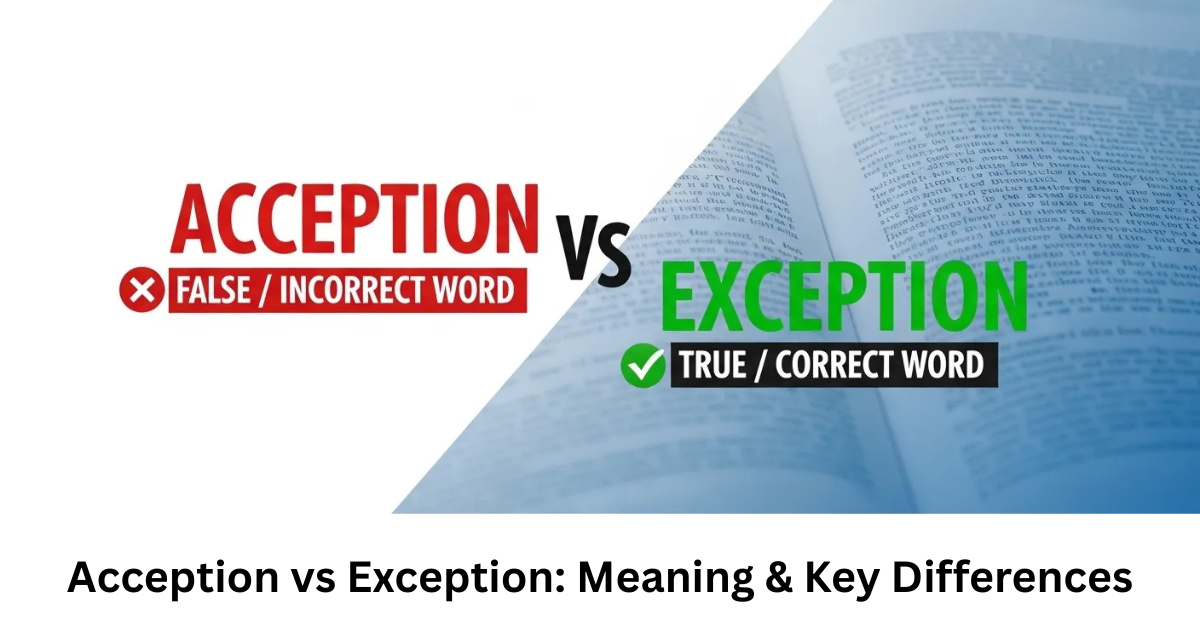
Ever paused while writing and wondered whether it’s acception or exception? You’re not alone. The confusion around acception vs exception is surprisingly common, even among fluent English speakers.
At first glance, both words look similar—but their meanings are completely different. In this article, we’ll break down the acception vs exception meaning, explain when (and if) you should use each term, and give you simple tricks to never mix them up again.
What Does “Acception” Mean?
Let’s start with the lesser-known word.
Acception is a rare and somewhat outdated term. It refers to:
- The acceptance of a word or phrase in a particular meaning
- How a term is understood or interpreted in a specific context
Example:
- “The word has a different acception in legal language.”
Important Note:
In modern English, acception is almost never used in everyday conversation or writing. Most people use alternatives like:
- Meaning
- Interpretation
- Sense
What Does “Exception” Mean?
Now, this is the word you’ve definitely seen—and used—a lot.
Exception means:
- Something that does not follow a rule
- A case that is excluded from a general statement
Examples:
- “Everyone passed the exam, with one exception.”
- “This rule applies to all employees, no exceptions.”
Acception vs Exception Meaning: Key Differences
Here’s a simple comparison to make things crystal clear:
| Feature | Acception | Exception |
|---|---|---|
| Usage | Rare, outdated | Common and widely used |
| Meaning | Interpretation of a word | Something excluded from a rule |
| Context | Linguistics, academic writing | Everyday conversation |
| Popularity | Very low | Very high |
Why People Confuse Acception vs Exception
The confusion happens mainly because:
- Both words look and sound similar
- They share a Latin origin
- “Acception” feels like a variation of “accept”
But here’s the reality:
In most situations, you probably mean exception, not acception.
When Should You Use Each Word?
Use “Exception” when:
- Talking about rules or conditions
- Mentioning something unusual or excluded
Example:
- “There are no exceptions to this policy.”
Use “Acception” when:
- Writing in linguistic or academic contexts
- Referring to the meaning of a word
Example:
- “The term has multiple acceptions in philosophy.”
Easy Trick to Remember the Difference
Here’s a quick memory hack:
- Exception = Excluded (both start with “Ex”)
- Acception = Accept (meaning-related)
If you’re talking about rules → go with exception.
If you’re talking about meaning → acception (rarely).
Common Mistakes to Avoid
Many people mistakenly use acception instead of exception in daily writing.
Incorrect:
- “There is one acception to this rule.”
Correct:
- “There is one exception to this rule.”
FAQs
1. Is “acception” a real word?
Yes, but it’s rare and mostly used in academic or linguistic contexts.
2. Can I use “acception” instead of “exception”?
No. They have completely different meanings, so they are not interchangeable.
3. Why is “exception” more common?
Because it’s used in everyday situations, especially when talking about rules or conditions.
4. What is the simplest way to understand acception vs exception meaning?
Think of it this way:
- Acception = meaning of a word
- Exception = something left out
5. Should I avoid using “acception”?
In most cases, yes. Unless you’re writing academically, it’s better to use simpler words like “meaning” or “interpretation.”
Conclusion
Understanding acception vs exception doesn’t have to be complicated. While exception is a common and essential word used in everyday English, acception is rare and mostly limited to specialized contexts.
The key takeaway?
If you’re talking about rules, exclusions, or something unusual—exception is your word.
If you’re discussing the meaning of a term in a formal setting—acception might fit.
Mastering small distinctions like this not only improves your writing but also boosts your confidence. Keep learning, and you’ll notice your language skills becoming sharper every day.