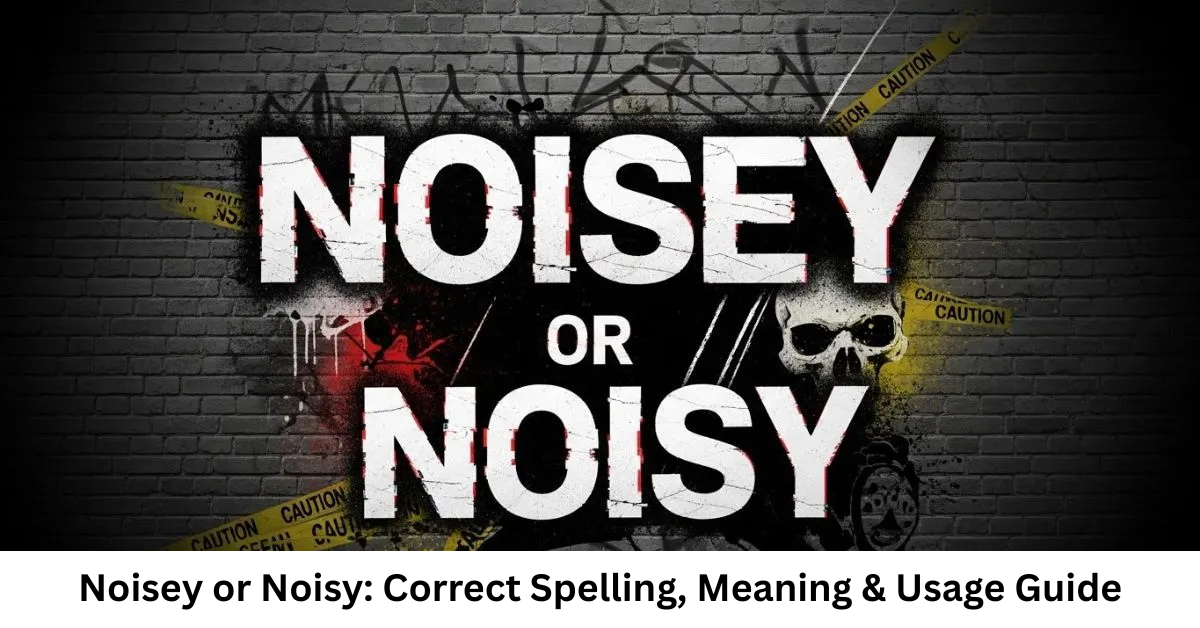
Have you ever stopped mid-sentence wondering whether it is noisey or noisy? You are not alone. This is one of those common English spelling confusions that trips up even native speakers. The correct word is “noisy”, but the misspelling “noisey” appears frequently in informal writing.
In this guide, we’ll break down the correct spelling, meaning, usage, and grammar rules behind the word noisy, so you never get confused again. Whether you’re writing essays, captions, or professional content, understanding this will improve your English accuracy.
Noisey or Noisy: Which One Is Correct?
The correct spelling is noisy.
The word noisey is simply a common spelling mistake and is not recognized in standard English dictionaries.
Why people get confused:
- The pronunciation sounds like “noiz-ee”
- Many English words end with “-ey” (like monkey or honey)
- Typing errors or autocorrect mistakes
So whenever you see noisey or noisy, remember only noisy is correct.
Meaning of “Noisy”
The word noisy is an adjective used to describe something that produces a lot of sound or disturbance.
Simple definition:
- Making a lot of noise
- Loud, disruptive, or chaotic in sound
Examples:
- The street is very noisy at night.
- The classroom became noisy after lunch break.
- My neighbors are extremely noisy on weekends.
Common Usage of Noisy in Sentences
Understanding how to use the word correctly helps improve your writing fluency.
Everyday examples:
- The restaurant was too noisy to enjoy dinner.
- Babies can be adorable but sometimes very noisy.
- Construction work makes the area noisy during the day.
Academic or formal usage:
- Urban environments are often more noisy than rural areas.
- The experiment was affected by a noisy background environment.
Why “Noisey” Is Incorrect
Many learners mistakenly write noisey or noisy interchangeably, but “noisey” is incorrect because:
- It does not follow English spelling rules for adjectives ending in “-y”
- It is not listed in any official dictionary
- It is considered a spelling error in academic and professional writing
A good rule to remember: if you’re unsure, always stick with noisy.
Tips to Remember the Correct Spelling
Here are some easy tricks to avoid confusion:
1. Think of “noise + y”
The base word is noise, so just add “y” → noisy
2. Remember common patterns
Most adjectives like “messy,” “funny,” and “happy” end in “-y,” not “-ey”
3. Use spell-check tools
They instantly correct noisey or noisy mistakes in writing apps
Common Words Related to “Noisy”
Expanding vocabulary helps improve expression:
- Loud
- Chaotic
- Boisterous
- Raucous
- Clamorous
- Disturbing
These can be used depending on tone and context.
FAQs About Noisey or Noisy
1. Is “noisey” a real word?
No, noisey is not a correct English word. The correct spelling is noisy.
2. What does noisy mean?
Noisy means something that produces a lot of sound or disturbance.
3. Why do people write noisey instead of noisy?
It is usually due to pronunciation confusion or spelling mistakes.
4. Can I use “noisy” in formal writing?
Yes, noisy is a standard English adjective and is acceptable in both formal and informal writing.
5. How can I remember the correct spelling?
Just remember: noise + y = noisy.
Conclusion
To wrap it up, the confusion between noisey or noisy is very common, but the correct spelling is always noisy. Understanding this small detail can significantly improve your writing accuracy and confidence.
Next time you’re writing, double-check your spelling and stick with the correct form. Small improvements like this make a big difference in both academic and professional communication.
If you’re working on improving your English, keep practicing—because strong language skills always make your content stand out.