The terms crier or cryer often confuse writers, students, and even native English speakers. At first glance, they look interchangeable, but their meanings and usage are quite different depending on context, history, and grammar rules.
In this guide, we’ll break down what crier or cryer actually means, how each word is used, and why one is considered standard in modern English. Whether you’re writing, studying, or simply curious, this explanation will make everything clear in a simple, human way.
What Does “Crier” Mean?
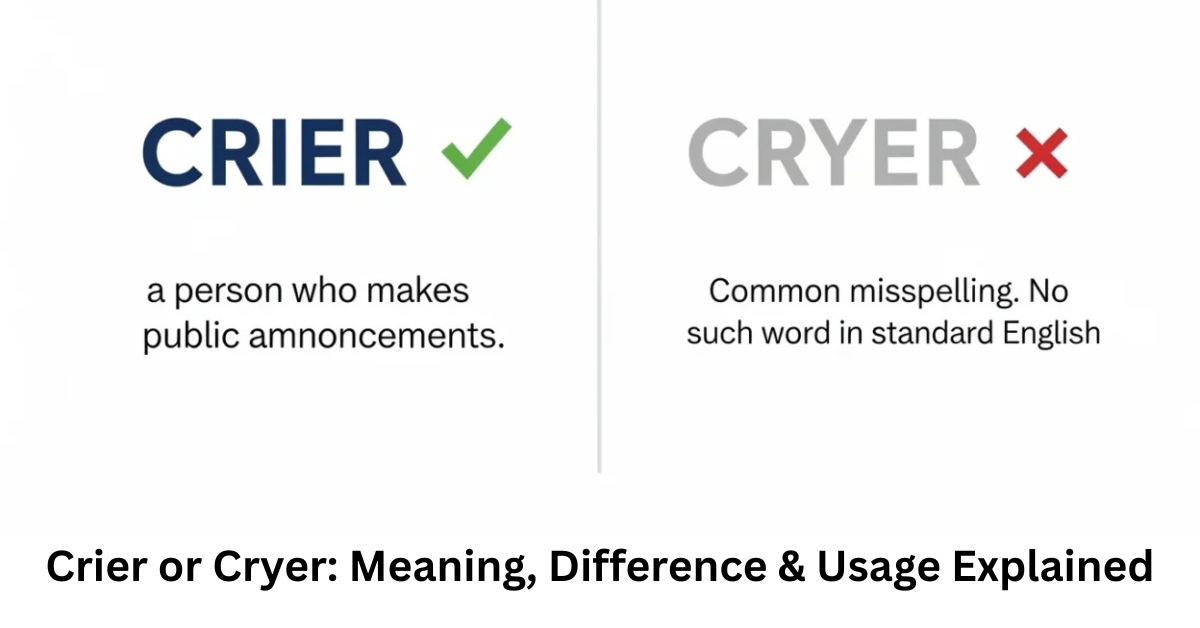
The word crier is the correct and widely accepted spelling in modern English. It refers to a person who publicly announces news or information.
Historically, a town crier would walk through streets ringing a bell and shouting important announcements before newspapers existed.
Common uses of “crier”:
- A public announcer in historical towns
- A courtroom officer (court crier)
- A metaphor for someone who loudly expresses emotions
For example:
- The town crier announced the royal decree in the village square.
In modern usage, “crier” is still used in legal systems and historical references.
What About “Cryer”?
The spelling cryer is often seen as a variation or misspelling of “crier,” but it does appear occasionally as a surname or in informal usage.
Unlike “crier,” it is not considered standard in professional or academic English when referring to an announcer.
Where “cryer” is used:
- As a last name (e.g., people with the surname Cryer)
- Rare informal or outdated spelling
- Occasionally in fiction or stylistic writing
However, in formal writing, crier or cryer comparison almost always leads to “crier” being the correct choice.
Key Difference Between Crier and Cryer
Understanding the difference between crier or cryer is simple once you break it down:
1. Spelling
- Crier → Standard and correct spelling
- Cryer → Variant or surname usage
2. Meaning
- Crier → A person who announces news publicly
- Cryer → Usually not used for that meaning
3. Usage Context
- Crier → History, law, formal writing
- Cryer → Names or informal references
4. Modern Acceptance
- Crier → Widely accepted
- Cryer → Not standard in grammar rules
So when you’re unsure, always choose crier.
Origin and History of the Word “Crier”
The word crier comes from the Old French word crier, meaning “to shout or proclaim.” This traces further back to Latin quiritare, which means to cry out.
Town criers were once essential in society because:
- Most people couldn’t read
- News needed to be spread orally
- Governments relied on public announcements
They were often dressed in uniforms and had official authority to deliver messages.
Modern Usage of Crier
Even though we no longer rely on town criers for news, the term still exists in several areas:
Court Crier
A court crier maintains order in courtrooms by announcing judges, cases, and instructions.
Ceremonial Roles
In some countries, town criers still appear in festivals and traditional events.
Figurative Use
Writers sometimes use “crier” to describe someone who expresses emotions loudly or dramatically.
Common Mistakes People Make
Many people confuse crier or cryer due to pronunciation. Here are common mistakes:
- Using “cryer” in formal essays
- Assuming both spellings are equally correct
- Mixing it with the verb “cry”
Remember:
- “Cry” = to produce tears
- “Crier” = a person who announces something
- “Cryer” = usually a name, not a role
Why Spelling Matters in English
Correct spelling like crier matters because:
- It improves clarity in communication
- It ensures academic accuracy
- It enhances SEO and online visibility
- It builds credibility in writing
Using the wrong form (like “cryer” in formal content) can make writing appear less professional.
Quick Summary
To make it easy:
- Crier = correct spelling, public announcer
- Cryer = surname or non-standard variation
- Always use crier in formal writing
So, the debate of crier or cryer is really about standard usage versus variation.
FAQs About Crier or Cryer
1. Is “cryer” a correct word?
“Cryer” is not considered correct in standard English when referring to an announcer. It is mostly used as a surname.
2. What is the meaning of “crier”?
A crier is someone who publicly announces news or information, historically in towns or courts.
3. Why do people confuse crier and cryer?
They sound similar when spoken, but only “crier” follows standard English spelling rules.
4. Is town crier still a job today?
Not in a traditional sense, but ceremonial town criers still exist in some places for cultural events.
5. Can I use “cryer” in writing?
Only if it’s a name or specific stylistic choice. Otherwise, always use “crier.”
Conclusion
Understanding crier or cryer is simple once you know the difference. “Crier” is the correct and historically grounded term used for someone who makes public announcements, while “cryer” is mostly seen as a surname or non-standard variation.
If you’re writing for school, work, or online content, stick with crier for accuracy and professionalism. Mastering small differences like this helps improve your writing clarity and credibility in the long run.