English grammar can be confusing, especially when people wonder about check in or check-in and which version is correct. One small hyphen can completely change the role of a word in a sentence. That is exactly what happens here.
Many people pause while writing emails, booking hotels, preparing office notes, or arranging travel because they are unsure which form is correct. The good news is that the rule is actually simple once you understand how each version works.
This guide explains check in or check-in clearly, along with examples, writing tips, and common mistakes.
Check In or Check-In: The Basic Rule
Here is the easiest way to remember it:
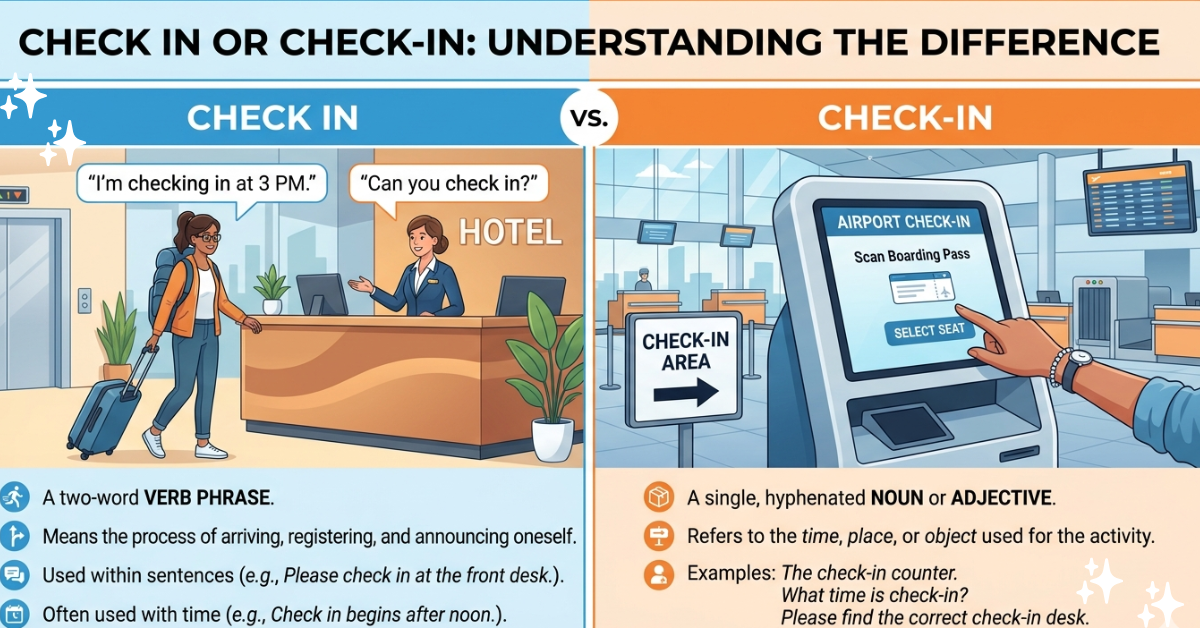
- The two-word version works as a verb.
- The hyphenated version works as a noun or adjective.
Examples:
- Please register at the reception desk.
- Hotel arrival process begins at 2 PM.
In the first sentence, someone is performing an action. In the second, the phrase names a process.
When to Use the Verb Form
The separated version is used when someone is performing an action such as arriving, registering, reporting, or confirming attendance.
Common Situations
People use it in:
- Airports
- Hotels
- Offices
- Hospitals
- Online platforms
- Events and conferences
Sentence Examples
- Passengers should register online before departure.
- Guests can register after noon.
- Employees must register using the office system.
- She called to register with her family.
Each sentence describes an action being performed.
When to Use the Hyphenated Form
The version with a hyphen acts as a noun or adjective. It refers to a process, location, event, or service.
Examples as a Noun
- The airport arrival process was crowded.
- Early arrival process is available for an extra fee.
- We scheduled a weekly team arrival process.
Examples as an Adjective
- Please visit the arrival process counter.
- The airline added a self-service arrival process kiosk.
- The hotel introduced digital arrival process options.
In these examples, the phrase names or describes something rather than showing an action.
How It Works in Meetings and Workplaces
Business communication often causes confusion because the phrase appears in schedules, emails, and reports.
When referring to the meeting itself, the hyphenated form is usually correct.
Correct Examples
- We had a weekly team arrival process.
- The manager arranged a short progress meeting.
- Our Monday arrival process helps everyone stay updated.
However, when talking about the action, the words stay separate.
Example
- Let’s register before the presentation starts.
The structure depends on how the phrase functions in the sentence.
Why Hyphens Matter in English
Hyphens help readers understand how words work together.
In English grammar:
- Verb phrases are often written as separate words.
- Compound nouns and adjectives are commonly hyphenated.
This pattern appears in many other expressions.
| Verb Form | Noun or Adjective |
| log in | login |
| sign up | sign-up |
| check out | checkout |
| follow up | follow-up |
Learning this pattern makes similar grammar rules easier to understand.
Common Mistakes to Avoid
Mistake 1: Adding a Hyphen to an Action
Incorrect:
- Please arrival process at the desk.
Correct:
- Please register at the desk.
The sentence describes an action, so no hyphen is needed.
Mistake 2: Removing the Hyphen From a Noun
Incorrect:
- Airport register takes only five minutes.
Correct:
- Airport arrival process takes only five minutes.
Because the phrase names a process, the hyphen is required.
A Simple Memory Trick
Ask yourself one question:
Is the phrase doing something or naming something?
- Action → use the separated form
- Thing or description → use the hyphenated form
This quick test works in most situations.
Everyday Examples
At Airports
- Travelers should register before boarding.
- Online arrival process saves time.
At Hotels
- Guests may register after 3 PM.
- Early arrival process may cost extra.
In Offices
- Teams often register every morning.
- A weekly progress arrival process improves communication.
In Healthcare
- Patients must register at reception.
- Digital arrival process systems reduce waiting times.
Is “Checkin” One Word?
In standard English, writing it as one word is generally incorrect.
Professional writing normally uses either:
- the separated verb form
- the hyphenated noun form
Some software systems or apps may shorten the spelling for branding purposes, but that is not considered standard grammar.
British and American Usage
Both British and American English follow the same grammar rule.
The difference is grammatical rather than regional. Whether you are writing for the UK, the US, or another English-speaking country, the usage remains the same.
Tips for Cleaner Writing
Read the Sentence Aloud
Hearing the sentence can help you decide whether the phrase sounds like an action or a noun.
Look at the Next Word
If the phrase directly describes another noun, the hyphenated version is usually correct.
Examples:
- arrival process desk
- arrival process process
- arrival process area
Stay Consistent
In business documents, websites, and reports, consistency improves professionalism and readability.
Frequently Asked Questions
Which form is correct at a hotel?
Use the verb form for the action and the hyphenated version for the noun.
Examples:
- We will register at 4 PM.
- Hotel arrival process starts at noon.
Should meeting-related usage include a hyphen?
If you are naming the meeting itself, the hyphenated form is usually preferred.
Example:
- We had a weekly project arrival process.
Is the one-word spelling correct?
Standard dictionaries generally do not accept it in formal writing.
Why is the hyphen important?
The hyphen changes the grammatical role of the phrase. Without it, the phrase acts as an action. With it, the phrase becomes a noun or adjective.
Is online usage hyphenated?
Yes, because it refers to a service or process.
Example:
- Online arrival process closes one hour before departure.
Final Thoughts on Check In or Check-In
This grammar rule becomes much easier once you understand the difference between actions and nouns.
- Use the separated form for actions.
- Use the hyphenated version for names, services, or descriptions.
Small grammar details like hyphen placement may seem minor, but they make writing clearer and more professional. Once you notice the pattern, you will start recognizing it in emails, travel documents, workplace communication, and everyday conversations.