English can be tricky, especially when two versions of a phrase look almost identical. One of the most common spelling questions people ask is atleast or at least. If you’ve ever paused while typing and wondered which one is correct, you’re not alone.
The short answer is simple: “at least” is correct, while “atleast” is considered incorrect in standard English. In this guide, we’ll explain why, how to use it properly, and share examples so you never second-guess yourself again.
Is It Atleast or At Least?
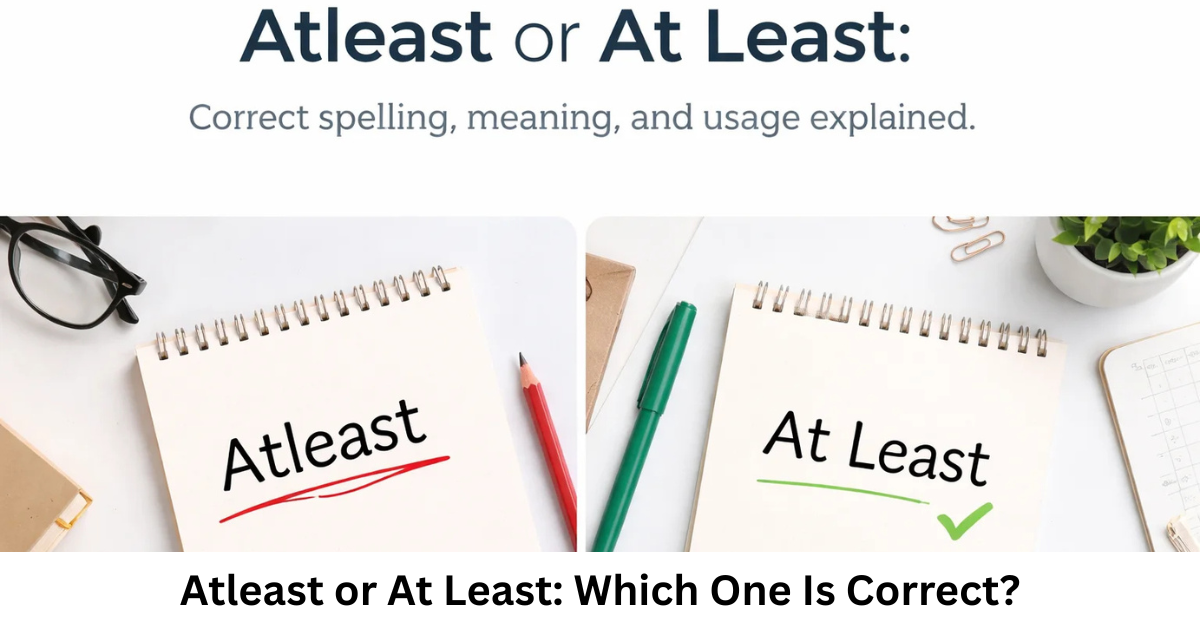
The correct form is at least — written as two separate words.
The version atleast is a common mistake caused by the way the phrase sounds when spoken quickly. Since many English phrases blend together in conversation, people sometimes assume they should be written as one word.
Correct:
- I need at least two hours to finish.
- She scored at least 90 marks.
- We should invite at least ten people.
Incorrect:
- I need atleast two hours.
- She scored atleast 90 marks.
Atleast or At Least Meaning
The phrase at least has a few common meanings depending on context. It usually means:
1. Minimum Amount
Used when referring to the smallest acceptable number or quantity.
Examples:
- You need at least three eggs for the recipe.
- Please arrive at least 15 minutes early.
2. If Nothing Else
Used to highlight one positive point in a difficult situation.
Examples:
- The trip was tiring, but at least we arrived safely.
- I lost the match, but at least I tried my best.
3. Correction or Clarification
Used when adjusting a statement.
Examples:
- There were twenty people there — no, at least thirty.
Why Do People Write “Atleast”?
This mistake happens for several reasons:
- Fast pronunciation: “At least” often sounds merged in speech.
- Typing habits: Many compound words in English create confusion.
- Autocorrect misses: Some devices may not flag it immediately.
- Visual assumption: It looks like it could be one word.
Even native speakers make this mistake, so it’s very common.
Grammar Rule Behind “At Least”
The phrase consists of:
- At = a preposition
- Least = superlative form of “little”
Together, they form an idiomatic phrase meaning minimum quantity or consolation. Because each word has its own role, they stay separate.
Easy Trick to Remember
If you can replace it with minimum or no less than, then use at least as two words.
Examples:
- Bring at least five chairs.
- Bring a minimum of five chairs.
This trick helps you remember the correct spacing.
Common Sentences Using At Least
Here are practical examples you can copy:
- We need at least one week to prepare.
- He should apologize at least once.
- There were at least fifty guests.
- At least the weather stayed clear.
- Save at least 10% of your income monthly.
At Least vs Similar Phrases
Some phrases also stay as two words:
- At first
- At times
- At once
- At last
- At least
These are standard expressions, so avoid combining them into one word.
Common Writing Mistakes to Avoid
When using this phrase, avoid these errors:
- Writing atleast in emails or essays
- Using it as one word in professional documents
- Mixing “at least” with “at last”
- Overusing it unnecessarily in every sentence
Clean writing builds credibility.
FAQs
Is atleast a real word?
No, atleast is not accepted in standard English dictionaries. The correct form is at least.
Is it atleast or at least in formal writing?
Always use at least in formal, academic, and professional writing.
Why do people type atleast?
Because the phrase sounds connected when spoken quickly, many people assume it is one word.
Can I use atleast in casual texting?
People may understand it in casual chats, but it is still grammatically incorrect.
What does at least mean?
It usually means a minimum amount, consolation, or correction depending on the sentence.
Conclusion
When choosing between atleast or at least, the correct answer is always at least. It should be written as two separate words in both formal and informal writing. The one-word version is a common spelling mistake, often caused by pronunciation.
Now that you know the rule, you can write with more confidence and avoid a very common English error. Keep practicing with everyday examples, and proper usage will soon feel natural.