The confusion between cachet vs cache is more common than you might think. At first glance, the two words look similar, but they belong to completely different worlds of meaning. If you’ve ever paused while writing or reading and wondered which one fits, you’re not alone.
Understanding cachet vs cache helps you avoid spelling mistakes and use both words confidently in the right context—whether you’re talking about prestige and reputation or computer storage and browsing speed.
In this guide, we’ll break down both terms in a simple, human way so you can never mix them up again.
What is Cachet? Meaning and Usage
Cachet is a word used to describe prestige, distinction, or high status. It often refers to something that carries social value or admiration.
For example, a luxury brand, a famous university, or an award-winning artist may be said to have “cachet.”
Key characteristics of cachet:
- Refers to reputation or prestige
- Often used in social, cultural, or professional contexts
- Suggests exclusivity or high value
Examples:
- That designer label has a lot of cachet in the fashion world.
- Graduating from that university adds cachet to your resume.
In simple terms, cachet is all about status and respect.
What is Cache? Meaning in Technology
On the other hand, cache is a technical term commonly used in computing and digital systems. It refers to temporary storage used to speed up processes.
When your browser stores website data so pages load faster next time, that’s cache at work.
Key characteristics of cache:
- Used in computers, apps, and browsers
- Stores temporary data for faster access
- Improves performance and efficiency
Examples:
- Clearing your browser cache can fix loading issues.
- The system uses cache to reduce processing time.
So, unlike cachet, cache is all about speed and efficiency, not reputation.
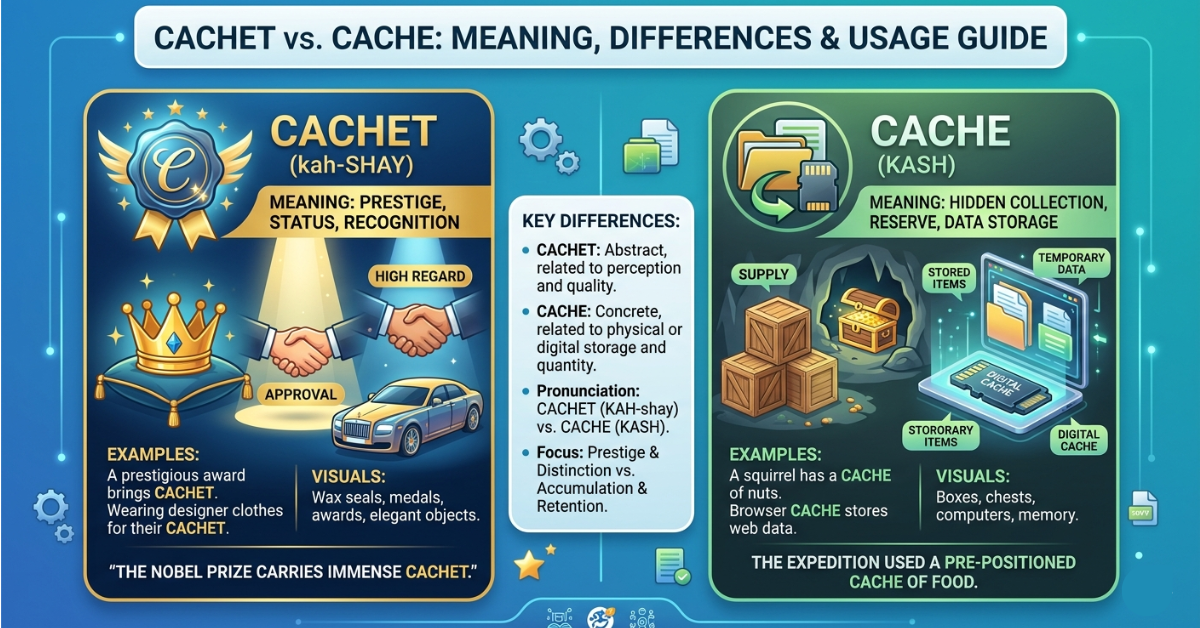
Cachet vs Cache: Key Differences Explained
The confusion between cachet vs cache comes from their similar spelling, but their meanings are completely unrelated.
Let’s break it down simply:
1. Meaning
- Cachet = prestige, status, or reputation
- Cache = temporary stored data in computing
2. Field of Use
- Cachet is used in language, culture, branding, and social contexts
- Cache is used in technology and computer science
3. Purpose
- Cachet highlights value or admiration
- Cache improves speed and performance
4. Pronunciation
- Cachet: “ka-shay”
- Cache: “kash”
Even though they look similar, cachet vs cache are not interchangeable in any situation.
Real-Life Examples of Cachet vs Cache
Understanding cachet vs cache becomes easier when you see them in real-life usage.
Cachet in everyday life:
- A celebrity endorsement adds cachet to a product.
- Winning a Nobel Prize gives immense cachet to a scientist.
- Luxury cars carry cachet among high-end buyers.
Cache in technology:
- Your phone stores app data in cache to open them faster.
- Websites use cache to reduce server load.
- Clearing cache can solve slow performance issues.
These examples clearly show how different the two terms are, even though people often confuse them.
Common Mistakes People Make
Because of their similar spelling, people often misuse cachet vs cache in writing. Here are some common mistakes:
- Using “cache” when referring to reputation (incorrect)
- Writing “cachet” in tech contexts (incorrect)
- Assuming both words are interchangeable (wrong)
Quick tip to remember:
- If it’s about status or prestige, use cachet
- If it’s about data or technology, use cache
When to Use Cachet vs Cache Correctly
To make things even clearer, here’s a quick guide:
Use “cachet” when:
- Talking about luxury or prestige
- Describing reputation or influence
- Writing about culture, branding, or status
Use “cache” when:
- Discussing computers or software
- Talking about browsers or apps
- Referring to stored digital data
Keeping this distinction in mind makes cachet vs cache easy to master in both writing and conversation.
FAQs About Cachet vs Cache
1. What is the main difference between cachet vs cache?
Cachet refers to prestige or status, while cache is temporary stored data in computing systems.
2. Is cachet used in technology?
No, cachet is not a technical term. It is used in social, cultural, and branding contexts.
3. How do I pronounce cachet and cache?
Cachet is pronounced “ka-shay,” and cache is pronounced “kash.”
4. Can cache and cachet be used interchangeably?
No, they have completely different meanings and cannot replace each other.
5. Why do people confuse cachet vs cache?
They look similar in spelling, but their meanings and usage are unrelated.
Conclusion
Understanding cachet vs cache is all about recognizing context. One represents prestige and reputation, while the other is a technical term related to computer storage and performance.
Once you remember that cachet is about status and cache is about speed, you’ll never confuse them again. Whether you’re writing professionally or just improving your vocabulary, using these terms correctly adds clarity and confidence to your communication.