English often creates confusion when words sound similar but carry completely different meanings. One of the most commonly mistaken pairs is Wood vs Would.
At first, they may look unrelated; however, in spoken English, they often get mixed up due to similar pronunciation. Therefore, understanding Wood vs Would is essential for improving grammar accuracy, writing clarity, and overall communication skills.
In this guide, we will clearly explain meanings, usage rules, and common mistakes. Moreover, we will also share practical examples so you can confidently use both words in real-life situations.
What Does “Wood” Mean?
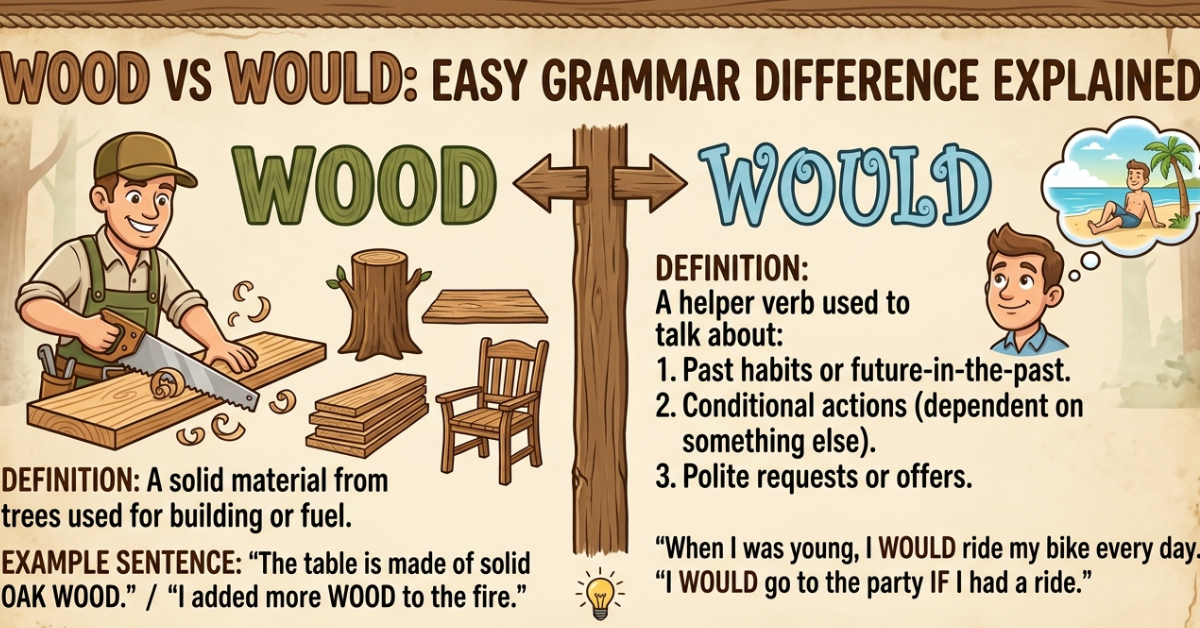
To begin with, wood is a noun that refers to a natural material obtained from trees. In addition, it is widely used in construction, furniture, and design.
Common meanings of wood:
- Material taken from tree trunks
- A small forested area
- Objects made from timber or lumber
Examples of “wood”:
- The chair is made of strong wood.
- We walked through a peaceful wood near the village.
- She loves the natural texture of wood in interior design.
Moreover, wood is often associated with nature, sustainability, and traditional craftsmanship.
What Does “Would” Mean?
On the other hand, would is a modal verb used in grammar. It does not refer to any physical object; instead, it expresses actions, possibilities, or polite intentions.
Common uses of would:
- Polite requests
- Hypothetical situations
- Repeated actions in the past
- Future intentions in reported speech
Examples of “would”:
- I would like some water, please.
- If I had time, I would learn painting.
- When we were young, we would play outside every evening.
Furthermore, “would” is commonly used to make sentences sound more polite and indirect.
Wood vs Would: Key Differences
Now let’s clearly compare Wood vs Would so the difference becomes easier to remember.
1. Meaning
- Wood → material from trees
- Would → modal verb for grammar use
2. Word Type
- Wood → noun
- Would → auxiliary (modal) verb
3. Usage Context
- Wood → nature, furniture, construction
- Would → speech, writing, expressions of possibility
4. Function
- Wood describes something physical
- Would describes an action or intention
Therefore, although they may sound similar, their meanings are completely different.
Why People Get Confused
There are several reasons why Wood vs Would is often confusing. For instance, pronunciation in fast speech can sound almost identical. Additionally, learners sometimes rely more on sound than spelling.
Common reasons:
- Similar pronunciation
- Typing based on sound
- Lack of grammar practice
- Quick informal texting
As a result, errors become common in both writing and speech.
Common Mistakes and Corrections
Let’s look at some frequent mistakes so you can avoid them:
Mistake 1
In correct: I wood like to join you
Correct: I would like to join you
Mistake 2
In correct: This table is made of would
Correct: This table is made of wood
Mistake 3
In correct: He wood help if he can
Correct: He would help if he can
In addition, such mistakes can completely change sentence meaning, especially in exams or formal writing.
Easy Ways to Remember the Difference
To make things easier, here are some simple memory tricks:
1. Think of meaning first
- Wood = tree material
- Would = grammar helper
2. Use association
- Wood = something you can touch
- Would = something you say or express
3. Practice regularly
Moreover, using both words in sentences daily improves accuracy quickly.
Real-Life Examples
Let’s look at practical usage so the difference becomes even clearer:
- The house is built of durable wood.
- I would love to visit that place someday.
- This wood has a natural and elegant finish.
- She said she would call me later.
As you can see, context completely changes the meaning.
Importance in Writing and Exams
In formal writing, confusing Wood vs Would can lead to misunderstandings. Therefore, careful proofreading is very important.
For example:
- In correct: I wood help you tomorrow
- Correct: I would help you tomorrow
As a result, even a small spelling mistake can affect clarity and grades.
FAQs
1. What is the main difference between wood and would?
Wood is a noun related to trees, whereas would is a modal verb used in grammar.
2. Why do learners confuse wood vs would?
Because they sound similar in pronunciation, especially in fast speech.
3. Is wood only used for furniture?
No, it also refers to forests and natural tree material.
4. Can would be used alone?
No, it is always used with another verb.
5. How can I improve usage?
Moreover, consistent practice and sentence writing help reduce confusion.
Conclusion
To sum up, understanding Wood vs Would is essential for clear and correct English communication. While wood refers to natural tree material, would is a grammatical helper used for expressing intentions, politeness, and possibilities.
Therefore, by focusing on meaning, practicing regularly, and paying attention to context, you can easily avoid confusion. In addition, improving small grammar details like this will significantly enhance your overall writing skills.