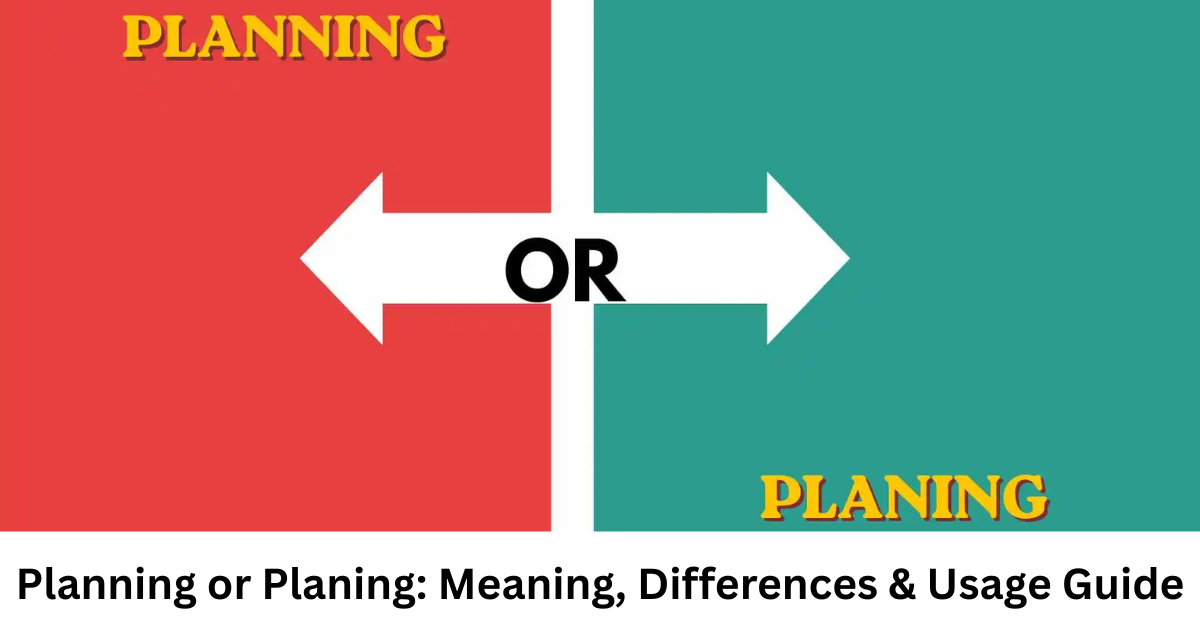
Many English learners often mix up planning and planing because the words look and sound similar. However, they have completely different meanings and belong to unrelated fields.
Understanding this difference is important for clear communication, especially in writing. In this guide, we’ll explain both terms in a simple way so you can use them correctly without confusion.
What Does Planning Mean?
Planning refers to the process of thinking ahead and organizing actions to achieve a goal. It is widely used in daily life, education, and professional settings.
Examples of planning:
- Organizing a study schedule
- Preparing for an event
- Setting business goals
It is all about strategy, preparation, and decision-making before taking action.
What Does Planing Mean?
Planing is a technical term used in woodworking. It means smoothing or shaping wood using a tool called a plane.
Examples of planing:
- Smoothing a wooden surface
- Shaping timber for furniture
- Refining edges of wood pieces
This process is physical and practical, unlike planning which is mental and strategic.
Key Differences
1. Meaning
- Planning: Organizing future actions
- Planing: Smoothing wood surfaces
2. Field of Use
- Planning: Life, education, business
- Planing: Carpentry and woodworking
3. Type of Process
- Planning: Mental and strategic
- Planing: Physical and manual
4. Example Comparison
- Planning: “She is preparing her exam strategy.”
- Planing: “The carpenter is smoothing the wood.”
Why the Confusion Happens
People often confuse these terms because:
- They look almost identical
- They sound similar when spoken
- One word is far more common than the other
- Spelling difference is very small
Context is the key to understanding the correct usage.
Easy Way to Remember
Here’s a simple trick:
- Plan = future → Planning
- Plane = tool → Planing
- Goals = planning
- Woodwork = planing
This makes it easy to avoid mistakes.
FAQs
What is the main difference between planning and planing?
Planning is about organizing future actions, while planing is a woodworking technique.
Is planing a common English word?
Yes, but it is mostly used in carpentry and technical fields, not daily conversation.
Why do people confuse planning and planing?
Because both words look and sound similar, even though they have different meanings.
Conclusion
The confusion between planning and planing is common, but once you understand their meanings, it becomes easy to use them correctly. One relates to organizing goals and the other to woodworking.
By focusing on context instead of spelling similarity, you can improve your grammar accuracy and write with more confidence.