Have you ever paused mid-sentence and wondered which spelling fits: to, too, or two? It happens more often than people admit. Although these words sound exactly the same, they do very different jobs in English.
That is why to vs too vs two is such a common grammar topic. Once you understand the difference, your writing becomes clearer, more accurate, and much easier to read. Fortunately, the rule is simple when you break it down step by step.
Why These Words Cause So Much Confusion
Because they are homophones, these words sound alike but carry different meanings. As a result, many writers mix them up in emails, essays, captions, and everyday messages.
Even so, each one has a distinct purpose:
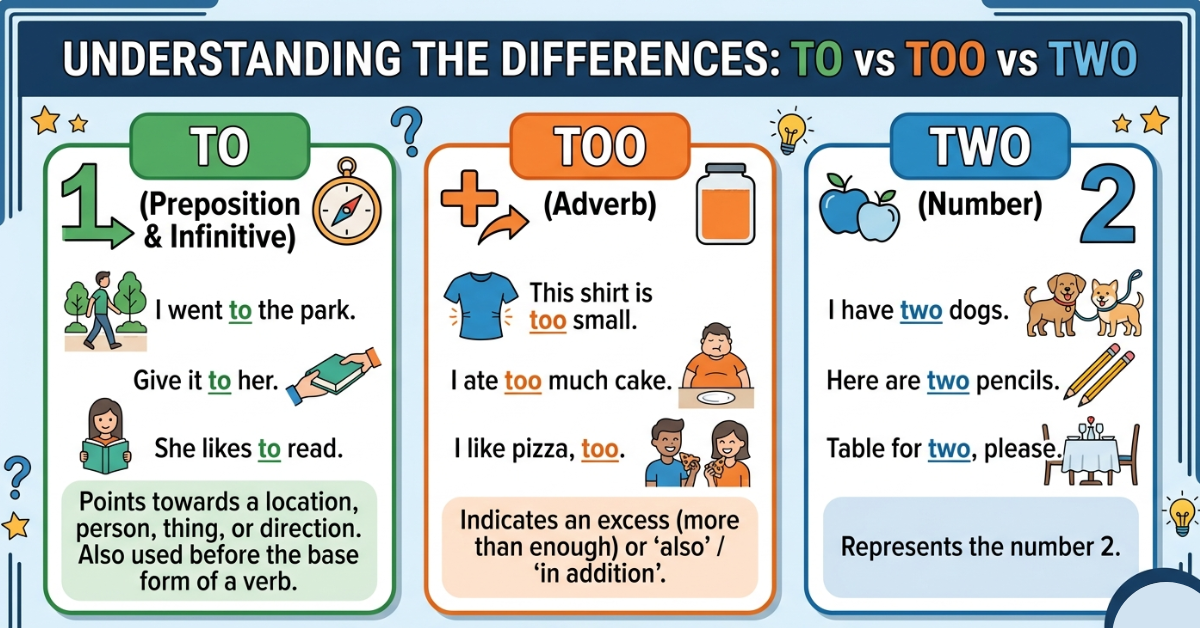
- To shows direction, connection, or purpose.
- Too means “also” or “excessively.”
- Two refers to the number 2.
Once you know that, the confusion starts to disappear.
What “To” Means
The word to is one of the most common words in English. It usually shows movement, direction, relationship, or part of an infinitive verb.
1. Direction or destination
Use it when someone or something is moving toward a place.
Examples:
- She went to the market.
- We drove to Karachi.
- He walked to school.
2. Connection or recipient
It can show who receives something or who is being addressed.
Examples:
- Give the letter to your teacher.
- I spoke to my cousin.
- This gift belongs to you.
3. Infinitive form of a verb
It also appears before a verb in its base form.
Examples:
- I want to learn French.
- They plan to travel next month.
- She decided to stay home.
So, whenever you see movement, purpose, connection, or a verb after it, to is usually the correct choice.
What “Too” Means
Unlike to, the word too has a different function. It is used when you mean “also” or when something is more than necessary.
Meaning 1: Also
Use too when you mean “in addition” or “as well.”
Examples:
- I want ice cream too.
- She is coming too.
- They enjoyed the movie, and we did too.
Meaning 2: Excessively
It can also mean “more than is desirable.”
Examples:
- The room is too hot.
- That bag is too heavy.
- You are speaking too fast.
A helpful trick is to remember that too has an extra “o,” which can remind you of something extra or excessive.
What “Two” Means
The word two is much easier to understand because it simply means the number 2. It is used for counting and describing quantity.
Examples:
- I bought two pens.
- There are two cats in the room.
- We waited for two hours.
Whenever you are referring to a number, choose two.
Side-by-Side Comparison
To make the difference even clearer, here is a quick comparison:
| Word | Meaning | Example |
| To | Direction, purpose, or connection | I am going to the park. |
| Too | Also or excessively | I want to go too. |
| Two | The number 2 | I have two books. |
How to Choose the Right Word
When you are unsure, ask yourself a simple question.
- Is the sentence about movement or a verb? Use to.
- Does it mean “also” or “very much”? Use too.
- Are you counting something? Use two.
That quick check works in most situations and saves time while writing.
Common Mistakes People Make
Although the rule is simple, mistakes still happen. Here are the ones people mix up most often.
Using “too” instead of “to”
I need too finish my homework. (In Correct)
I need to finish my homework. (Correct)
Because the word comes before a verb, to is correct.
Using “to” instead of “too”
I like chocolate to. (In Correct)
I like chocolate too. (Correct)
Here, the meaning is “also,” so too is the right choice.
Using “two” instead of “too”
The tea is two hot. (In Correct)
The tea is too hot. (Correct)
Since the sentence describes excess, too fits better.
Using “too” instead of “two”
I have too brothers. (In Correct)
I have two brothers. (Correct)
This sentence refers to quantity, so the number word two is needed.
Easy Memory Tricks
A few simple tricks can help you remember the difference forever.
- To often goes with action or direction.
- Too means “also” or “more than needed.”
- Two is the number 2.
You can also use this mini formula:
- Go to a place
- Add too much
- Count two items
With enough practice, the right choice starts to feel automatic.
Practice Examples
Try these sentences and see whether the blank should be filled with to, too, or two.
- I am going ___ the library.
- She wants ___ join us.
- I would like tea ___ .
- The soup is ___ salty.
- We have ___ exams this week.
Answers
- to
- to
- too
- too
- two
Why This Difference Matters
Small grammar mistakes can change how your writing looks. More importantly, they can affect clarity and confidence. Once you master to vs too vs two, your sentences become cleaner and more professional.
That matters in schoolwork, job applications, blog posts, social media captions, and everyday messages. After all, good grammar helps your meaning shine through without distraction.
FAQs
What is the easiest way to remember to vs too vs two?
The simplest method is to link each word with its job: to shows direction, too means also or excessive, and two is the number 2.
Can “too” come at the end of a sentence?
Yes, it often does. For example: “I want to go too.”
Is “to” always followed by a verb?
Not always, but it often appears before a verb in infinitive form, such as “to read” or “to go.”
Is “two” only used for numbers?
Yes, it refers specifically to the number 2 or a quantity of two items.
Why do people mix these words up?
They sound identical, so spelling becomes the only clue. That is why careful reading matters.
Conclusion
Mastering to vs too vs two does not take long once you understand the pattern. In fact, the difference becomes easy when you remember that to shows direction or purpose, too means also or excessively, and two stands for the number 2.
From now on, a quick mental check can help you pick the right word with confidence. If you keep practicing with real sentences, the correct spelling will start to feel completely natural.
If you want, I can also turn this into a more SEO-optimized blog format with a stronger introduction, keyword placement, and a cleaner FAQ schema style.