Have you ever paused while writing and wondered whether to use tail or tale? You’re not alone. These two words sound exactly the same when spoken, yet they have completely different meanings. Because they are homophones—words that share pronunciation but differ in spelling and definition—they often cause confusion for writers, students, and English learners alike.
Understanding tail vs tale is important for clear communication. Whether you’re describing an animal’s body part or telling a fascinating story, choosing the correct word ensures your message is understood exactly as intended. This guide explains the meanings, differences, examples, and memory tricks that make these commonly confused words easy to master.
Why Do People Confuse These Words?
The confusion comes from pronunciation. Both words are pronounced the same way: /teɪl/.
However, despite sounding identical, they belong to different contexts:
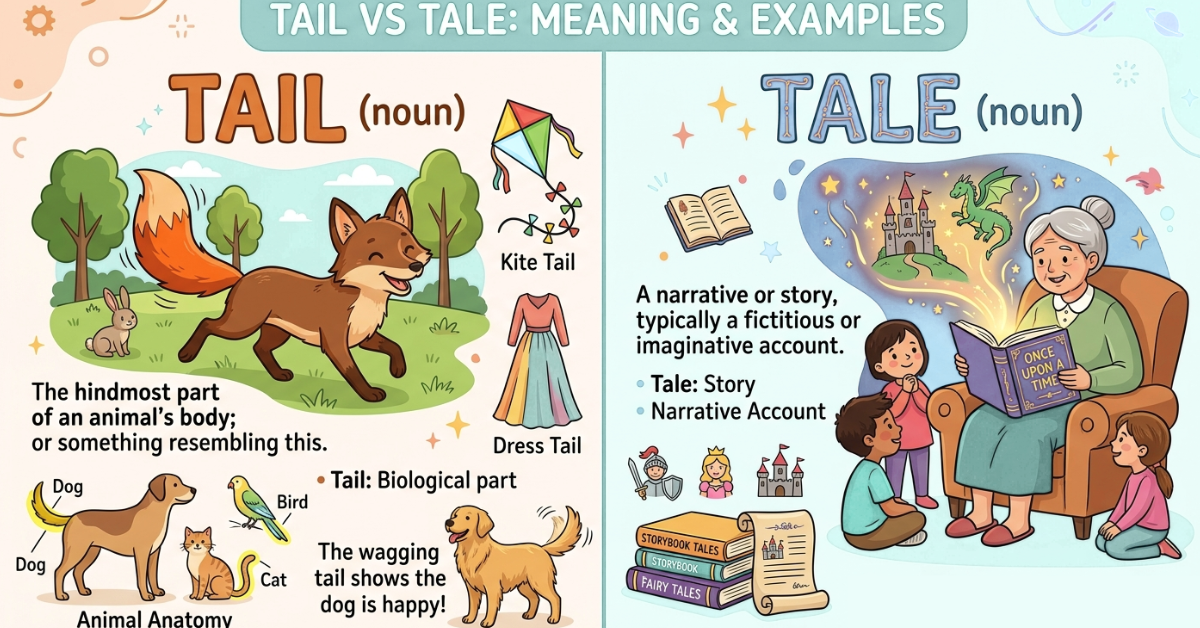
- Tail refers to a physical appendage or the end part of something.
- Tale refers to a story, narrative, or account of events.
Since English contains many homophones, mistakes like these are common even among fluent speakers.
What Does Tail Mean?
The word tail most commonly refers to the rear appendage of an animal. It can also describe the back end of an object, line, or process.
Common Definitions of Tail
- The flexible rear part of an animal’s body.
- The back section of an aircraft, vehicle, or object.
- The end portion of something.
- To follow someone closely (as a verb).
Examples of Tail in Sentences
- The dog wagged its tail excitedly when its owner arrived.
- A peacock’s colorful tail attracts attention.
- The airplane’s tail was damaged during the storm.
- Detectives were assigned to tail the suspect.
In every example, the word relates to a physical end, extension, or following action.
What Does Tale Mean?
The word tale refers to a story, narrative, account, or report of events. It can be fictional or based on real experiences.
Common Definitions of Tale
- A story or narrative.
- A report of events or experiences.
- A traditional folk story or legend.
Examples of Tale in Sentences
- Her grandmother told a magical tale before bedtime.
- The traveler shared a fascinating tale about his journey.
- The novel is a moving tale of friendship and courage.
- Ancient cultures passed down many folk tales through generations.
Whenever the meaning involves storytelling, narration, or an account of events, tale is the correct choice.
Tail vs Tale: Key Differences
The easiest way to distinguish these words is by focusing on their meanings.
| Feature | Tail | Tale |
| Meaning | End part or appendage | Story or narrative |
| Part of Speech | Noun or verb | Noun |
| Common Context | Animals, objects, movement | Books, stories, experiences |
| Example | The cat’s tail is fluffy. | The author wrote a tale. |
Although they sound identical, their uses rarely overlap.
Simple Trick to Remember the Difference
A memory aid can help prevent mistakes.
Remember Tail
The word tail contains the letters “AI.”
Think of:
- Animal
- Appendage
If you’re referring to a physical body part or the end of something, use tail.
Remember Tale
The word tale contains the word beginning “tal.”
Think of:
- Telling
- Storytelling
If someone is sharing a story or narrative, use tale.
Common Mistakes and Corrections
Many writing errors happen because spell-checkers may not catch homophone mistakes. Here are examples:
Incorrect:
- My grandfather told me a wonderful tail.
Correct:
- My grandfather told me a wonderful tale.
Incorrect:
- The horse’s tale was long and shiny.
Correct:
- The horse’s tail was long and shiny.
Incorrect:
- The fairy tail became famous worldwide.
Correct:
- The fairy tale became famous worldwide.
Paying attention to the sentence’s meaning tail vs tale usually reveals the correct spelling immediately.
Tail and Tale in Literature and Everyday Language
Both words appear frequently in everyday English.
Where You Commonly See Tail
- Animal descriptions
- Biology textbooks
- Aviation terminology
- Vehicle design
- Action and detective stories
Examples:
- Fish tail
- Tail section
- Tail rotor
- Tailgate
Where You Commonly See Tale
- Children’s books
- Novels
- Fairy tales
- Folklore collections
- Personal storytelling
Examples:
- Adventure tale
- Fairy tale
- Cautionary tale
- Love tale
Recognizing the context makes word selection much easier.
Examples Comparing Both Words
Seeing the two words side by side highlights their difference.
- The fox disappeared into the forest, its tail swaying behind it.
- The hunter later told a dramatic tale about the encounter.
- The horse flicked its tail to chase away flies.
- The old man shared a humorous tale from his childhood.
- The kite’s tail helped it remain stable.
- The storyteller captivated the audience with a magical tale.
These paired examples show that one word relates to physical objects while the other relates to stories.
Related Homophones Worth Knowing
English contains many pairs similar to these words:
- There / Their / They’re
- Sea / See
- Right / Write
- Flour / Flower
- Knight / Night
- Pair / Pear
- Mail / Male
Learning homophones improves both spelling accuracy and reading comprehension.
How to Choose the Correct Word Every Time
Follow these simple steps:
- Ask yourself whether the sentence involves a story.
- If it does, choose tale.
- If it refers to an animal, object, or ending section, choose tail.
- Read the sentence aloud and check whether the meaning makes sense.
- Proofread carefully because spell-check may not identify homophone errors.
This quick process eliminates most confusion.
Frequently Asked Questions
Is tail or tale used for a story?
Tale is the correct word for a story, narrative, legend, or account of events.
What is the meaning of tail?
A tail is the rear appendage of an animal or the back end of an object, vehicle, or structure.
Why do tail and tale sound the same?
They are homophones, meaning they share the same pronunciation but have different spellings and meanings.
Can tail be used as a verb?
Yes. As a verb, tail means to follow someone closely, often secretly.
Example: Detectives tailed the suspect for several hours.
What is a fairy tale?
A fairy tale is a traditional story that often includes magical characters, supernatural events, and moral lessons.
How can I remember the difference?
Think:
- Tail = animal body part or end section.
- Tale = telling a story.
Conclusion
Understanding tail vs tale becomes simple once you focus on meaning rather than pronunciation. Tail refers to a physical appendage, back section, or following action, while tale refers to a story, narrative, or account of events. Although they sound identical, their uses are entirely different.
Whenever you’re unsure, ask yourself a simple question: Am I talking about a story or a physical object? If it’s a story, choose tale. If it’s an animal’s appendage or the end part of something, choose tail. Mastering this distinction will make your writing clearer, more professional, and free from one of English’s most common spelling mistakes.