Have you ever written a sentence and paused to wonder whether you should use steel or steal? You’re not alone. These two words sound exactly the same when spoken, yet they have completely different meanings. Because they are homophones—words that share the same pronunciation but differ in spelling and meaning—they are often confused in writing.
Understanding the difference between steel vs steal is essential for clear communication, whether you’re writing an email, an academic paper, a social media post, or everyday messages. In this guide, we’ll break down their meanings, usage, examples, and simple tricks to help you remember the correct word every time.
What Is the Difference Between Steel and Steal?
The main difference is simple:
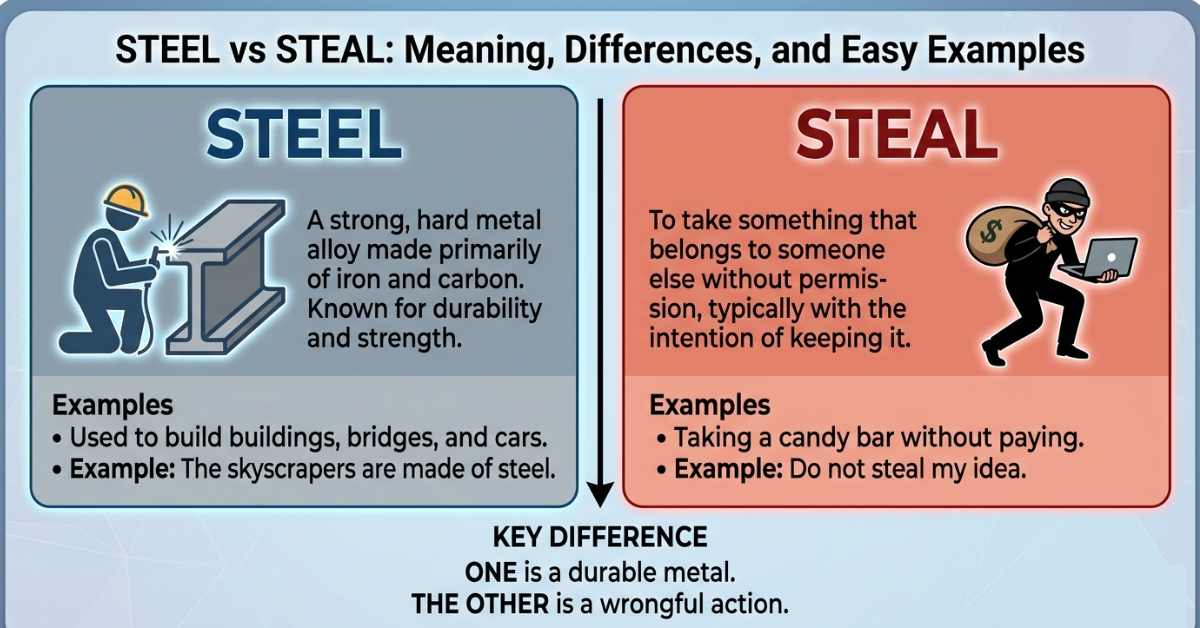
- Steel is a noun that refers to a strong metal alloy made primarily from iron and carbon.
- Steal is a verb that means to take something without permission or unlawfully.
Although they sound identical, their functions and meanings are entirely unrelated.
| Word | Part of Speech | Meaning |
| Steel | Noun (sometimes adjective) | A strong metal used in construction, manufacturing, and tools |
| Steal | Verb | To take something that belongs to someone else without permission |
This distinction forms the basis of the steel vs steal definition and helps eliminate confusion in everyday writing.
Understanding the Word “Steel”
Definition of Steel
Steel is one of the most widely used materials in the world. It is an alloy composed mainly of iron combined with carbon and sometimes other elements to improve strength and durability.
Steel is valued for its:
- Strength
- Durability
- Resistance to wear
- Versatility
- Recyclability
Common Uses of Steel
You encounter steel every day, often without realizing it.
Examples include:
- Building structures
- Bridges
- Cars and trucks
- Kitchen appliances
- Railway tracks
- Tools and machinery
- Household furniture
Examples of Steel in Sentences
- The skyscraper’s frame is made of reinforced steel.
- Engineers selected high-quality steel for the bridge project.
- Stainless steel is commonly used in kitchen equipment.
- The factory produces thousands of tons of steel each year.
Related Terms
Some words commonly associated with steel include:
- Metal
- Alloy
- Iron
- Stainless steel
- Structural steel
- Construction material
- Industrial manufacturing
Understanding the Word “Steal”
Definition of Steal
Steal means to take another person’s property without permission, usually with the intention of keeping it permanently. It is generally associated with theft or dishonest behavior.
Different Forms of the Verb
| Verb Form | Example |
| Steal | I never steal from others. |
| Stole | Someone stole my bicycle yesterday. |
| Stolen | The stolen wallet was recovered. |
| Stealing | He was caught stealing merchandise. |
Examples of Steal in Sentences
- It is wrong to steal from anyone.
- Someone tried to steal her purse at the market.
- The thief stole several valuable paintings.
- Never steal another person’s work or ideas.
Informal Meanings of Steal
In casual conversation, steal can also have figurative meanings:
- To attract attention unexpectedly
- To obtain something at an exceptionally low price
Examples:
- Her performance stole the show.
- That laptop was a steal at that price.
Steel vs Steal Definition Explained Clearly
When comparing the meanings side by side, the distinction becomes obvious.
Steel
- Refers to a material or substance
- Connected with manufacturing and construction
- Usually functions as a noun
Example:
The building’s support beams are made of steel.
Steal
- Refers to an action
- Connected with taking something unlawfully
- Functions primarily as a verb
Example:
It is illegal to steal someone else’s property.
A useful way to remember the steel vs steal definition is to think of steel as a “thing” and steal as an “action.”
Why Are Steel and Steal Confused?
The confusion occurs because these words are homophones.
What Are Homophones?
Homophones are words that:
- Sound the same
- Have different spellings
- Have different meanings
Examples include:
- Their / There / They’re
- Right / Write
- Sea / See
- Steel / Steal
Because people often write words based on sound, homophones can easily lead to spelling mistakes.
Memory Tricks to Remember the Difference
Simple memory devices can make these words easier to distinguish.
Remembering Steel
The word steel contains two consecutive “e” letters.
Think:
The double “e” looks strong and solid, just like metal.
Association:
- Steel = Structure
- Steel = Buildings
- Steel = Metal
Remembering Steal
The word steal begins with “stea.”
Think:
A thief might try to sneak away and “steal.”
Association:
- Steal = Taking
- Steal = Theft
- Steal = Action
Common Mistakes and Corrections
Writers frequently interchange these words accidentally.
Incorrect:
The thief tried to steel my phone.
Correct:
The thief tried to steal my phone.
Incorrect:
The bridge was built using reinforced steal.
Correct:
The bridge was built using reinforced steel.
Incorrect:
Criminals often steel valuable items.
Correct:
Criminals often steal valuable items.
Incorrect:
Stainless steal appliances are durable.
Correct:
Stainless steel appliances are durable.
Quick Comparison Table
| Feature | Steel | Steal |
| Meaning | Strong metal alloy | Take unlawfully |
| Word Type | Noun | Verb |
| Related To | Construction and manufacturing | Theft and taking |
| Example | Steel beams support the building. | Never steal from others. |
| Pronunciation | Same as “steal” | Same as “steel” |
When to Use Steel
Use steel when discussing:
- Metals
- Engineering
- Construction
- Manufacturing
- Industrial products
- Household appliances
Example sentences:
- The company manufactures structural steel.
- Steel pipes are used in the project.
- The sculpture was crafted from stainless steel.
When to Use Steal
Use steal when discussing:
- Theft
- Crime
- Taking without permission
- Figurative expressions involving taking attention or value
Example sentences:
- Don’t steal copyrighted material.
- The actor managed to steal every scene.
- Someone attempted to steal the vehicle.
Examples in Everyday Context
At Work
- The warehouse stores steel components.
- Employees must not steal company property.
At Home
- The kitchen sink is made from stainless steel.
- Children should learn that it is wrong to steal.
In Business
- Steel prices affect construction costs.
- Businesses take measures to prevent theft and stealing.
In Entertainment
- The stage design included steel structures.
- The comedian managed to steal the spotlight.
Frequently Asked Questions
Is steel a noun or a verb?
Steel is primarily a noun referring to a metal alloy. In some literary contexts, it can be used as a verb meaning to strengthen oneself mentally, but this usage is less common.
Is steal always related to theft?
Mostly yes. However, in informal language it can also mean attracting attention or getting an exceptional bargain, such as “steal the show” or “a steal at that price.”
Why do steel and steal sound the same?
They are homophones. English contains many words that share pronunciation while having different spellings and meanings.
How can I remember which spelling is correct?
Remember that steel refers to metal and structures, while steal refers to taking something. Thinking “metal versus action” can help prevent mistakes.
What is the easiest way to identify the correct word?
Ask yourself whether you’re referring to:
- A material → use steel
- An action of taking → use steal
Are steel and steal interchangeable?
No. Despite sounding identical, they have entirely different meanings and cannot be substituted for one another.
Conclusion
Understanding steel vs steal is easier once you recognize that one word refers to a material and the other refers to an action. Steel is the strong metal used in buildings, tools, and manufacturing, while steal means taking something without permission. Although these homophones share the same pronunciation, their meanings, grammatical roles, and contexts are completely different.
By remembering the simple distinction—steel equals metal, steal equals taking—you can avoid common spelling mistakes and write with greater confidence. The next time you encounter these words, you’ll know exactly which one belongs in your sentence.