Have you ever paused mid-sentence and wondered whether to write affended or offended? You are not alone. This is a common spelling question because the two words look similar, but only one is the standard English word used to describe hurt feelings, disrespect, or insult.
In everyday English, offended is the correct spelling. The form affended is usually a misspelling, although people sometimes confuse it because of similar-sounding words like offend, offensive, and affect. Let’s clear it up in a simple, practical way.
What Does “Offended” Mean?
The word offended means feeling upset, insulted, or disrespected by something someone said or did.
It is often used when a remark, action, or joke crosses a personal or social line. For example:
- She felt offended by the comment.
- He was offended when no one listened to his opinion.
- Many people were offended by the rude message.
So, when you are choosing between affended or offended, the correct choice is offended.
Why “Affended” Is Incorrect
The word affended is not the standard spelling in modern English. Most of the time, it appears because of typing mistakes, pronunciation confusion, or simple memory errors.
A helpful way to remember this is to think about the verb offend.
If the base word is offend, the past participle becomes offended.
Here is the pattern:
- offend
- offended
- offense
- offensive
That makes the spelling easier to understand and much easier to remember.
How to Use “Offended” in Sentences
To use the word correctly, place it where you want to show hurt feelings or disrespect. The word often follows a form of be, such as am, is, was, or were.
Examples:
- I was offended by the joke.
- She is easily offended by rude behavior.
- They were offended when their work was ignored.
- He did not mean to offend anyone, but some people still felt offended.
Notice how natural and direct the sentences sound. That is one reason offended is the version you should always choose in formal writing, essays, and professional content.
Common Mistakes People Make
Many writers mix up affended or offended because English spelling does not always match pronunciation perfectly. Still, a few simple habits can help you avoid the mistake.
1. Confusing similar words
People often confuse:
- offend
- offense
- offensive
- offended
2. Relying on sound instead of spelling
Sometimes a word sounds like it could start with “a,” but English spelling rules do not support that.
3. Using the wrong form in writing
In school work, blogs, social media posts, or emails, writing affended can make the sentence look incorrect or unpolished.
Easy Way to Remember the Correct Spelling
Here is a simple memory trick:
If someone is insulted, they are offended, not affended.
You can also connect it to the word offense. Since offense begins with “off,” the related word offended does too.
Another useful tip is to remember that the letter o appears in all the main related words:
- offend
- offense
- offensive
- offended
That pattern makes the spelling much easier to trust.
When to Use “Offended” in Real Life
The word appears often in both speech and writing. You may use it in conversations, professional messages, or formal essays.
Common situations include:
- Someone says something rude
- A joke goes too far
- A cultural or personal boundary is crossed
- A person feels insulted by a comment
- A social media post causes hurt feelings
Because the word is so common, using the right spelling matters. It improves clarity and makes your writing look more credible.
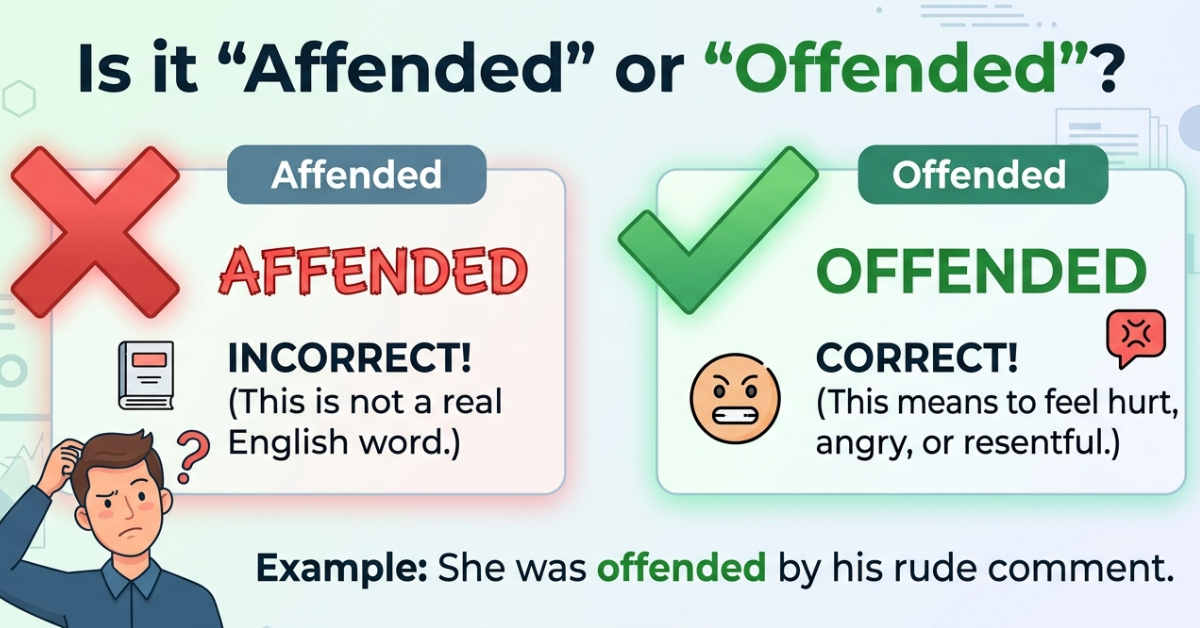
Affended or Offended: Quick Comparison
Here is the simplest answer:
- Affended = incorrect spelling
- Offended = correct spelling
That is the rule to remember every time.
Grammar Tip: Stronger Writing Choices
If you want your writing to sound more natural, try using specific phrases instead of repeating the same word too often.
For example, instead of always saying “offended,” you can also write:
- upset
- insulted
- hurt
- disrespected
- annoyed
These alternatives can make your writing feel smoother and more engaging. They also help avoid repetition in longer articles.
FAQ
Is “affended” a real word?
No, affended is not the standard English spelling. The correct word is offended.
Why do people write “affended”?
People usually misspell it because the pronunciation can be confusing, or they mix it up with similar words.
What is the difference between offend and offended?
Offend is the base verb. Offended is the past form or adjective used to describe someone who feels insulted.
Can “offended” be used in formal writing?
Yes. Offended is perfectly correct in formal writing, academic work, and professional communication.
How do I remember the correct spelling?
Link it to offend and offense. They all begin with off, so offended does too.
Conclusion
When it comes to affended or offended, the correct spelling is offended. The word is simple, common, and important in everyday English, especially when you want to describe hurt feelings or disrespect. Once you connect it to offend and offense, the spelling becomes much easier to remember.
Use offended in your writing, avoid the incorrect form, and your English will sound clearer and more professional. For more grammar topics like this, explore related spelling guides and usage tips that can make your writing even stronger.