English grammar can sometimes feel confusing, especially when two words look almost identical. One of the most common mix-ups is complaint vs complain. Many people use them incorrectly because both words come from the same idea: expressing dissatisfaction.
The difference is actually simple once you understand how each word functions in a sentence. One is a noun, while the other is a verb. Knowing when to use each can instantly improve your speaking and writing.
In this guide, you will learn the meaning, grammar role, examples, common mistakes, and easy tricks to remember the correct usage.
Why People Confuse These Words
The confusion happens because the two terms are closely related in meaning. Both involve expressing annoyance, frustration, or dissatisfaction about something.
However, they do not play the same grammatical role.
- One describes the action
- The other names the issue itself
That small difference changes how the word fits into a sentence.
What Does “Complain” Mean?
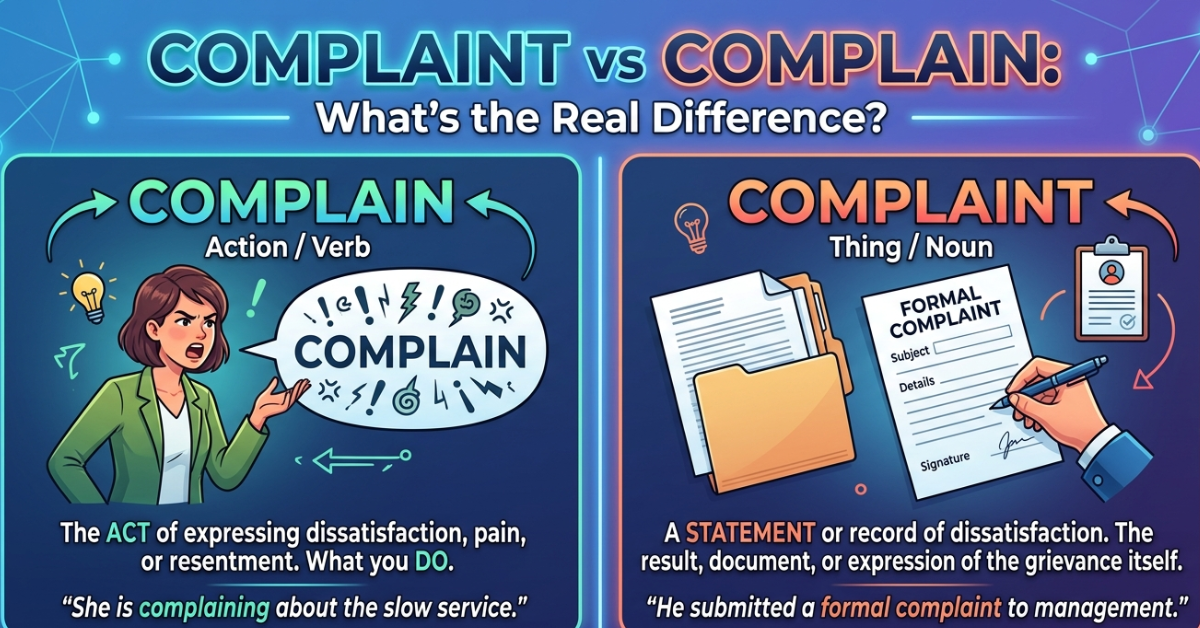
“Complain” is a verb.
A verb is an action word, so this term refers to the act of expressing dissatisfaction.
Examples of “Complain”
- Customers often complain about slow service.
- She did not complain during the trip.
- Why do people complain so much online?
In all these sentences, the word describes an action someone performs.
Easy Memory Trick
If someone is actively expressing frustration, you usually need the verb form.
Think of it this way:
People complain when something bothers them.
What Does “Complaint” Mean?
“Complaint” is a noun.
A noun names a thing, idea, or issue. In this case, it refers to the statement or problem itself.
Examples of “Complaint”
- The manager received a formal complaint.
- His main complaint was the noise.
- They filed a complaint against the company.
Here, the word acts as a thing rather than an action.
Simple Way to Remember
A complaint is the result or statement created after someone complains.
Main Difference Explained
The easiest way to understand the distinction is this:
| Word | Part of Speech | Meaning |
| Complain | Verb | To express dissatisfaction |
| Complaint | Noun | A statement of dissatisfaction |
This grammar rule applies in both formal and casual English.
Sentence Comparison Examples
Seeing both words side by side makes the difference clearer.
Correct Usage Examples
- I want to complain about the poor service.
- The customer submitted a complaint yesterday.
- Students sometimes complain about homework.
- The teacher listened to their complaint carefully.
- He refused to complain publicly.
- Her complaint was understandable.
Notice how one shows action while the other names the issue.
Common Grammar Mistakes
Many learners accidentally swap the words because they sound related.
Incorrect:
- She made a complain.
Correct:
- She made a complaint.
Why? Because after “made a,” you need a noun.
Another common error:
Incorrect:
- He complaint every day.
Correct:
- He complains every day.
Here, the sentence requires a verb.
When to Use Each Word
Here is a quick guideline that works in most situations.
Use the Verb Form When:
- Someone is speaking negatively about something
- Describing an action
- Talking about expressing frustration
Use the Noun Form When:
- Referring to a report or issue
- Naming the dissatisfaction itself
- Discussing customer service cases
Formal vs Informal Usage
Both words can appear in formal and informal communication.
Informal Situations
- Friends talking about problems
- Casual conversations
- Social media comments
Example:
- People always complain about traffic.
Formal Situations
- Legal reports
- Workplace issues
- Customer support cases
Example:
- The company investigated the complaint immediately.
Related Words and Similar Terms
Understanding related vocabulary can make your English stronger.
Similar Verbs
- Protest
- Criticize
- Object
- Grumble
Similar Nouns
- Issue
- Concern
- Protest
- Report
These alternatives can improve writing variety and reduce repetition.
Pronunciation Difference
Although the words are connected, their endings sound different.
- Complain → ends with a strong “-plain” sound
- Complaint → ends with a softer “-plaint” sound
Paying attention to pronunciation can help avoid mistakes while speaking.
Quick Practice Exercise
Choose the correct word:
- She decided to ___ to the manager.
- The customer filed a formal ___.
- They always ___ about prices.
- His biggest ___ was the waiting time.
Answers
- complain
- complaint
- complain
- complaint
Tips to Avoid Confusion
Here are a few easy tricks to remember the correct form:
1. Check the Sentence Role
Ask yourself:
- Is this an action?
- Or is it a thing/report?
2. Look for Articles
Words like “a,” “an,” or “the” usually come before nouns.
Example:
- a complaint
3. Watch for Action Verbs
If the sentence needs an action, use the verb form.
Example:
- People complain frequently.
Why This Grammar Difference Matters
Using the correct word improves:
- Professional communication
- Academic writing
- Workplace emails
- Everyday English fluency
Small grammar mistakes can sometimes make writing look less polished. Learning these distinctions helps your communication sound clearer and more confident.
FAQs
Is “complain” a noun or verb?
It is a verb because it describes the action of expressing dissatisfaction.
Is “complaint” a verb?
No. It is a noun that refers to the issue or statement itself.
Can I say “make a complain”?
No. The correct phrase is “make a complaint.”
Which word is used in customer service?
Both may appear, but reports and records usually use the noun form.
Why do people confuse these words?
They come from the same root word and have similar meanings, which makes them easy to mix up.
Conclusion
Understanding complaint vs complain becomes much easier once you know the grammar rule behind each word. One describes the action of expressing dissatisfaction, while the other refers to the issue itself.
A simple way to remember it is:
- People complain
- They make a complaint
Mastering small grammar differences like this can make your English sound more natural, professional, and confident. Keep practicing with real sentences, and the correct usage will soon become automatic.