English spelling can be confusing, especially when a single word appears in two different forms. One of the most searched examples is authorization or authorisation. At first glance, they may look like completely separate words, but they actually mean the same thing.
The only real difference comes down to regional spelling preferences. One version is commonly used in American English, while the other belongs to British English. Understanding when to use each spelling can help you write more professionally and avoid mistakes in academic, legal, and business communication.
In this guide, you’ll learn the meaning, spelling differences, examples, grammar rules, and the correct usage in different contexts.
What Does the Word Mean?
The term refers to official permission, approval, or legal power to do something. It is often used in business, finance, technology, healthcare, and law.
For example:
- A bank may require approval before processing a transaction.
- A company manager may give permission for access to confidential files.
- A hospital may ask for signed consent before treatment.
In simple words, it means giving someone the right or authority to act.
The Main Difference Between the Two Spellings
The distinction is entirely based on regional English.
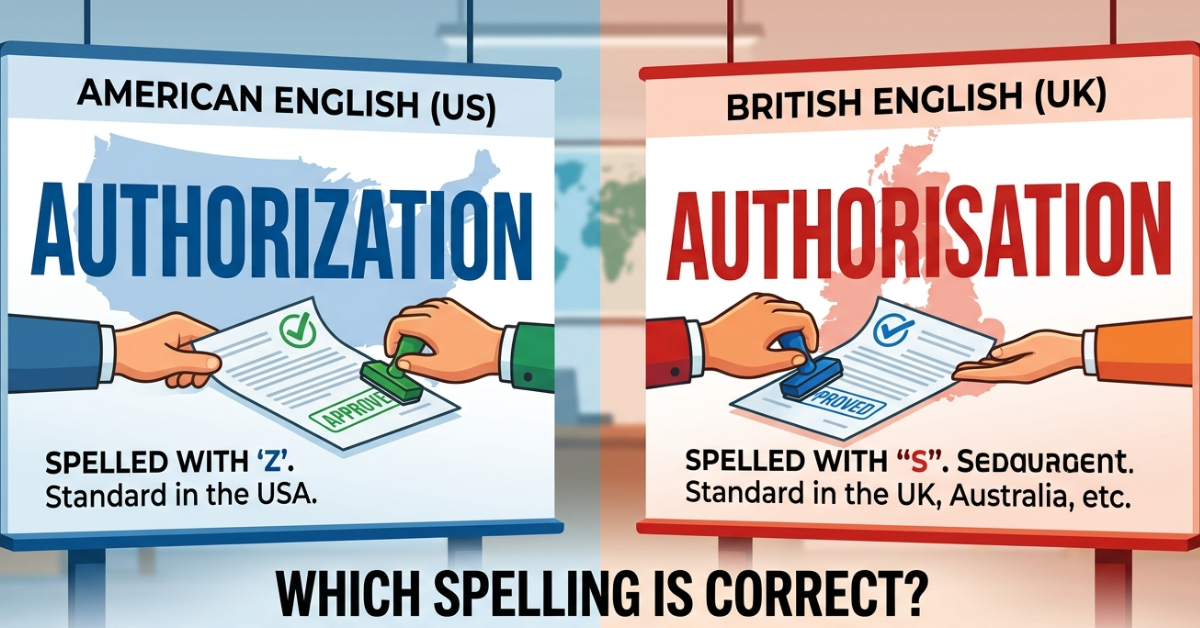
American English
In the United States, the preferred spelling uses “z.”
- Authorization
This style follows common American spelling patterns such as:
- organize
- realize
- recognize
British English
In the United Kingdom and many Commonwealth countries, the spelling with “s” is more common.
- Authorisation
This pattern matches words like:
- organise
- realise
- recognise
Both spellings are correct. The important thing is consistency.
Why Do Both Versions Exist?
The variation comes from the historical evolution of English. American English gradually simplified many spellings during the 18th and 19th centuries, especially under the influence of lexicographer Noah Webster.
British English kept many older forms that used “s” instead of “z.” Over time, both styles became accepted standards in their respective regions.
Which One Should You Use?
The right choice depends on your audience and writing style.
Use American spelling if:
- You write for U.S. readers
- Your company follows U.S. style guides
- You create content for American websites
- You study in the United States
Use British spelling if:
- Your audience is in the UK
- You follow British academic standards
- Your organization uses Commonwealth English
- You write for international publications using UK style
The key rule is simple: never mix both spellings in the same document.
Common Places Where the Word Appears
You’ll often see this term in professional and technical settings.
Legal Documents
Lawyers and contracts frequently use it when discussing official approval or delegated power.
Example:
The employee received written approval to sign the agreement.
Banking and Finance
Banks use it for transaction verification and payment permissions.
Example:
The payment could not proceed without prior approval.
Technology and Cybersecurity
Software systems use the term for user access and permissions.
Example:
Two-factor verification adds an extra layer of security.
Healthcare
Hospitals and clinics require signed consent before medical procedures.
Example:
The patient signed the required medical approval form.
Grammar and Usage Tips
Many people confuse the noun form with related verbs and adjectives. Here’s a simple breakdown.
| Word Form | Example |
| Authorize / Authorise | The manager approved the request. |
| Authorized / Authorised | The user has official access. |
| Authorization / Authorisation | Written approval is required. |
Easy Trick to Remember the Difference
A simple memory tip can help:
- American English usually prefers “z”
- British English often prefers “s”
If you remember the spelling of “organize” versus “organise,” the same rule applies here.
Examples in Everyday Sentences
Here are some practical examples to make usage clearer:
- The company requested written approval before releasing the funds.
- Employees need official permission to access the system.
- The doctor asked for signed consent before surgery.
- The software requires administrator verification.
These examples all show the same core meaning: official permission or authority.
Mistakes People Commonly Make
Mixing Spellings
One of the biggest mistakes is switching between both forms in the same article or document.
Incorrect:
- The form requires authorisation before authorization is granted.
Correct:
- Stick to one regional spelling throughout the content.
Confusing It With Authentication
These two terms are related but not identical.
- Authentication confirms identity.
- Authorization determines permissions.
For example:
- Logging into an account is authentication.
- Accessing admin settings is authorization.
Is One More Professional Than the Other?
No. Both are fully correct in standard English. Neither spelling is more formal or more intelligent.
Professionalism depends on:
- Consistency
- Correct grammar
- Clear writing
- Appropriate regional style
A British company expects UK spelling, while an American company expects U.S. spelling.
How Search Engines Treat Both Spellings
Modern search engines understand that both versions carry the same meaning. However, localized SEO still matters.
For example:
- U.S.-targeted websites often rank better using American spelling.
- UK audiences may respond more naturally to British spelling.
That’s why businesses usually match the language preferences of their target readers.
FAQs
Is there a difference in meaning between the two spellings?
No. Both words mean official permission or approval.
Which spelling is correct in the United States?
American English prefers the version with “z.”
Which spelling is used in the UK?
British English commonly uses the version with “s.”
Can I use both in the same article?
It’s better to choose one style and stay consistent throughout the document.
Is one spelling older than the other?
The British form reflects older English traditions, while American English later adopted simplified spellings.
Do companies care about the spelling difference?
Yes, especially in professional writing. Businesses usually follow a specific language style guide.
Conclusion
Understanding the difference between authorization or authorisation is actually quite simple once you know the regional rule behind it. Both spellings are correct, both carry the same meaning, and both are widely accepted in professional communication.
The best choice depends on your audience. Use the American form for U.S.-focused writing and the British form for UK or Commonwealth readers. Most importantly, stay consistent throughout your content.
Whether you’re writing legal documents, business emails, academic papers, or website content, choosing the correct regional spelling helps your work look polished, accurate, and professional.