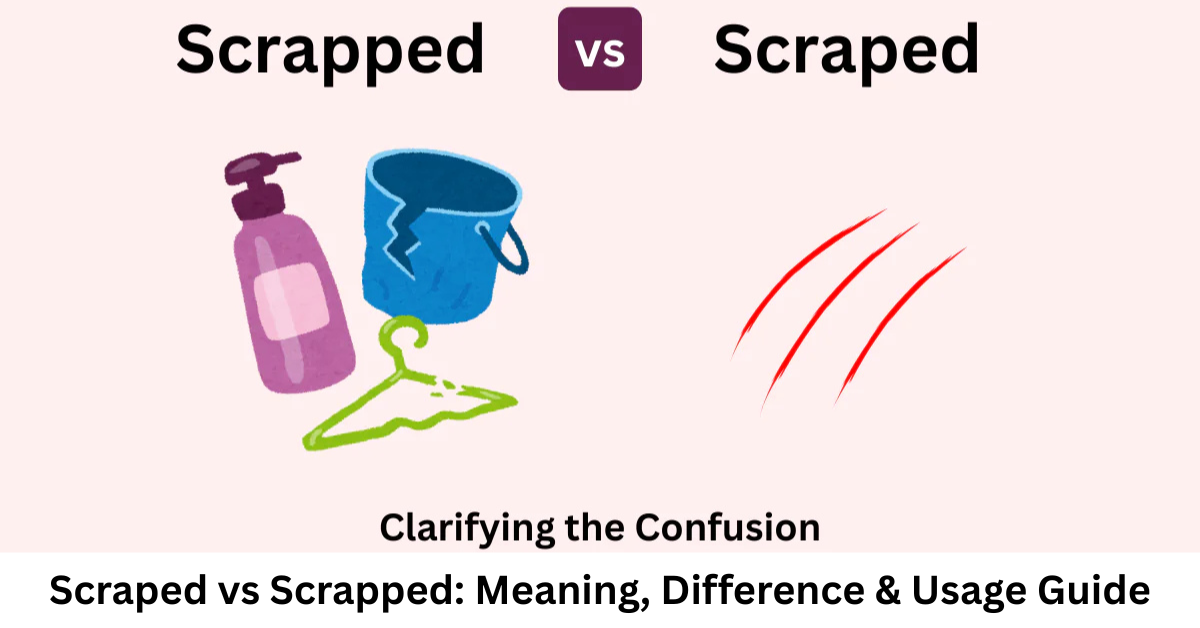
English can be tricky, especially when two words look almost identical but mean completely different things. One of the most confusing pairs is scraped vs scrapped.
At first glance, they seem like spelling variations, but they are not. The meaning changes entirely depending on which word you use. In this article, we’ll break down scraped vs scrapped in a simple, human-friendly way so you never mix them up again.
What Does “Scraped” Mean?
The word scraped comes from the verb scrape, which means to remove something by rubbing or dragging a hard object over a surface.
Common meanings of scraped:
- To remove a layer from a surface
- To collect information from websites (web scraping)
- To accidentally scratch something
Examples:
- She scraped the paint off the wall.
- The car scraped against the gate.
- The software scraped data from multiple websites.
In simple terms: scraped = removing or collecting something by scraping.
What Does “Scrapped” Mean?
Now let’s look at scrapped, which comes from the word scrap.
It means to discard, cancel, or throw something away because it is no longer useful.
Common meanings of scrapped:
- To cancel a plan or project
- To discard something old or useless
- To abandon an idea
Examples:
- The company scrapped the old design.
- They scrapped the project due to budget issues.
- The plan was scrapped last minute.
In simple terms: scrapped = cancelled or thrown away.
Scraped vs Scrapped: Key Differences
This is where most people get confused. Even though the spelling is similar, the meaning is completely different.
| Feature | Scraped | Scrapped |
|---|---|---|
| Base word | Scrape | Scrap |
| Meaning | To remove or collect | To discard or cancel |
| Usage | Physical or digital action | Decision or plan |
| Example | Scraped data from a website | Scrapped the entire plan |
Quick trick to remember:
- Scraped = Surface action (removing/collecting)
- Scrapped = Stop action (canceling/throwing away)
Why People Confuse Scraped and Scrapped
The confusion usually happens because:
- Both words sound similar when spoken
- Only one letter “p” changes the meaning
- Auto-correct sometimes suggests the wrong word
- Beginners often mix verb forms
But once you understand the root words, the confusion disappears quickly.
Real-Life Usage Examples
Let’s make it even clearer with real-life situations:
Technology Example
- Developers often scraped websites to collect data for research.
Business Example
- The company scrapped its old marketing strategy and started fresh.
Daily Life Example
- I accidentally scraped my knee while cycling.
- We scrapped our weekend trip plans.
Memory Hack to Never Forget the Difference
Here’s a simple trick:
- Think of scraped = scratch (both involve surface contact)
- Think of scrapped = trash can (something thrown away)
This mental image helps you instantly choose the correct word.
Common Mistakes to Avoid
- Don’t use scraped when talking about canceling plans
- Don’t use scrapped when talking about collecting data
- Don’t rely only on spellcheck—context matters
Understanding context is the key to mastering scraped vs scrapped.
FAQs About Scraped vs Scrapped
1. What is the main difference between scraped and scrapped?
Scraped means removing or collecting something, while scrapped means canceling or discarding something.
2. Is scraped used in technology?
Yes, especially in “web scraping,” where data is collected from websites.
3. Can scrapped mean destroyed?
Not exactly destroyed, but more like abandoned or thrown away as useless.
4. Why do people confuse scraped and scrapped?
Because they look and sound very similar, but their meanings are completely different.
5. Is scrapped only used for projects?
No, it can be used for plans, ideas, designs, or anything that gets canceled or abandoned.
Conclusion
Understanding scraped vs scrapped is all about context and meaning. One refers to removing or collecting, while the other refers to canceling or discarding.
Once you remember the simple trick—scraped = scratch, scrapped = trash—you’ll never mix them up again.
Language becomes much easier when you focus on meaning instead of just spelling.