If you’ve ever typed or heard the confusion between payed vs paid, you’re definitely not alone. Many English learners mix these up because they look similar and come from the same verb “pay.”
But here’s the simple truth: only one of them is widely correct in modern English. Let’s break it down in an easy, human way so you never get confused again.
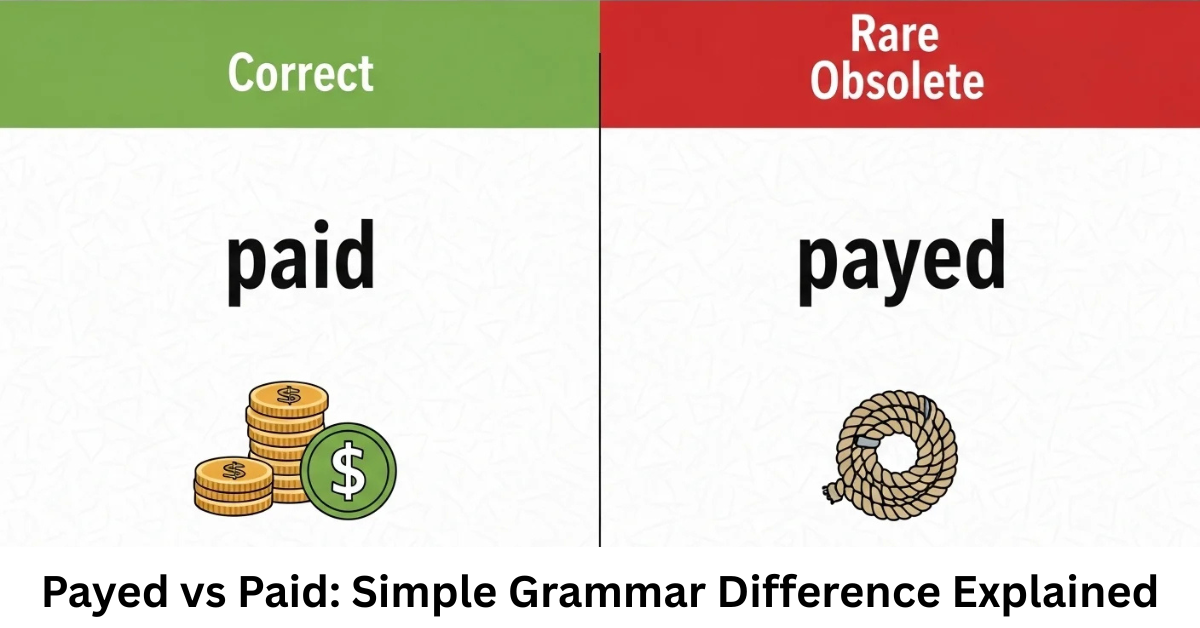
Why “Paid” Is the Correct Form in English
The verb pay is irregular, which means it does not follow the normal “-ed” rule for past tense verbs.
Instead of becoming “payed,” it changes completely to paid.
So in everyday English:
- Correct: I paid the bill
- Incorrect: I payed the bill
This is the standard form used in writing, exams, business communication, and daily speech.
When People Get Confused
Most confusion happens because many verbs in English follow a simple pattern:
play → played
stay → stayed
So naturally, people assume:
pay → payed
But English is full of irregular verbs, and pay is one of them. That’s why the correct past form is paid, not “payed.”
Payed vs Paid Attention: Common Mistake
One of the most searched grammar doubts is related to attention.
The correct phrase is:
- I paid attention in class
- I payed attention in class
Even though it feels like it should follow the regular rule, English grammar doesn’t apply it here.
Payed vs Paid Money: Real-Life Usage
When talking about money, the correct structure is always:
- I paid money for the course
- She paid money for the ticket
You will never see “payed money” in standard English writing.
This is important for emails, academic writing, and professional communication.
Payed vs Paid Examples in Simple Sentences
Here are some clear comparisons:
Correct Usage:
- He paid the rent on time
- They paid for dinner
- She paid attention to the lecture
Incorrect Usage:
- He payed the rent
- They payed for dinner
The second set is not accepted in modern English.
Does “Payed” Ever Exist?
Yes — but only in very rare cases.
“Payed” can appear in nautical (sea-related) language, such as:
- “payed out the rope”
However, this is not used in everyday conversation or writing. For most learners, you can safely ignore it.
Quick Grammar Rule to Remember
If you’re ever unsure:
- Use paid for everything related to money, attention, or actions
- Avoid “payed” in modern English
- Think: irregular verb = paid
This simple rule will save you from most mistakes.
FAQs
1. Is payed vs paid grammar confusing for everyone?
Yes, even native speakers sometimes hesitate, but “paid” is always correct in modern usage.
2. Can I ever use payed in writing?
Only in rare nautical contexts. Otherwise, avoid it completely.
3. Which is correct: payed vs paid attention?
The correct phrase is paid attention.
4. What about payed vs paid money?
The correct form is paid money, not “payed money.”
5. Why is “paid” irregular?
Because English has many irregular verbs that don’t follow normal past tense rules.
Conclusion
The confusion between payed vs paid comes from how English spelling tricks our expectations. But once you remember the rule, it becomes simple: pay paid, always.
If you focus on using “paid” in daily writing and speaking, you’ll automatically avoid one of the most common grammar mistakes in English.