Ever paused mid-sentence wondering whether to write passed or past? You’re not alone. The confusion around Passed vs Past is one of the most common grammar slip-ups, even among fluent English speakers.
Although both words sound identical, their meanings and uses are completely different. In this guide, you’ll learn the difference in a simple, practical way—so you can use each word confidently without second-guessing yourself.
What Does “Passed” Mean?
To begin with, passed is the past tense of the verb pass. In other words, it always involves an action—something that has happened.
Key Idea:
Whenever a sentence shows movement, completion, or action, passed is usually the correct choice.
Examples:
- She passed the exam with excellent marks.
- Meanwhile, the car passed us on the highway.
- Over time, the days passed quickly.
Common Uses of “Passed”:
- Completing something → passed a test
- Moving by something → passed a building
- Giving something → passed the salt
Quick Tip: If you can replace it with another verb like completed or moved, then “passed” is the right choice.
What Does “Past” Mean?
On the other hand, past is not a verb. Instead, it works as a noun, adjective, preposition, or adverb, usually referring to time, direction, or position.
Key Idea:
If you’re talking about time or position rather than action, past is what you need.
Examples:
- That’s all in the past now.
- By now, it’s already half past five.
- Just walk past the store and turn left.
Common Uses of “Past”:
- Time → in the past
- Direction → walk past me
- Position → just past the bridge
Quick Tip: If no action is happening, and you’re describing time or location, choose “past.”
Passed vs Past: The Key Difference
Now that both words are clear, let’s compare them directly:
| Word | Type | Meaning | Example |
|---|---|---|---|
| Passed | Verb | Action or completed event | He passed the ball |
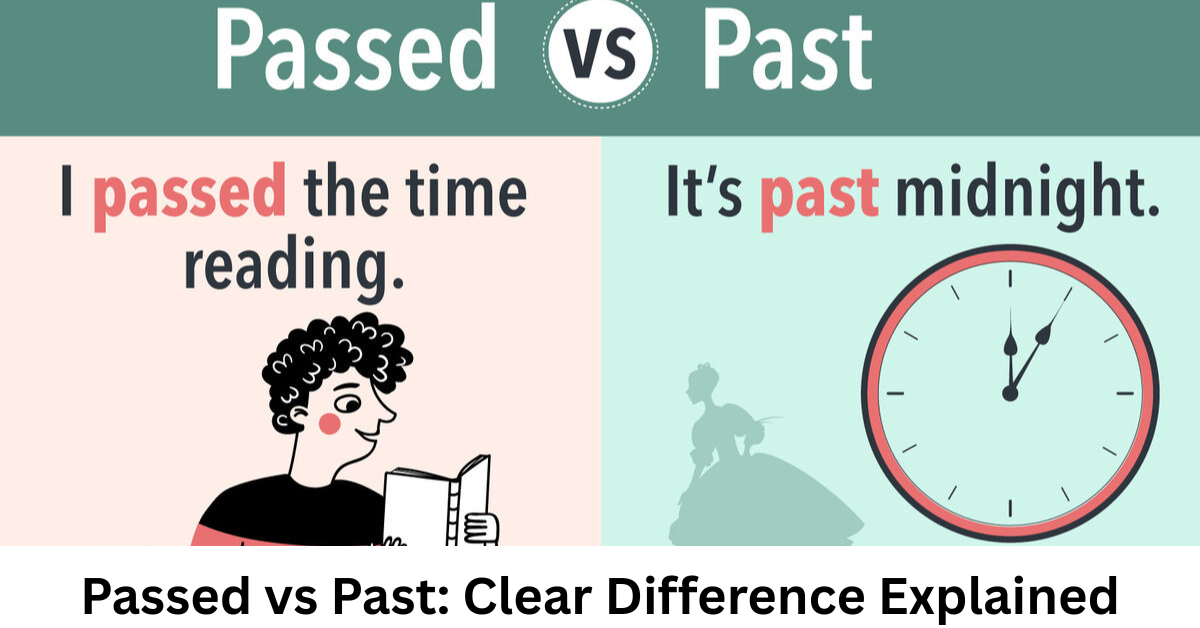
| Past | Noun/Adj | Time, direction, or position | It’s past midnight |
Simply put, one shows something happening, while the other describes where or when something is.
Easy Tricks to Remember
To make things easier, here are a few practical tricks:
1. Look for Action
If the sentence shows something happening, then use passed
2. Think About Time
If it refers to time or something gone, then use past
3. Replace the Word
Another helpful method is substitution:
- “Passed” → completed
- “Past” → gone or beyond
If the sentence still makes sense, you’ve chosen correctly.
Common Mistakes to Avoid
Even so, small errors can change the meaning of a sentence. Therefore, watch out for these:
I walked passed the park
I walked past the park
She past the exam
She passed the exam
It is passed midnight
It is past midnight
When Both Appear in One Sentence
Interestingly, both words can appear together—and that’s completely correct.
Example:
- He passed the shop just past the corner.
Here, passed shows the action, while past explains the position.
Why This Confusion Happens
Primarily, the confusion comes from pronunciation. Since both words sound exactly the same, they are known as homophones. As a result, writers often rely on instinct instead of grammar rules.
However, once you focus on function (verb vs non-verb), the difference becomes much clearer.
FAQs
1. What is the main difference between passed and past?
Essentially, passed is a verb showing action, while past refers to time, direction, or position.
2. Can “past” ever be a verb?
No, it cannot. In every case, past functions as a noun, adjective, or preposition.
3. How do I quickly check which one to use?
First, ask yourself:
- Is something happening? → use passed
- Is it about time or place? → use past
4. Why do people confuse these words?
Because they sound identical, which makes them easy to mix up in writing.
5. Is this mistake common in professional writing?
Yes, it is. Therefore, careful proofreading is always recommended.
Conclusion
In summary, understanding Passed vs Past becomes easy once you focus on their roles. One represents action, whereas the other describes time or place.
From now on, take a moment to check the function of the word in your sentence. As a result, your writing will become clearer, more polished, and far more professional.
If this guide helped you, consider practicing with your own sentences—because the more you apply it, the more natural it becomes.