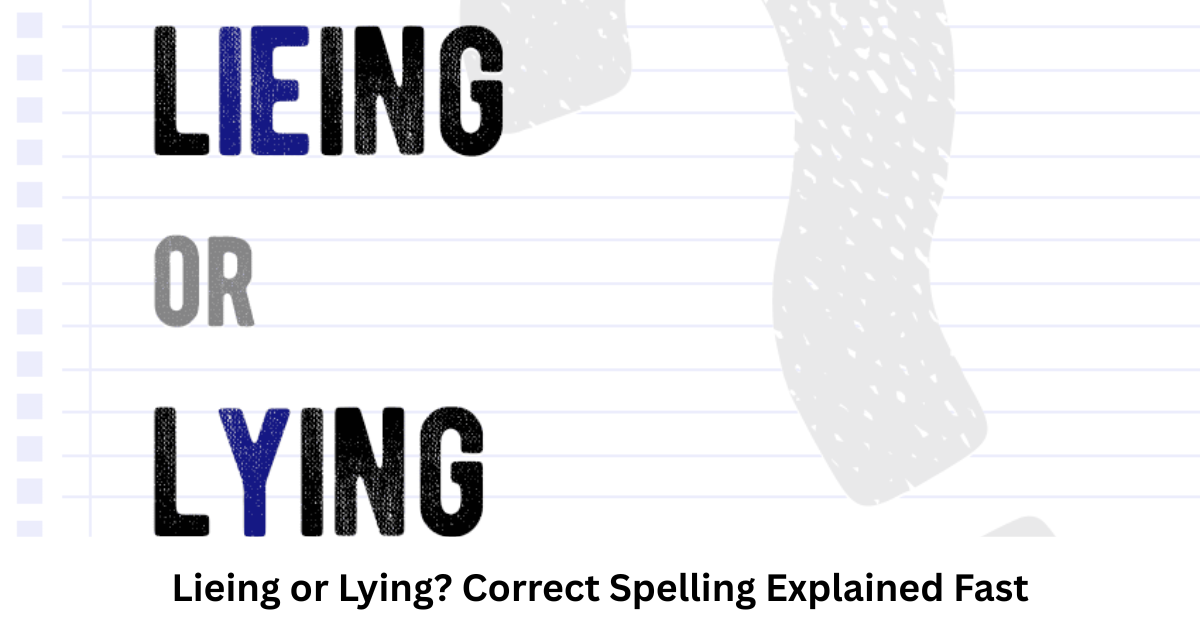
English spelling can be tricky, especially when words change form in unexpected ways. One common confusion is lieing or lying. Many people assume both spellings might be acceptable, but only one is correct in standard English.
If you’ve ever paused while writing a message, essay, or email wondering which version to use, you’re not alone. In this guide, we’ll explain the correct spelling, why it changes, grammar rules behind it, and how to remember it easily.
Lieing or Lying: The Correct Answer
The correct spelling is lying.
The word lieing is incorrect and not recognized as the standard present participle of the verb lie.
Correct Examples:
- He is lying on the couch.
- She was lying about the situation.
- The keys are lying on the table.
Incorrect Example:
- He is lieing on the couch.
Why Is It Lying Instead of Lieing?
This happens because of an English spelling rule.
When verbs ending in -ie change to -ing, the ie usually becomes y.
Examples:
| Base Verb | -ing Form |
|---|---|
| Lie | Lying |
| Die | Dying |
| Tie | Tying |
So instead of adding -ing directly to lie, the word changes to lying.
Different Meanings of Lie and Lying
The verb lie has two common meanings, and both use lying in the continuous form.
1. To Recline or Rest
Meaning: To be in a horizontal position.
Examples:
- The cat is lying on the bed.
- I was lying down after lunch.
2. To Tell an Untruth
Meaning: To say something false.
Examples:
- He is lying to his parents.
- They were lying during the interview.
Context tells you which meaning is intended.
Common Grammar Mistakes People Make
Because English has many spelling exceptions, people often guess the form incorrectly. Here are common mistakes:
Wrong:
- Lieing
- Lyeing
- Liing
Right:
- Lying
Always remember the ie → y change before adding -ing.
How to Remember the Correct Spelling
A quick memory trick:
Lie becomes lying just like die becomes dying.
If you know dying is correct, then lying follows the same rule.
Another easy trick:
- If the word ends in ie, switch it to y before adding ing.
Lie vs Lay: Another Common Confusion
Many people mix up lie and lay.
Lie
Means to recline.
- I lie down every afternoon.
- I am lying down now.
Lay
Means to place something somewhere.
- Please lay the book on the table.
- She is laying tiles in the kitchen.
This is separate from the spelling issue but often causes confusion.
Why People Search Lieing or Lying
Searches like this usually happen because:
- The pronunciation sounds similar
- English spelling rules are inconsistent
- Autocorrect sometimes misses it
- Many learners rely on sound instead of grammar rules
That’s completely normal. English spelling often requires memorization plus pattern recognition.
Quick Summary
If you’re unsure between lieing or lying, choose lying every time.
- Lying = correct spelling
- Lieing = incorrect spelling
- Rule: ie changes to y before -ing
FAQs
Is lieing ever correct?
No. In modern standard English, lieing is considered incorrect.
Why does lie become lying?
Because verbs ending in ie usually change ie to y before adding -ing.
Is lying used for both meanings of lie?
Yes. It can mean resting horizontally or telling something false.
How do I spell lie down in present tense?
Use lying down.
Example: She is lying down.
Is lying a real word?
Yes, it is the correct present participle of lie.
Conclusion
The confusion between lieing or lying is common, but the answer is simple: lying is the only correct spelling. Whether you mean resting on a sofa or not telling the truth, the word stays the same. Once you remember the ie changes to y rule, you’ll never second-guess it again.
If grammar and spelling questions interest you, keep exploring similar word pairs to sharpen your English even more.