English spelling can be surprisingly confusing, especially when verbs change form. One common question people ask is: tries or trys — which spelling is actually correct?
If you’ve ever typed “trys” and wondered why autocorrect flagged it, you’re not alone. Many English learners and even native speakers get confused when verbs ending in “y” change into the third-person singular form.
In this guide, you’ll learn:
- The correct spelling
- Why the rule works this way
- Real examples in sentences
- Common mistakes to avoid
- Whether “3 tries or trys” is correct
By the end, you’ll never hesitate again when using this word.
Is It Tries or Trys?
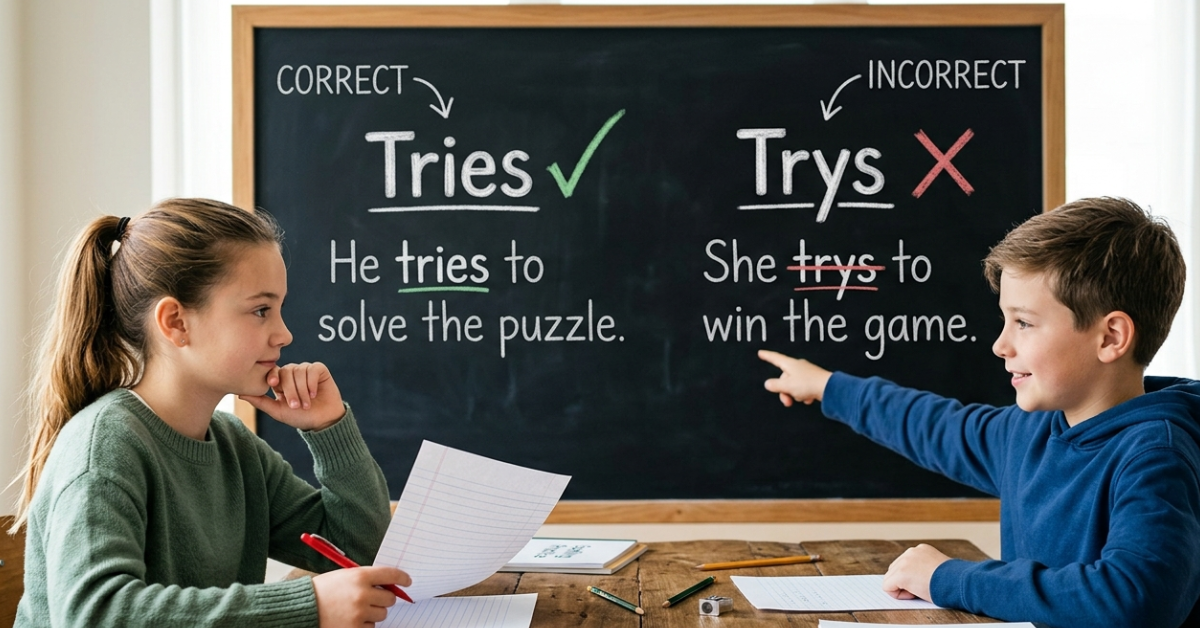
The correct spelling is tries.
“Trys” is not considered correct in standard English grammar.
The verb try changes to tries when used with singular subjects like:
- he
- she
- it
Correct Examples
- She tries her best every day.
- He tries to stay positive.
- The machine tries to restart automatically.
Incorrect Examples
- She trys her best.
- He trys to help.
- The dog trys to escape.
So if you’re wondering, is it tries or trys, the answer is simple: tries is always correct.
Why Does “Try” Become “Tries”?
This follows a common English grammar rule for verbs ending in a consonant + “y.”
When a verb ends with:
- a consonant
- followed by the letter “y”
you usually:
- remove the “y”
- add “ies”
Examples
| Base Verb | Correct Form |
| Try | Tries |
| Cry | Cries |
| Fly | Flies |
| Carry | Carries |
This rule helps pronunciation flow more naturally in English.
What Does “Tries” Mean?
“Tries” is the third-person singular present tense form of the verb “try.”
It means:
- attempting something
- making an effort
- testing or experimenting
Sentence Examples
- She tries new recipes every weekend.
- My brother tries hard in school.
- The company tries to improve customer service.
The word can describe physical effort, emotional effort, or even experiments.
Why Do People Write “Trys”?
The mistake usually happens because English contains many irregular spelling patterns.
People often assume they can simply add “s” to every verb:
- run → runs
- jump → jumps
- walk → walks
So they incorrectly write:
- try → trys
But verbs ending with consonant + y follow a different rule.
This is why “trys” looks logical at first glance, even though it’s grammatically incorrect.
3 Tries or Trys: Which Is Correct?
The correct phrase is 3 tries.
Here, “tries” is used as a noun, meaning attempts.
Correct Usage
- You get 3 tries to unlock the phone.
- The game allows only 3 tries.
- After several tries, she succeeded.
Incorrect Usage
- 3 trys
So when searching for 3 tries or trys, always use tries.
“Tries” as a Verb vs. Noun
Interestingly, “tries” can function as both a verb and a noun.
As a Verb
It shows someone attempting something.
Example:
- She tries to wake up early.
As a Noun
It refers to multiple attempts.
Example:
- After two tries, he passed the test.
The spelling remains the same in both cases.
Easy Trick to Remember the Correct Spelling
A quick memory trick:
If a word ends in consonant + y, change the y to ies.
Examples:
- try → tries
- cry → cries
- spy → spies
This simple rule works in most common English verbs.
Common Grammar Mistakes Similar to “Trys”
Many learners make similar spelling mistakes with other words.
Incorrect vs Correct
| Incorrect | Correct |
| Flys | Flies |
| Crys | Cries |
| Carrys | Carries |
| Worrys | Worries |
Recognizing the pattern makes English grammar much easier.
How “Tries” Is Used in Everyday English
You’ll hear and read this word often in daily conversation.
Examples in Real Life
- A student tries to improve grades.
- A child tries to ride a bicycle.
- Someone tries a new restaurant.
- A team tries to win a match.
Because “try” is such a common verb, learning its correct spelling is important for both writing and speaking.
Tips to Avoid Spelling Mistakes
Here are a few practical ways to remember the correct form:
1. Learn Common Verb Rules
Focus on verbs ending in:
- y
- ch
- sh
- x
- s
2. Read More English Content
Books, articles, and subtitles help reinforce spelling patterns naturally.
3. Use Sentences for Practice
Write your own examples:
- She tries every morning.
- He tries to stay calm.
4. Pay Attention to Autocorrect
If your device marks “trys” as incorrect, trust it.
FAQs
Is “trys” ever correct?
No. “Trys” is not accepted in standard English spelling.
Why is it “tries” instead of “trys”?
Because verbs ending in consonant + y change the “y” to “ies” in third-person singular form.
Is “tries” a verb or noun?
It can be both:
- Verb: “She tries hard.”
- Noun: “He had three tries.”
How do you spell multiple attempts?
The correct spelling is “tries.”
Example:
- I needed several tries before succeeding.
What is the rule for words ending in y?
If a word ends in consonant + y:
- remove “y”
- add “ies”
Example:
- try → tries
Conclusion
The confusion between tries or trys is very common, but the correct spelling is always tries. Whether you’re using it as a verb or talking about multiple attempts, “tries” follows a standard English grammar rule for verbs ending in consonant + y.
Remember:
- “tries” = correct
- “trys” = incorrect
Understanding small grammar rules like this can greatly improve your writing confidence and help you communicate more clearly in English. Keep practicing with real examples, and these spelling patterns will soon feel natural.