English has many confusing word pairs, but few trip people up more than their vs there. Add “they’re” into the mix, and it becomes even easier to make mistakes in everyday writing. The good news is that once you understand the meaning and purpose of each word, using them correctly becomes simple.
In this guide, you’ll learn the difference between these commonly confused words, how to remember them, and when to use each one correctly. Whether you’re writing emails, essays, captions, or professional content, mastering these words can instantly improve your grammar and confidence.
Why People Confuse These Words
The confusion happens because these words sound almost identical when spoken. They are known as homophones, which are words that sound alike but have different meanings and spellings.
Here’s the quick breakdown:
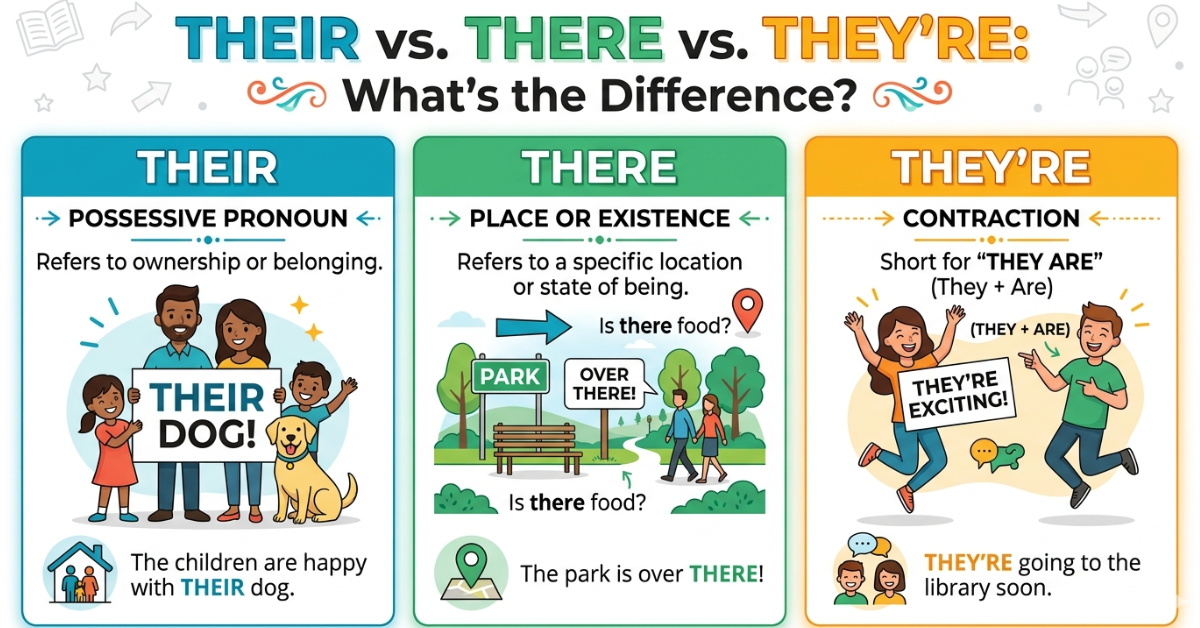
- Their = shows ownership
- There = refers to a place or position
- They’re = short form of “they are”
Although the meanings are different, many writers accidentally swap them while typing quickly.
Their vs There Meaning
Understanding the basic meaning behind each word is the easiest way to avoid mistakes.
What Does “Their” Mean?
“Their” is a possessive adjective. It shows that something belongs to a group of people or individuals.
Examples of “Their”
- The students forgot their books.
- My neighbors painted their house blue.
- The cats are chasing their toys.
In each sentence, “their” indicates ownership.
Easy Memory Trick for “Their”
Notice that their contains the word “heir,” which relates to ownership or inheritance. That can help you remember that “their” is connected to possession.
What Does “There” Mean?
“There” usually refers to a place, location, or position. It can also introduce a sentence.
Examples of “There”
- The keys are over there.
- We went there last summer.
- There is a problem with the computer.
In these examples, the word either points to a location or introduces information.
Easy Memory Trick for “There”
The word “there” contains “here,” and both relate to places or locations.
What Does “They’re” Mean?
“They’re” is a contraction of they are.
Examples of “They’re”
- They’re going to the mall.
- I think they’re ready.
- They’re watching a movie tonight.
A simple trick is to replace the word with “they are.” If the sentence still makes sense, then “they’re” is correct.
Their vs There vs They’re Explained
Many learners search for their vs there vs they’re because they want a simple way to distinguish all three at once.
Here’s a quick comparison table:
| Word | Meaning | Example |
| Their | Shows ownership | Their car is new. |
| There | Refers to a place | Put it there. |
| They’re | Means “they are” | They’re excited today. |
This quick chart can help you remember the differences while writing.
Common Grammar Mistakes
Even fluent English speakers confuse these words occasionally. Here are some of the most common mistakes people make.
Incorrect Usage Examples
Their going to school. (In correct)
They’re going to school. (Correct)
Put the bags in their. (In correct)
Put the bags in there. (Correct)
There dog is barking loudly. (In correct)
Their dog is barking loudly. (Correct)
Small spelling differences can completely change the meaning of a sentence.
Simple Ways to Remember the Difference
If you struggle with these words, these tricks can help.
1. Use the “They Are” Test
Whenever you see “they’re,” replace it with “they are.”
- They’re happy.
- They are happy.
If it works, you used the correct word.
2. Connect “There” With Location
Remember that “there” refers to a place.
- Over there
- Right there
- Here and there
Thinking about location makes the choice easier.
3. Associate “Their” With Ownership
If something belongs to someone, use “their.”
- Their shoes
- Their ideas
- Their classroom
Why Correct Usage Matters
Using the wrong word can make writing look careless, especially in professional or academic settings. Correct grammar improves:
- Clarity
- Credibility
- Communication
- Writing quality
Whether you’re sending an email, posting online, or writing an assignment, proper usage leaves a stronger impression.
They’re vs Their vs There in Everyday Writing
You’ll encounter these words constantly in daily communication. Here are a few real-world examples:
Social Media
- They’re having fun at the beach.
- Their outfits look amazing.
- We should go there sometime.
School Writing
- Their project received top marks.
- There are many causes of pollution.
- They’re presenting tomorrow.
Workplace Communication
- Their report was approved.
- There will be a meeting at noon.
- They’re reviewing the proposal now.
Quick Practice Sentences
Test yourself with these examples.
- ___ going to arrive soon.
- The kids left ___ backpacks at school.
- Please place the package over ___.
Answers
- They’re
- Their
- There
Practicing regularly helps the differences become automatic.
Frequently Asked Questions
What is the difference between their and there?
“Their” shows ownership, while “there” refers to a place or location.
When should I use they’re?
Use “they’re” when you mean “they are.”
Why are these words confusing?
They sound alike when spoken, making them easy to mix up in writing.
Is it okay to confuse these words in casual writing?
Mistakes happen, but using the correct word improves readability and professionalism.
How can I remember the correct usage?
Use memory tricks:
- “Their” = ownership
- “There” = place
- “They’re” = they are
Conclusion
Understanding their vs there becomes much easier once you learn the role each word plays in a sentence. “Their” shows possession, “there” points to a place, and “they’re” is simply short for “they are.”
These small grammar details may seem minor, but they make a big difference in clear communication. With a little practice and a few memory tricks, you’ll avoid these common mistakes naturally.
If you found this guide helpful, explore more grammar comparisons and writing tips to strengthen your English skills even further.