English can be surprisingly confusing when two spellings look almost identical. One common example is halfday or half day. Many people use both versions online, in emails, and even in workplaces, but only one is generally accepted in standard English.
If you have ever paused before writing it in a message or document, you are not alone. The difference may seem small, yet it matters in professional writing, grammar, and clarity.
This guide explains the correct form, why the confusion happens, and how to use the term naturally in everyday communication.
The Correct Form in Standard English
The preferred and grammatically correct version is half day as two separate words.
Examples:
- I am taking a half day from work tomorrow.
- The school announced a half day schedule.
- Employees can request a half day leave.
The single-word version appears occasionally online or in informal writing, but most dictionaries and style guides do not recognize it as the standard spelling.
Why People Get Confused
English contains many compound words that eventually become one word over time. For example:
- notebook
- bedtime
- football
Because of this pattern, many people assume “halfday” should also be combined into one word. However, language evolves differently for each expression, and this one has largely remained open as two words.
Another reason for confusion is workplace communication. In office chats or quick text messages, people often shorten expressions for convenience, which makes the combined form appear more common than it actually is.
What Does “Half Day” Mean?
The phrase refers to a period that lasts for only half of the usual working, school, or business hours.
It is commonly used in:
- Offices
- Schools
- Events
- Employee schedules
- Leave requests
For example, if a normal workday is eight hours, a half day usually means working four hours.
Common Situations Where the Phrase Is Used
Workplace Communication
Employees often use the term when requesting leave or flexible hours.
Examples:
- I need a half day on Friday for a medical appointment.
- She worked a half day before traveling.
School Schedules
Schools may shorten the academic schedule for meetings, weather conditions, or special events.
Examples:
- Students were dismissed after a half day.
- The school calendar includes several half day sessions.
Business Operations
Some businesses operate for reduced hours during holidays or special occasions.
Examples:
- The office will remain open for a half day before Eid.
- Banks may follow a half day schedule during national events.
Is “Halfday” Ever Acceptable?
You may occasionally see the combined spelling in:
- Informal social media posts
- Internal office chats
- Brand names or software systems
- Casual text messages
Even though people use it informally, it is still safer to choose the two-word version in professional or academic writing.
Using the standard form helps your writing appear polished and grammatically correct.
Grammar Rule Behind the Phrase
The term works as a noun phrase or adjective phrase depending on the sentence.
As a Noun Phrase
Example:
- Today was a half day at school.
As an Adjective Phrase
Example:
- We attended a half day workshop.
In both cases, the words remain separated.
Similar Compound Word Examples
English has many expressions that follow a similar pattern.
Open Compounds (Two Words)
- high school
- full time
- real estate
Closed Compounds (One Word)
- notebook
- keyboard
- toothpaste
“Half day” currently belongs to the open compound category.
Easy Trick to Remember the Correct Form
A simple way to remember it is this:
If the phrase describes part of a day, keep the words separate.
Think of it like:
- half hour
- half meal
- half shift
We naturally separate those expressions, so the same logic applies here.
Common Mistakes to Avoid
Here are a few mistakes people often make:
Using the Combined Version in Professional Writing
Incorrect:
- Please approve my halfday leave.
Correct:
- Please approve my half day leave.
Overusing Hyphens
Some writers use “half-day.” This version can be acceptable when directly modifying a noun.
Example:
- We attended a half-day seminar.
However, when used normally, the open form is still more common.
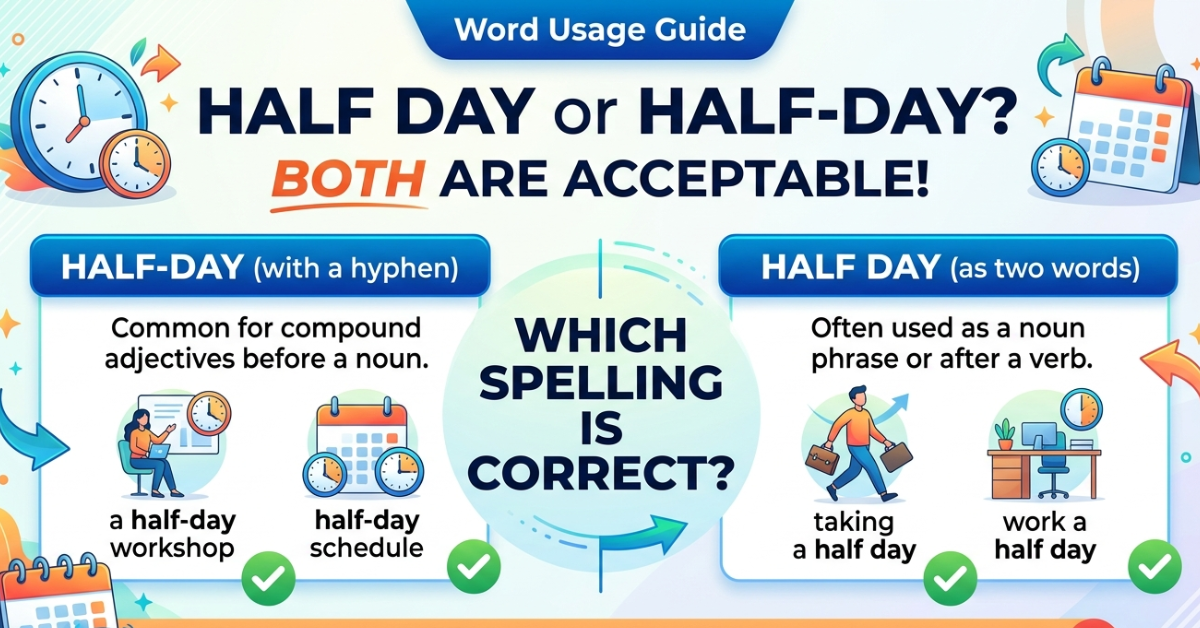
Half Day vs Half-Day
This is another area where writers get confused.
Half Day
Used as a noun phrase.
Example:
- I took a half day from work.
Half-Day
Used as a compound adjective before a noun.
Example:
- It was a half-day event.
Both can be correct depending on sentence structure.
Why Correct Spelling Matters
Using the proper form improves:
- Professional communication
- Academic writing
- SEO content quality
- Readability
- Grammar accuracy
Small grammar details often shape how polished and trustworthy your writing appears.
FAQs
Is “halfday” a real word?
It may appear informally online, but it is not widely accepted in standard English dictionaries.
Which spelling is grammatically correct?
“Half day” is the standard and preferred form.
Can I use “half-day” with a hyphen?
Yes. The hyphenated version works when the phrase acts as an adjective before a noun.
Is the phrase commonly used in offices?
Yes. It is frequently used for leave requests, schedules, and reduced working hours.
Should I avoid the single-word version in formal writing?
Yes. The separated form is safer and more professional.
Conclusion
Understanding the difference between halfday or half day is simpler once you know the grammar rule. In most situations, “half day” is the correct and professional choice, while “half-day” works as an adjective before a noun. The combined version is mostly informal and best avoided in formal writing.
Using the right spelling improves clarity and helps your communication look more polished. Whether you are writing an email, preparing office documents, or creating content online, choosing the standard form makes a better impression.