English is full of words that change spelling depending on where you are in the world. One common example is endeavors or endeavours. At first glance, they may look like completely different words, but they actually share the same meaning.
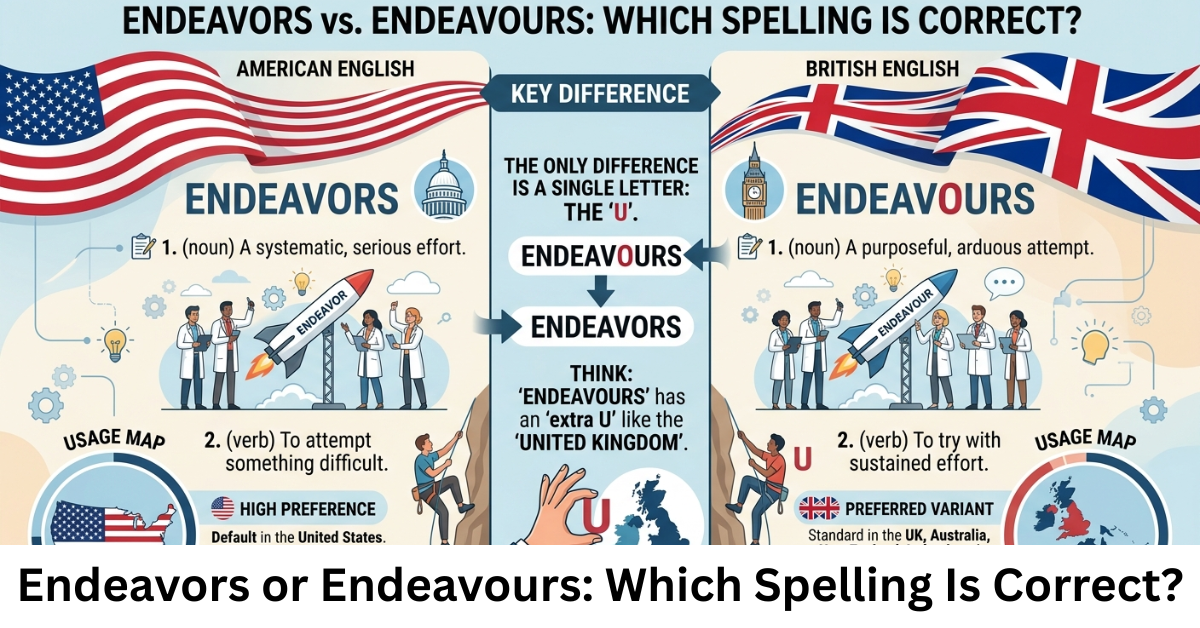
The only real difference comes down to regional spelling preferences. One version is mostly used in American English, while the other appears in British English and countries influenced by it. Understanding when to use each form can make your writing look more polished and professional.
In this guide, you’ll learn the meaning of the word, the spelling differences, examples in sentences, grammar tips, and how to choose the right version for your audience.
What Does the Word Mean?
The word refers to serious attempts or efforts made to achieve something. It can be used as both a noun and a verb.
As a Noun
It describes an effort, project, or attempt.
Examples:
- Her artistic efforts gained international attention.
- Scientific projects often require years of research.
As a Verb
It means to try hard to accomplish something.
Examples:
- The company tried to improve customer satisfaction.
- Students worked hard to complete the competition.
The term often appears in formal writing, education, business communication, and motivational content.
Endeavors vs. Endeavours: The Main Difference
The distinction is based entirely on regional spelling conventions.
| Version | English Style | Common Regions |
| Endeavors | American English | United States |
| Endeavours | British English | UK, Canada, Australia, Pakistan |
Both spellings are grammatically correct. The choice depends on which English style you are following.
Why Do Some Words Have Different Spellings?
English spelling evolved differently in various parts of the world.
American English simplified many words over time by removing extra letters. British English kept older traditional spellings. This is why you also see differences like:
- Color vs Colour
- Honor vs Honour
- Favorite vs Favourite
The same pattern explains the spelling variation in this word.
Which Version Should You Use?
The correct choice depends on your audience and writing style.
Use American English If:
- You are writing for U.S. readers
- Your company follows American style guides
- Your website targets an American audience
Use British English If:
- You write for international or Commonwealth readers
- Your school or university uses British spelling
- Your content follows UK grammar standards
The most important thing is consistency. Avoid switching between styles in the same article or document.
Examples in Everyday Writing
Here are a few examples showing how the word appears naturally in sentences.
American Style
- The entrepreneur expanded her business through creative endeavors.
- Their environmental endeavors inspired many young volunteers.
British Style
- The organisation supported several educational endeavours.
- His charitable endeavours earned public respect.
Notice that the meaning remains exactly the same.
Common Contexts Where the Word Appears
This term is widely used in professional and academic communication.
Business
Companies often describe new projects or goals using this word.
Example:
“Our future efforts will focus on sustainability.”
Education
Schools and universities may use it when discussing research or student activities.
Personal Growth
Motivational writing frequently uses the term to describe ambitions and achievements.
Creative Industries
Artists, writers, and designers often refer to their creative projects using this expression.
Is One Version More Formal Than the Other?
No. Both forms are equally formal and accepted in professional writing.
However, British spellings sometimes appear slightly more traditional because they retain older forms. American spellings are often viewed as more streamlined and modern.
Still, neither version is considered incorrect.
Tips to Avoid Spelling Confusion
If you often mix British and American English, these quick tips can help:
1. Know Your Audience
Think about who will read your content before choosing a spelling style.
2. Use Grammar Tools
Spell-checkers can automatically detect inconsistencies.
3. Stay Consistent
Do not alternate between English styles within the same piece.
4. Follow a Style Guide
Academic institutions and companies usually prefer a specific language style.
Related Words With Similar Variations
Many English words follow the same spelling pattern.
| American English | British English |
| Labor | Labour |
| Behavior | Behaviour |
| Neighbor | Neighbour |
| Humor | Humour |
Recognizing these patterns makes it easier to identify spelling differences in global English.
Why Correct Spelling Matters in SEO and Writing
Using the correct regional spelling improves readability and credibility.
Search engines also consider audience relevance. For example:
- American readers are more likely to search using American spelling.
- British and Commonwealth audiences may prefer traditional spellings.
Writers targeting global audiences sometimes include both versions naturally to improve search visibility without overstuffing keywords.
Frequently Asked Questions
Is “endeavors” correct?
Yes. It is the standard American English spelling.
Is “endeavours” also correct?
Yes. It is the British English version and is widely accepted internationally.
Do both words mean the same thing?
Absolutely. They carry identical meanings and differ only in spelling style.
Which spelling is used in Pakistan?
British English spelling is more commonly taught and used in Pakistan.
Can I use both spellings in one article?
It is better not to. Consistency improves professionalism and readability.
Is the word formal or informal?
It is generally considered formal or semi-formal and often appears in professional or academic writing.
Conclusion
Understanding the difference between endeavors or endeavours is actually quite simple once you know the rule behind it. Both spellings are correct, both share the same meaning, and both are widely accepted in English writing.
The deciding factor is your audience. American English prefers the shorter spelling, while British English keeps the traditional form with the extra “u.” No matter which version you choose, consistency is what truly matters.
If you regularly write blogs, academic content, or professional documents, learning these regional spelling differences can make your writing clearer, stronger, and more credible.