English is full of words that look similar but carry different meanings, and “born” and “borne” are a perfect example. Many writers confuse these two forms because both come from the verb “bear.” However, they are used in completely different situations. Understanding born vs borne can instantly improve your grammar, writing clarity, and confidence.
While “born” is mostly connected to birth, “borne” relates to carrying, supporting, or enduring something. Then there’s another similar-looking word, “bourne,” which adds even more confusion. In this guide, you’ll learn the differences, grammar rules, examples, and common mistakes related to born vs borne vs bourne in a simple and practical way.
Understanding the Verb “Bear”
Before comparing the words directly, it helps to understand their root verb.
The verb bear has several meanings, including:
- To carry something
- To support or endure
- To produce or give birth
- To tolerate something difficult
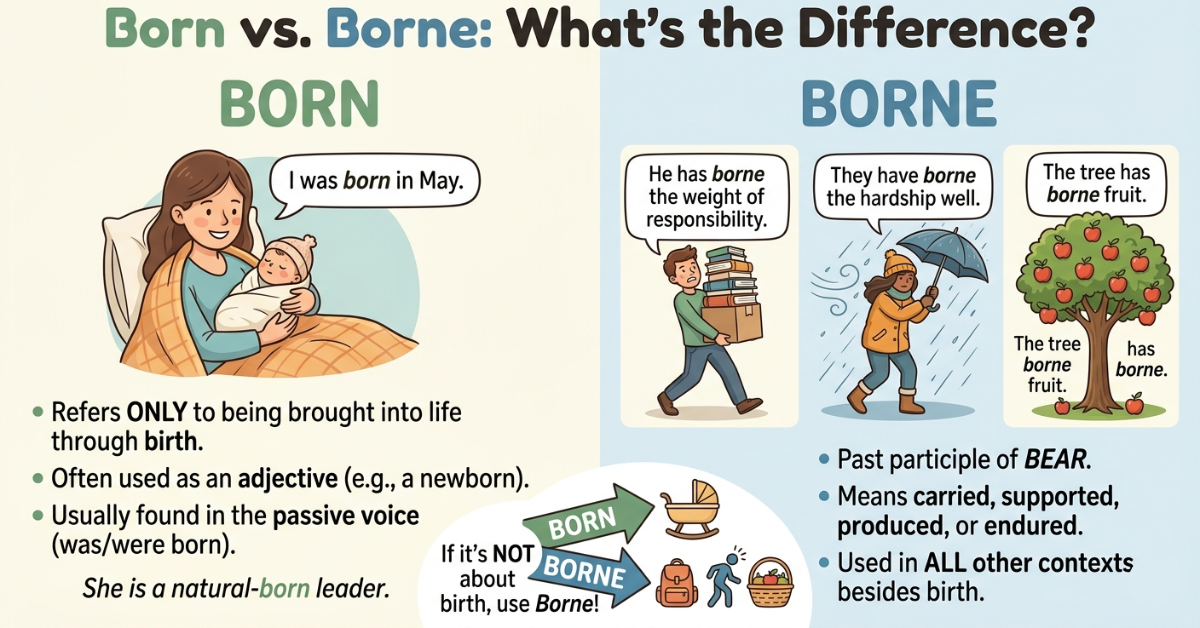
Both “born” and “borne” are past participle forms of “bear,” but their usage depends on the meaning of the sentence.
Born vs Borne: The Main Difference
What Does “Born” Mean?
“Born” is used specifically in relation to birth. It refers to coming into life or existing naturally with a particular quality or talent.
Examples:
- She was born in Karachi.
- He was born on a rainy morning.
- Some people are born leaders.
In modern English, “born” is almost always connected to childbirth or natural ability.
What Does “Borne” Mean?
“Borne” is used for every other meaning of “bear” except birth. It usually refers to carrying, enduring, tolerating, or supporting something.
Examples:
- The workers have borne many hardships.
- The bridge has borne heavy traffic for years.
- She has borne the responsibility alone.
Here, the meaning has nothing to do with childbirth. Instead, it involves carrying a burden, responsibility, or weight.
Quick Comparison Table
| Word | Meaning | Common Usage |
| Born | Related to birth | Born in 2000 |
| Borne | Carried or endured | Borne the pressure |
| Bourne | A boundary or destination | Rare literary usage |
Born vs Borne in Grammar
When to Use “Born”
Use “born” when:
- Talking about birth
- Referring to natural talent
- Describing origin
Sentence Examples
- She was born in Pakistan.
- He was born with musical talent.
- The idea was born from creativity.
When to Use “Borne”
Use “borne” when:
- Talking about carrying weight
- Describing endurance
- Referring to responsibility or stress
Sentence Examples
- They have borne the costs themselves.
- The company has borne major losses.
- She bore the pain quietly.
Born vs Borne in a Sentence
Seeing both words in context makes the distinction much easier.
Correct Usage Examples
- The child was born yesterday.
- The camel has borne heavy loads across the desert.
- She was born into a creative family.
- He has borne criticism with patience.
Incorrect Usage Examples
- She was borne in 1998.
- The truck has born heavy materials.
The correct forms would be:
- She was born in 1998.
- The truck has borne heavy materials.
What About “Bourne”?
Many people searching for born vs borne vs bourne are surprised to discover that “bourne” is an entirely different word.
Meaning of “Bourne”
“Bourne” is an old English noun meaning:
- A boundary
- A destination
- A small stream
It is mostly used in literature or names.
Examples
- They crossed the bourne between kingdoms.
- The river served as a natural bourne.
Most modern writing rarely uses this word unless discussing literature or place names.
Common Mistakes People Make
Mixing Up Birth and Burden
The biggest mistake is using “borne” when referring to birth.
Wrong:
- He was borne in London.
Correct:
- He was born in London.
Using “Born” for Carrying
Another common error happens when talking about responsibility or endurance.
Wrong:
- She has born the pressure well.
Correct:
- She has borne the pressure well.
Easy Trick to Remember the Difference
A simple memory trick can help:
- Born = Birth
- Borne = Burden
If the sentence relates to coming into life, use “born.”
If it involves carrying or enduring something, use “borne.”
Why These Words Matter in Writing
Using the correct form improves:
- Grammar accuracy
- Professional writing
- Academic work
- SEO content quality
- Reader trust
Even small grammar mistakes can distract readers or weaken the credibility of your writing. Learning distinctions like these helps your communication sound more polished and natural.
Historical Background of the Words
Both words originated from Old English forms of the verb “bear.” Over time, English separated the meanings into different past participles for clarity.
- “Born” became linked almost entirely with childbirth.
- “Borne” remained connected to carrying and enduring.
This distinction has been part of standard English grammar for centuries.
Frequently Confused Expressions
“Airborne”
This word comes from “borne,” meaning carried through the air.
Example:
- Airborne particles spread quickly.
“Waterborne”
Also connected to “borne,” meaning transported by water.
Example:
- Waterborne diseases can spread rapidly.
“Home-born”
This uses “born” because it refers to origin or birth.
Example:
- The village is famous for its home-born traditions.
FAQs
Is “borne” ever used for childbirth?
Usually no. Modern English uses “born” for childbirth. “Borne” may appear in very old or poetic writing, but it is uncommon today.
What is the difference between born and borne?
“Born” relates to birth or natural qualities, while “borne” means carried, endured, or supported.
Is “bourne” the same as “borne”?
No. “Bourne” is a separate noun meaning a boundary or destination, while “borne” is the past participle of “bear.”
Which is correct: “born by” or “borne by”?
It depends on meaning:
- “Born by” usually refers to birth.
- “Borne by” refers to something carried or supported.
Example:
- The costs were borne by the company.
Can someone be “born talented”?
Yes. “Born talented” means naturally gifted from birth.
Conclusion
Understanding born vs borne becomes much easier once you connect each word to its meaning. “Born” is all about birth, origin, and natural ability, while “borne” refers to carrying, enduring, or supporting something. Meanwhile, “bourne” is a separate literary word that rarely appears in everyday writing.
Mastering these distinctions can improve your grammar, sharpen your communication skills, and make your writing sound more professional. If you often confuse similar English words, exploring grammar comparisons like this can help you write with greater confidence and accuracy.