Have you ever written a sentence and paused because you weren’t sure whether to use pair, pear, or pare? You’re not alone. These three words sound exactly alike, making them classic examples of English homophones—words that share the same pronunciation but have different meanings and spellings.
Understanding Pair vs Pear vs Pare is important for clear communication, whether you’re writing an email, completing school assignments, or creating professional content. While they may sound identical, each word serves a completely different purpose. This guide explains their meanings, usage, examples, and simple memory tricks to help you choose the correct word every time.
What Are Pair, Pear, and Pare?
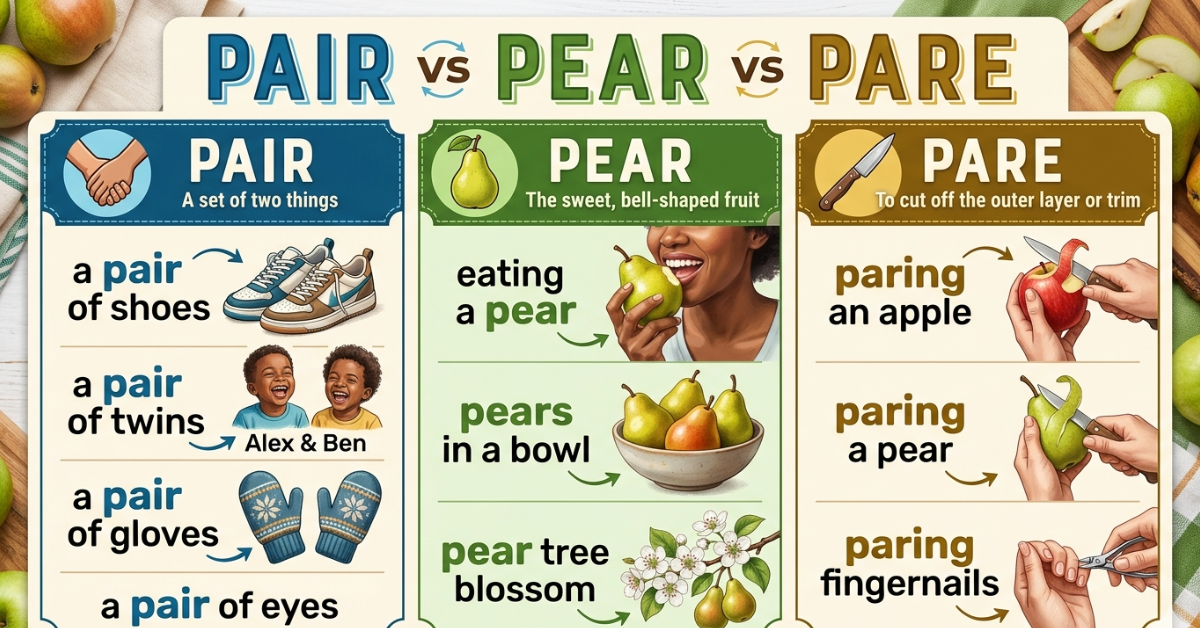
The words pair, pear, and pare are homophones. When spoken aloud, they sound the same, but their definitions and uses are unrelated.
Here’s a quick overview:
| Word | Meaning | Part of Speech |
| Pair | Two matching or connected things | Noun/Verb |
| Pear | A sweet fruit | Noun |
| Pare | To cut away or trim something | Verb |
Let’s examine each word in more detail.
What Does Pair Mean?
The word pair refers to two things that belong together, match each other, or function as a set. It can also mean bringing two things or people together.
Pair as a Noun
When used as a noun, it describes a set of two.
Examples:
- I bought a new pair of shoes.
- The birds stayed together as a pair.
- She wore a pair of earrings to the event.
- We found a matching pair of gloves.
Pair as a Verb
As a verb, it means to join or match items together.
Examples:
- The teacher paired students for the project.
- This wine pairs well with seafood.
- We need to pair the devices before using them.
Common Expressions with Pair
- Pair of socks
- Pair of glasses
- Pair of scissors
- Pair up
- Perfect pair
What Does Pear Mean?
A pear is a fruit with a rounded base and a narrower top. It is typically sweet, juicy, and rich in nutrients.
Examples of Pear in Sentences
- I packed a pear for lunch.
- The pear tree produced fruit this year.
- She sliced a ripe pear into her salad.
- Pears are often used in desserts and jams.
Characteristics of a Pear
A pear is generally:
- Sweet and juicy
- Bell-shaped
- High in fiber
- Rich in vitamins and antioxidants
- Available in several varieties
Popular varieties include:
- Bartlett pear
- Anjou pear
- Bosc pear
- Comice pear
Because pear only refers to the fruit, its meaning is usually easy to identify from context.
What Does Pare Mean?
The verb pare means to cut away the outer layer of something or reduce it gradually.
It is commonly used when talking about peeling fruits and vegetables, trimming materials, or decreasing something over time.
Examples of Pare in Sentences
- Please pare the apples before baking the pie.
- The chef pared the potatoes carefully.
- The company plans to pare expenses this year.
- She pared the wood to create a smoother surface.
Common Uses of Pare
The word often appears in situations involving:
- Peeling fruits
- Trimming vegetables
- Cutting excess material
- Reducing costs or budgets
- Simplifying plans
Common Phrases
- Pare down expenses
- Pare back spending
- Pare away excess material
- Pare the skin from fruit
Key Differences Between the Three Words
Although these words sound identical, their meanings are completely different.
Meaning Comparison
| Word | Meaning |
| Pair | Two matching items or people |
| Pear | A type of fruit |
| Pare | To trim, peel, or reduce |
Usage Comparison
| Sentence | Correct Word |
| I need a new ___ of shoes. | Pair |
| She ate a juicy ___. | Pear |
| Please ___ the potatoes first. | Pare |
| They make a wonderful ___. | Pair |
| The recipe requires one ripe ___. | Pear |
| We must ___ unnecessary expenses. | Pare |
Easy Memory Tricks
Remembering the difference Pair vs Pear vs Pare becomes easier when you connect each spelling with a visual clue.
Pair = Two
The letters “ai” can remind you of two things working together, like partners.
Example: A pair of shoes.
Pear = Fruit
The word contains “ea”, similar to words associated with food such as eat.
Example: Eat a pear.
Pare = Remove
The word starts with “par”, which can remind you of reducing or cutting something down.
Example: Pare away excess material.
Common Mistakes and How to Avoid Them
Because the pronunciation is identical, many writers accidentally substitute one spelling for another.
Incorrect Examples
I bought a pear of socks.
Please pair the potatoes before cooking.
She ate a delicious pare.
Correct Examples
I bought a pair of socks.
Please pare the potatoes before cooking.
She ate a delicious pear.
A quick review of the sentence’s meaning usually reveals the correct choice.
Why These Homophones Cause Confusion
English contains many homophones that can confuse both native and non-native speakers. Since pronunciation offers no clue, writers must rely on spelling and context.
Other similar examples include:
- There, their, and they’re
- To, too, and two
- Brake and break
- Flower and flour
- Principal and principle
Learning homophones improves writing accuracy and helps prevent misunderstandings.
Examples in Everyday Writing
Here are practical examples showing all three words used correctly.
Pair
- I found a matching pair of boots.
- The app can pair with multiple devices.
- They became a successful pair of business partners.
Pear
- A fresh pear makes a healthy snack.
- The orchard grows several types of pears.
- She blended pear and banana into a smoothie.
Pare
- Pare the cucumber before slicing it.
- The manager decided to pare operational costs.
- He pared away the rough edges of the sculpture.
How to Choose the Right Word Quickly
When proofreading, ask yourself one simple question:
Is the sentence about:
- Two matching things? → Use pair
- A fruit? → Use pear
- Cutting, peeling, or reducing? → Use pare
This quick check eliminates most spelling errors instantly.
FAQs
What is the difference between pair, pear, and pare?
Pair means two matching things, pear is a fruit, and pare means to trim, peel, or reduce something.
Are pair, pear, and pare pronounced the same?
Yes. They are homophones and are typically pronounced the same in standard English.
Is “pair of shoes” correct?
Yes. Since shoes come as two matching items, “pair of shoes” is the correct expression.
What does pare down mean?
“Pare down” means to reduce something gradually, such as costs, expenses, or unnecessary details.
Can pare be used for food preparation?
Yes. It often refers to peeling or trimming fruits and vegetables before cooking.
Is pear only a noun?
Yes. In modern English, pear is used as a noun referring to the fruit or the tree that produces it.
Why do people confuse these words?
They sound identical when spoken, so many writers accidentally choose the wrong spelling without checking the meaning.
Conclusion
Understanding Pair vs Pear vs Pare is easier once you focus on the meaning behind each word. Pair refers to two matching items, pear is the popular fruit, and pare means to trim, peel, or reduce. Although these homophones sound exactly alike, context makes the correct choice clear.
The next time you encounter one of these words, think about whether you’re describing two things, a fruit, or an act of cutting something away. A simple meaning check will help you write with greater confidence and accuracy.