English contains many words that sound identical but carry completely different meanings. One of the most commonly confused pairs is Mail vs Male. Although these words share the same pronunciation, they represent entirely different concepts. As a result, writers often make spelling mistakes that can change the meaning of a sentence.
Whether you are writing an email, filling out a form, or improving your English skills, understanding the distinction is important. In this guide, you’ll learn the meaning of each word, discover practical examples, and pick up simple memory tricks that make correct usage much easier.
What Does “Mail” Mean?
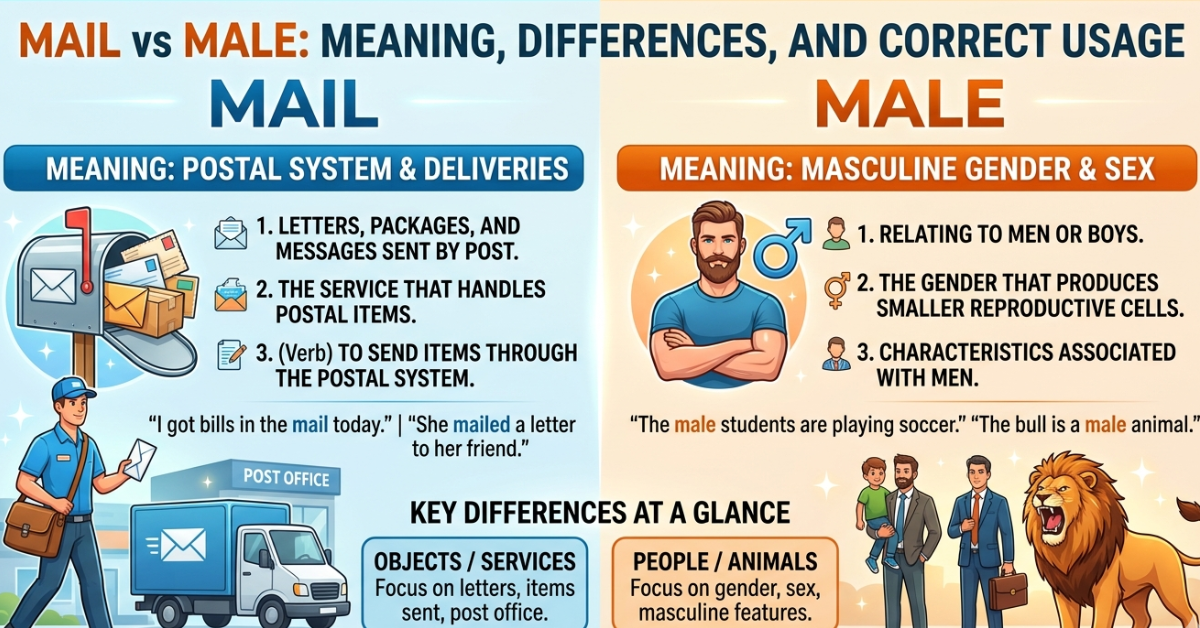
The word mail refers to letters, packages, postcards, and other items delivered through a postal service. Today, the term is also commonly associated with electronic communication, particularly email.
For example, someone might receive a birthday card in the mail or send important documents through email. In both situations, the word relates to communication or delivery.
Common Uses of Mail
- Sending letters and postcards
- Receiving packages and parcels
- Referring to email messages
- Describing postal services and deliveries
Examples of Mail in Sentences
- I checked my mail before leaving the house.
- Yesterday, a package arrived in the mail.
- Please send the completed form by email.
- Our office receives business mail every morning.
What Does “Male” Mean?
Unlike mail, male refers to gender or biological sex. Specifically, it describes a person, animal, or plant associated with producing sperm or carrying masculine reproductive characteristics.
In everyday conversation, the word often appears in educational, medical, scientific, and administrative contexts. Furthermore, it is commonly used on forms that ask for gender information.
Common Uses of Male
- Referring to a man or boy
- Identifying the sex of animals
- Describing biological characteristics
- Categorizing demographic information
Examples of Male in Sentences
- The male lion guarded the pride.
- A male student won the scholarship.
- Doctors recorded the newborn as male.
- Scientists studied the behavior of male birds during mating season.
Mail vs Male: Key Differences Explained
At first glance, these words may seem interchangeable because they sound exactly alike. However, their meanings are completely unrelated.
| Word | Meaning | Part of Speech | Example |
| Letters, packages, or electronic messages | Noun/Verb | The mail arrived this morning. | |
| Male | A person or organism of the masculine sex | Noun/Adjective | The male deer stood near the river. |
Therefore, the easiest way to distinguish them is by considering the context. If the sentence involves communication, delivery, or correspondence, use mail. Conversely, if the sentence refers to gender or biological sex, choose male.
Why Do People Confuse These Words?
Many English learners struggle with these terms because they are homophones. In other words, they sound identical when spoken but have different spellings and meanings.
For instance, someone hearing the sentence aloud may not immediately know which spelling is intended. When reading written text, however, the spelling provides the necessary context.
Other Common Homophones
- Right and Write
- Sea and See
- Flour and Flower
- Pair and Pear
Because English contains many homophones, paying attention to context becomes especially important.
How to Remember the Difference
Fortunately, remembering the distinction is easier than many people expect.
For Mail
Think about words connected to communication:
- Mailbox
- Delivery
- Post office
Whenever a sentence involves sending or receiving something, mail is usually the correct choice.
For Male
Connect the word to gender-related terms:
- Man
- Masculine
- Male athlete
- Male student
Since both male and man begin with the letter M, many learners find this association helpful.
Common Mistakes and How to Fix Them
Writers occasionally confuse these words, especially when typing quickly. Nevertheless, a quick review can prevent embarrassing errors.
Incorrect
- I received a male from my friend.
- The mail student won the competition.
- Please check your male inbox.
Correct
- I received a mail message from my friend.
- The male student won the competition.
- Please check your email inbox.
As a result, proofreading becomes an effective way to catch these mistakes before publishing or sending a message.
Conclusion
Understanding Mail vs Male is essential for clear and accurate communication. While mail relates to letters, packages, and electronic messages, male refers to a masculine person, animal, or biological sex. Although both words share the same pronunciation, their meanings are entirely different.
By paying attention to context and applying the memory tips discussed above, you can avoid common mistakes with confidence. Ultimately, mastering commonly confused words strengthens both your writing skills and your overall command of English. This way, your communication remains professional, precise, and easy to understand.