English spelling can sometimes feel confusing, especially when similar words sound exactly the same. One common question people ask is whether the correct phrase is flies away or flys away. If you’ve ever paused while writing this phrase, you’re definitely not alone.
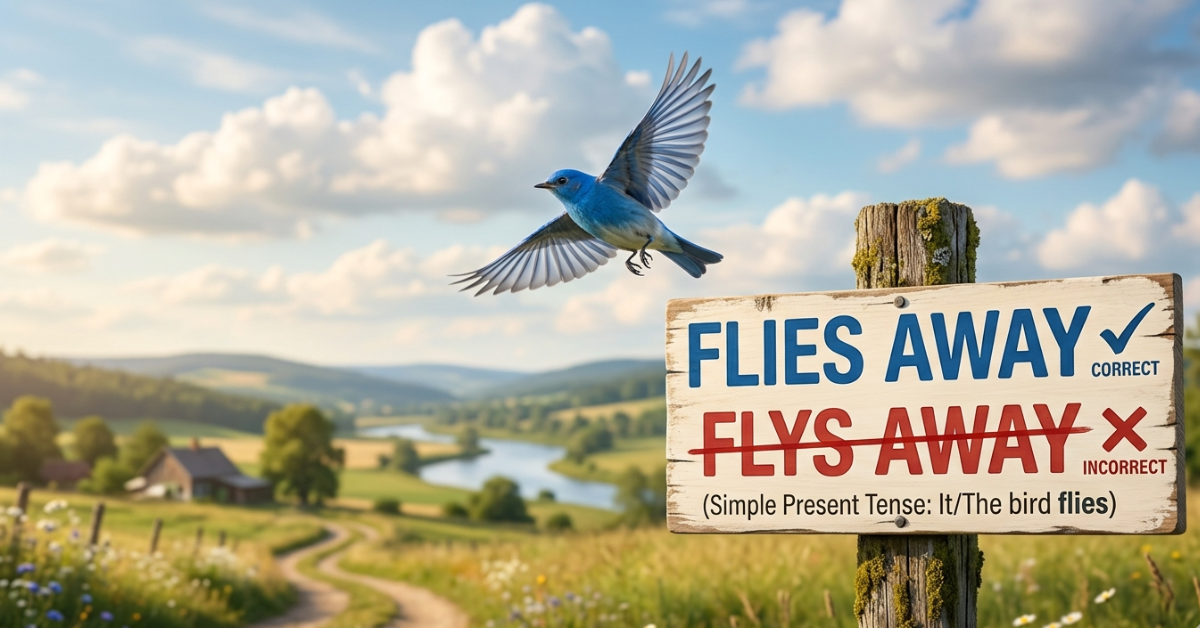
The short answer is simple: “flies away” is correct, while “flys away” is usually considered incorrect in standard English grammar. But why does this happen? And where does the confusion come from?
In this article, you’ll learn the difference between the two forms, the grammar rule behind them, real-life examples, and easy tricks to remember the correct spelling every time.
What Does “Flies Away” Mean?
The phrase “flies away” means that something or someone moves through the air and leaves a place. It is commonly used for:
- Birds
- Insects
- Airplanes
- Balloons
- Imaginary or emotional expressions
Examples:
- The bird flies away when it hears noise.
- Her scarf almost flies away in the wind.
- Time flies away when you’re having fun.
In all these examples, “flies” is the correct verb form of “fly.”
Is “Flys Away” Correct?
In normal English writing, “flys away” is incorrect.
The word “flys” is rarely used and does not function as the standard verb form of “fly.” The confusion happens because many English verbs simply add “s” in the third-person singular form:
- walk → walks
- run → runs
- sing → sings
So people assume:
- fly → flys
But English has a spelling rule that changes this pattern.
Why “Flies” Is the Correct Spelling
When a verb ends with a consonant + “y,” the “y” usually changes to “ies” when forming the third-person singular present tense.
Examples of This Rule
| Base Verb | Correct Form |
| cry | cries |
| try | tries |
| carry | carries |
| fly | flies |
That’s why the correct phrase is:
He flies away. (Correct)
He flys away.(In correct)
Easy Grammar Rule to Remember
Here’s a simple trick:
Change “y” to “ies” if:
- The word ends in a consonant + y.
Since “fly” ends with “l + y,” it becomes:
- fly → flies
This same rule applies to many common English verbs.
Common Sentences Using “Flies Away”
Seeing the phrase in context makes it easier to remember.
Examples
- The butterfly flies away from the flower.
- Dust quickly flies away in strong wind.
- A paper plane flies away across the park.
- The owl silently flies away at night.
- Happiness sometimes feels like it flies away too fast.
These examples show how naturally the phrase fits into everyday English.
Why People Get Confused Between the Two
English pronunciation is one major reason behind the confusion. Both “flies” and “flys” sound almost identical when spoken quickly.
Another reason is autocorrect or informal typing habits online. Many people type words the way they sound rather than following grammar rules.
Common Causes of Mistakes
- Sound-based spelling
- Lack of grammar knowledge
- Fast texting habits
- Confusion with plural nouns
- Influence of informal internet language
Even fluent English speakers occasionally make this mistake.
Difference Between “Flies” as a Verb and Noun
Interestingly, “flies” can also be a plural noun.
As a Verb
- She flies away every summer.
As a Noun
- Flies are annoying insects.
The meaning changes depending on the sentence structure, but the spelling remains correct in both cases.
Are There Any Situations Where “Flys” Is Used?
Technically, “flys” does exist in very limited contexts, but not as the standard verb form.
For example:
- It may appear in proper names or specialized terms.
- Some older or nonstandard spellings may use it.
However, in modern everyday English, especially in writing and grammar, “flies away” is the accepted and correct phrase.
Tips to Avoid This Mistake
Here are a few quick ways to remember the correct form:
Remember These Points
- “Fly” changes to “flies” because of the consonant + y rule.
- If you can replace it with “tries” or “cries,” the pattern becomes easier.
- Read your sentence aloud slowly.
- Use grammar-checking tools when writing professionally.
Quick Memory Trick
Think of this sentence:
“A bird flies, it never flys.”
Simple and easy to remember.
Similar Grammar Examples
Learning related patterns can strengthen your grammar skills.
| Incorrect | Correct |
| crys | cries |
| trys | tries |
| carrys | carries |
| flys | flies |
Once you understand the rule, many English spellings become much easier.
Flies Away in Figurative Language
The phrase is also commonly used metaphorically.
Examples
- Childhood flies away quickly.
- Opportunities can fly away if ignored.
- Time flies away before we realize it.
Writers often use this phrase to describe something disappearing fast or passing quickly.
FAQs
Is “flies away” grammatically correct?
Yes, “flies away” is grammatically correct and follows standard English spelling rules.
Why is “flys away” incorrect?
Because verbs ending in consonant + y change the “y” to “ies” in third-person singular form.
What is the rule for fly becoming flies?
The grammar rule says to replace “y” with “ies” when the word ends in a consonant followed by “y.”
Can “flys” ever be used?
It is very uncommon and mostly appears in special names or nonstandard usage, not in regular grammar.
How do I remember the correct spelling?
Compare it with similar words like “tries” and “cries.” The same rule applies.
Conclusion
When choosing between flies away or flys away, the correct phrase is clearly flies away. The spelling follows a common English grammar rule where verbs ending in consonant + y change to “ies” in the third-person singular form.
Although “flys away” may appear online or in casual writing, it is not considered correct in standard English. Understanding this small grammar rule can improve your writing accuracy and help you avoid common spelling mistakes.
If you enjoy learning tricky English word differences, keep exploring similar grammar guides to strengthen your vocabulary and writing skills naturally.