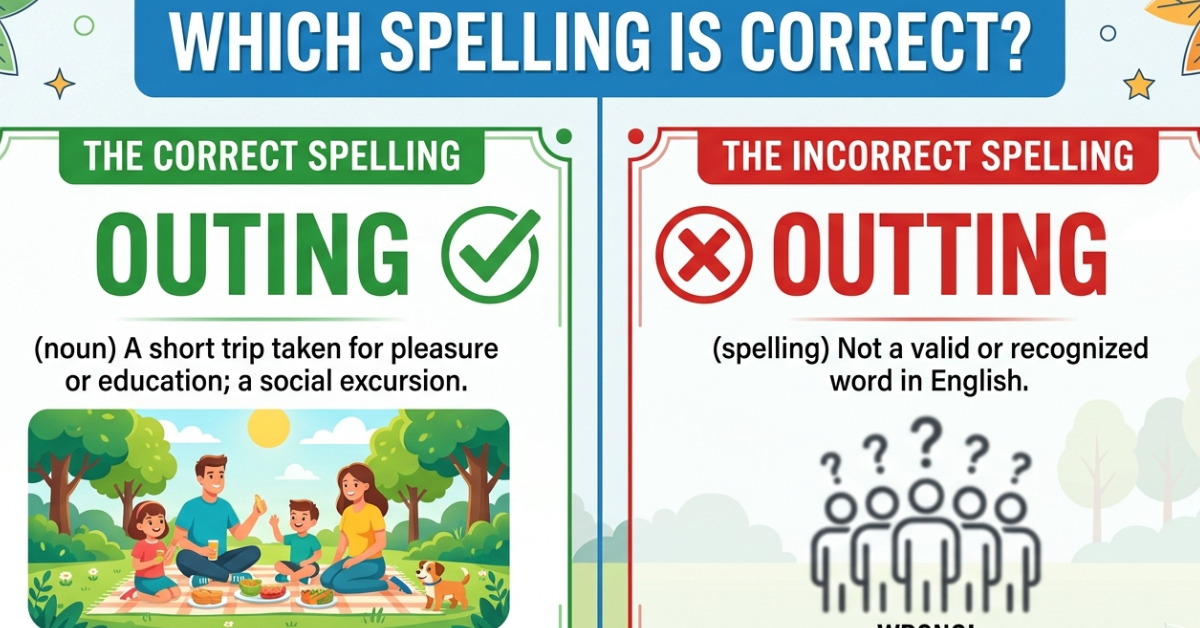
English spelling mistakes are more common than people think, especially when two words sound almost identical. One confusion many writers face is whether the correct word is “outing” or “outting.” If you’ve ever paused while typing it, you’re definitely not alone.
The good news is that the answer is simpler than it seems. In most cases, “outing” is the correct spelling, while “outting” is usually considered incorrect or only used in very specific contexts. Understanding the difference can help you write more confidently in emails, essays, captions, and everyday conversations.
In this guide, you’ll learn the correct spelling, meanings, grammar rules, examples, and common mistakes people make with these words.
What Does “Outing” Mean?
The word outing is a noun commonly used to describe a short trip, excursion, or social activity outside the home.
Common Meaning of Outing
An outing usually refers to:
- A fun trip with friends or family
- A school or office excursion
- A casual day outdoors
- A social gathering or activity
Examples of “Outing” in Sentences
- We planned a family outing for the weekend.
- The school outing was both educational and fun.
- They enjoyed a beach outing during summer vacation.
- Our office outing helped everyone relax and bond.
In all these examples, “outing” refers to an enjoyable trip or activity.
Is “Outting” a Real Word?
Technically, “outting” exists in some contexts, but it is extremely uncommon and often considered incorrect in standard writing.
The term may appear as a form of the verb “out,” especially when referring to exposing someone’s private identity or information publicly. However, even in that usage, many dictionaries and style guides prefer the spelling and form “outing” instead.
Why People Write “Outting”
Most people accidentally write “outting” because they assume the final consonant should double before adding “-ing.” English spelling rules can sometimes make that seem logical.
For example:
- Run → Running
- Sit → Sitting
But “out” does not follow that same pattern because it already ends with two vowel sounds and does not require doubling the “t.”
The Correct Spelling: Outing
If you are referring to:
- A trip
- A social event
- A recreational activity
- A casual excursion
then outing is the correct word.
Quick Grammar Tip
When adding “-ing” to “out,” you usually do not double the consonant.
Correct:
- outing
Incorrect:
- outting
Why the Confusion Happens
English spelling rules are not always predictable, which is why words like this create confusion.
Here are a few reasons people mix them up:
1. Double Consonant Rules
Some verbs double the final consonant before adding “-ing,” but not all do.
2. Pronunciation Similarity
Both spellings sound almost the same when spoken aloud.
3. Typing Habits
Autocorrect errors and fast typing often lead to extra letters being added unintentionally.
Outing in Different Contexts
The word is versatile and appears in many situations.
Family and Friends
- We went on a picnic outing last Sunday.
School Activities
- Students were excited about the science museum outing.
Corporate Events
- The annual company outing improved team morale.
Travel and Recreation
- Hiking outings are popular during spring.
Common Mistakes to Avoid
Here are a few mistakes writers often make:
Incorrect Usage
- We had a fun outting yesterday.
Correct Usage
- We had a fun outing yesterday.
Another mistake is assuming every short word doubles the consonant before “-ing.” English grammar simply doesn’t work that way every time.
Easy Trick to Remember the Correct Word
A simple memory trick can help:
Think of the word “outing” as “going out.”
Since “out” already sounds complete, you only add “ing” without doubling the “t.”
- Out + ing = Outing
Similar Word Confusions in English
This type of spelling confusion is actually very common. Here are similar examples:
| Incorrect | Correct |
| Begining | Beginning |
| Outting | Outing |
| Refering | Referring |
| Travelling/Traveling | Depends on region |
These examples show why English learners and even native speakers sometimes struggle with spelling consistency.
How Dictionaries Define “Outing”
Most modern dictionaries recognize “outing” as:
- A pleasure trip or excursion
- The act of revealing someone’s identity publicly in certain contexts
Meanwhile, “outting” is rarely listed as a preferred spelling.
That’s why using “outing” is the safest and most grammatically accepted choice in nearly all writing situations.
Tips for Using “Outing” Correctly
Here are some quick writing tips:
- Use “outing” for trips or social activities.
- Avoid adding an extra “t.”
- Double-check spellings in professional writing.
- Read the sentence aloud to see if it sounds natural.
FAQs
Is outing or outting correct?
“Outing” is the correct and widely accepted spelling in standard English.
What does outing mean?
It usually means a short trip, excursion, or social activity outside the home.
Why do people spell it as outting?
People often assume the “t” should double before adding “-ing,” but that spelling rule does not apply here.
Can outting ever be used?
In rare cases, some people use it informally as a verb form related to exposing someone publicly, but it is not commonly preferred in formal writing.
How can I remember the correct spelling?
Think of it as “out” + “ing.” No extra “t” is needed.
Conclusion
The confusion between outing or outting is understandable, but the correct spelling in standard English is almost always outing. Whether you are talking about a fun family trip, a school excursion, or a casual social event, “outing” is the word you should use.
Understanding small spelling differences like this can improve your writing clarity and confidence. If you often mix up similar words, building awareness of common grammar patterns can make English much easier to master over time.