English grammar can feel confusing, especially when two words seem almost identical. One of the most common grammar questions people ask is about who vs whom. Even native speakers mix them up regularly, and many avoid using “whom” completely because they are unsure of the rules.
The good news is that understanding the difference is much easier than it seems. Once you learn a few simple grammar patterns and memory tricks, you will know exactly when each word fits naturally in a sentence.
In this guide, you will learn:
- The difference between who and whom
- Easy grammar rules
- A quick memory trick
- Real-life examples
- Common mistakes to avoid
- A short practice quiz
By the end, you will feel much more confident using these words in both speaking and writing.
What Is the Difference Between Who and Whom?
The main difference comes down to grammar function.
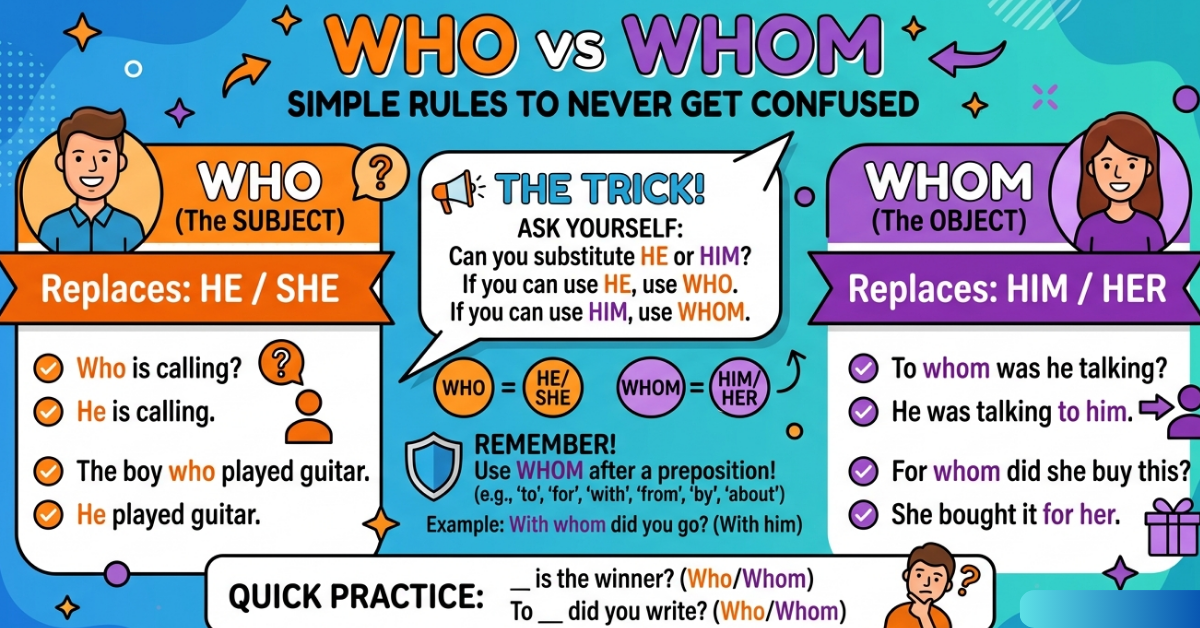
- Who is used as a subject
- Whom is used as an object
Think of it this way:
- The subject performs the action
- The object receives the action
Examples
- Who called you last night?
(“Who” is doing the calling.) - Whom did you call last night?
(“Whom” receives the action of calling.)
This is the core idea behind all who vs whom rules.
The Simplest Who vs Whom Trick
One of the easiest grammar shortcuts is the he/him test.
Use “who” if the answer could be:
- he
- she
- they
Use “whom” if the answer could be:
- him
- her
- them
Example 1
Who wrote this letter?
Possible answer:
He wrote the letter.
Since “he” works, “who” is correct.
Example 2
To whom should I send the package?
Possible answer:
Send it to him.
Since “him” works, “whom” is correct.
This is the most popular who vs whom trick because it works quickly in everyday situations.
When to Use Who vs Whom
Understanding sentence structure makes things much easier.
Use “Who” as the Subject
Use “who” when the person is performing the action.
Examples
- Who wants pizza?
- Who broke the window?
- Who is coming to the party?
- Who made this painting?
In all these examples, the word acts as the subject of the sentence.
Use “Whom” as the Object
Use “whom” when the person receives the action.
Examples
- Whom did you invite?
- Whom are they talking about?
- With whom are you traveling?
- Whom should we contact?
Here, the person is receiving the action instead of doing it.
Why “Whom” Sounds Formal Today
In modern English, especially casual conversation, many people use “who” instead of “whom.” That is why sentences with “whom” can sometimes sound formal or old-fashioned.
For example:
- Who are you talking to?
sounds more natural in conversation.
While this is technically less formal than “To whom are you talking?”, it is widely accepted in spoken English.
Still, knowing proper grammar is important for:
- academic writing
- business emails
- formal communication
- exams and interviews
Common Mistakes People Make
Here are some frequent grammar errors involving these words.
Incorrect:
- Whom is calling me?
Correct:
- Who is calling me?
Why? Because the person is performing the action.
Incorrect:
- Who did you meet yesterday?
Technically, “whom” is grammatically correct because it is the object:
- Whom did you meet yesterday?
However, modern conversational English often accepts “who” here.
Who vs Whom in Questions
Questions confuse people the most because the sentence order changes.
Easy Tip
Ignore extra words and focus on:
- who is doing the action
- who receives the action
Example
Whom did Sarah invite to dinner?
Simplified:
Sarah invited whom.
“Whom” receives the action.
Who vs Whom in Relative Clauses
Relative clauses are another area where people hesitate.
Examples Using “Who”
- The teacher who helped me was kind.
- I know the artist who painted this wall.
The person performs the action.
Examples Using “Whom”
- The student whom the teacher praised smiled proudly.
- The manager whom we interviewed got the job.
The person receives the action.
Who vs Whom Rules Made Simple
Here is a quick summary you can remember easily.
| Use | Grammar Role | Example |
| Who | Subject | Who called you? |
| Whom | Object | Whom did you call? |
Quick Memory Formula
- He = Who
- Him = Whom
This shortcut helps answer most grammar questions instantly.
Formal vs Informal Usage
Modern English has become more relaxed over time.
Formal English
- To whom it may concern
- Whom should I contact?
Informal English
- Who should I contact?
- Who are you talking to?
Both may appear in daily life, depending on the situation and tone.
Who vs Whom Act: Why People Mention It
Some people search for who vs whom act because they have seen the phrase in grammar discussions or school materials. In grammar, “act” usually refers to how the word functions in a sentence.
Ask yourself:
- Is the word acting as the subject? → use “who”
- Is it acting as the object? → use “whom”
That simple idea explains most grammar situations.
Mini Who vs Whom Quiz
Try these practice questions.
1. ___ is knocking at the door?
Answer: Who
2. ___ did you choose for the project?
Answer: Whom
3. The woman ___ called earlier left a message.
Answer: Who
4. With ___ are you going?
Answer: Whom
5. ___ wants coffee?
Answer: Who
This quick who vs whom quiz helps reinforce the rules naturally.
Tips to Remember Forever
Here are a few practical ways to avoid confusion.
1. Use the He/Him Test
This remains the easiest grammar shortcut.
2. Listen for Formal Situations
“Whom” appears more often in formal writing.
3. Simplify the Sentence
Remove extra words to identify the subject and object.
4. Practice With Questions
Questions are the best way to master the rule.
Is It Wrong to Avoid “Whom”?
Not necessarily.
In casual English, many native speakers rarely use “whom.” Even professional writers sometimes replace it with “who” to sound more natural.
However, understanding proper grammar still matters because:
- it improves writing clarity
- it helps in academic settings
- it creates polished professional communication
So while everyday speech is flexible, knowing the correct form gives you more confidence and control over your language.
FAQs
What is the main difference between who and whom?
“Who” acts as the subject of a sentence, while “whom” acts as the object.
What is the easiest who vs whom trick?
Use the he/him test:
- he = who
- him = whom
If “him” fits naturally, use “whom.”
When do you use who vs whom in a sentence?
Use “who” when the person performs the action and “whom” when the person receives the action.
Is “whom” still used today?
Yes, but mostly in formal writing and professional communication. In casual conversation, many people simply use “who.”
Is it okay to say “Who did you invite?”
Yes. While “whom” is technically more formal, “who” is widely accepted in modern spoken English.
Why is who vs whom confusing?
The confusion happens because English speakers often use “who” in everyday speech, even where traditional grammar would prefer “whom.”
Conclusion
Understanding who vs whom does not have to feel complicated. Once you remember that “who” acts as the subject and “whom” acts as the object, the rule becomes much easier to apply.
The he/him shortcut is one of the fastest ways to check yourself, especially during writing or conversations. While modern English has become more relaxed about using “whom,” knowing the correct grammar still helps you communicate more clearly and professionally.
Keep practicing with simple examples and questions, and soon the difference will feel natural rather than confusing.