Have you ever typed a word so many times that it suddenly looked wrong? That happens to many people with sentance vs sentence. Since both words sound similar when spoken quickly, it is easy to confuse them while writing.
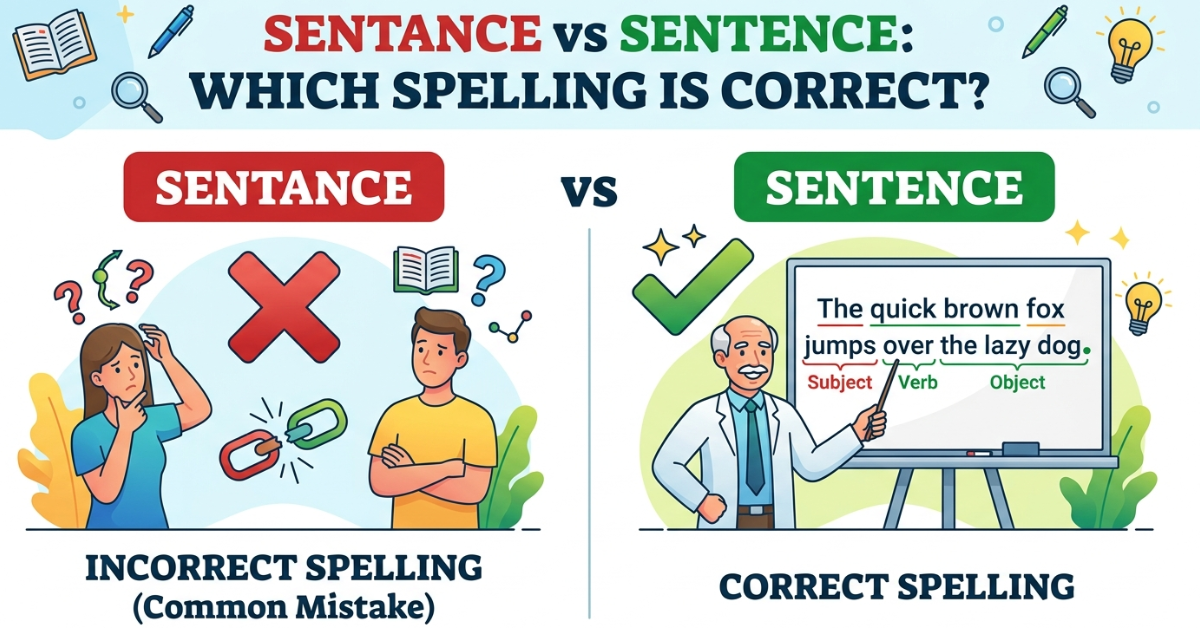
The truth is simple: “sentence” is the correct spelling, while “sentance” is a common misspelling. Even fluent English speakers accidentally write it incorrectly because pronunciation can sometimes be misleading.
In this guide, you will learn:
- Which spelling is correct
- Why people confuse the two
- How to remember the right version
- Examples of proper usage
- Common grammar mistakes related to the word
By the end, you will never hesitate again when writing this word.
What Does “Sentence” Mean?
A sentence is a group of words that expresses a complete idea. It usually contains:
- A subject
- A verb
- Proper punctuation
For example:
- She loves painting.
- The weather looks beautiful today.
- Interior design requires creativity and planning.
A complete thought begins with a capital letter and ends with punctuation such as a period, question mark, or exclamation mark.
Is “Sentance” a Real Word?
No, “sentance” is not considered a correct English word.
It is simply a spelling error that appears because of pronunciation habits. Many English learners — and even native speakers — accidentally replace the “e” with an “a.”
Correct:
- sentence
Incorrect:
- sentance
Most grammar checkers and dictionaries automatically flag the incorrect spelling.
Why Do People Confuse the Two?
English spelling is not always phonetic. Many words are written differently from how they sound.
People often write the incorrect version because:
- The pronunciation sounds similar
- Fast typing leads to mistakes
- Autocorrect is sometimes ignored
- English contains many irregular spelling patterns
This confusion is especially common among students, content writers, and language learners.
Easy Trick to Remember the Correct Spelling
A simple memory trick can help.
Think of this:
A proper sentence makes sense.
Both sentence and sense contain the letter “e” sound pattern. This small association can help you remember the correct spelling more easily.
Another helpful tip:
- “Sentence” follows the same spelling style as words like:
- presence
- silence
- confidence
Notice the “-ence” ending pattern.
Examples of Correct Usage
Here are some examples showing how the word should appear in writing.
Everyday Examples
- Please write a complete sentence.
- Her teacher corrected the grammar mistake.
- That final line was the strongest part of the paragraph.
Academic Examples
- A topic sentence introduces the main idea.
- Complex structures contain independent and dependent clauses.
- Good writing depends on clarity and punctuation.
Legal Meaning
The word can also refer to a legal punishment given by a court.
Example:
- The judge announced the prison sentence yesterday.
Context helps determine which meaning is intended.
Common Grammar Mistakes Related to Sentence Writing
Spelling is only one part of strong writing. Many people also struggle with sentence structure.
Here are a few common issues:
1. Run-On Sentences
This happens when two ideas are joined incorrectly.
Incorrect:
- I love art I also enjoy architecture.
Correct:
- I love art, and I also enjoy architecture.
2. Sentence Fragments
A fragment is incomplete and lacks a full thought.
Incorrect:
- Because she was tired.
Correct:
- She went to sleep because she was tired.
3. Incorrect Punctuation
Punctuation changes readability and meaning.
Incorrect:
- Lets eat grandma.
Correct:
- Let’s eat, Grandma.
Tiny punctuation marks make a huge difference.
Sentence Types You Should Know
Understanding sentence types improves both writing and communication.
Declarative
Makes a statement.
- The project is complete.
Interrogative
Asks a question.
- Did you finish the assignment?
Imperative
Gives a command.
- Close the door.
Exclamatory
Shows emotion.
- What a beautiful design!
Learning these forms can strengthen academic, professional, and creative writing.
How Spelling Mistakes Affect Writing
Small spelling mistakes may seem harmless, but they can impact:
- Professionalism
- Search engine rankings
- Academic grades
- Reader trust
In digital writing, even minor errors can reduce credibility. That is why proofreading is essential for bloggers, students, and professionals alike.
Helpful proofreading habits include:
- Reading text aloud
- Using grammar tools
- Taking short breaks before editing
- Checking commonly confused words
British vs American English: Does the Spelling Change?
No. Both British and American English use the same spelling:
- sentence
Unlike words such as:
- colour/color
- organise/organize
This word remains unchanged across major English variations.
Frequently Confused Words Similar to This
English contains many commonly confused spellings.
Examples include:
- definitely vs definately
- separate vs seperate
- grammar vs grammer
- occurrence vs occurence
These mistakes happen because English spelling patterns are inconsistent. Regular reading and writing help improve accuracy over time.
FAQs
Is “sentance” ever correct?
No. It is considered a misspelling in standard English.
Why do people type it incorrectly?
Mostly because pronunciation makes the word sound different from its actual spelling.
How can I remember the correct spelling?
Associate it with the word “sense” or remember the “-ence” ending pattern.
Can grammar tools detect the mistake?
Yes. Most modern spelling and grammar checkers automatically correct it.
Does the word have more than one meaning?
Yes. It can refer to a grammatical structure or a legal punishment decided by a court.
Conclusion
The debate around sentance vs sentence is actually very straightforward once you understand the rule. “Sentence” is the only correct spelling in English, while the other version is simply a common typo.
Although the mistake is small, using the correct spelling improves clarity, professionalism, and confidence in writing. Whether you are working on academic assignments, blog posts, emails, or social media captions, accurate spelling always leaves a stronger impression.
The best way to avoid future mistakes is simple: read regularly, proofread carefully, and practice writing often. Over time, the correct spelling becomes natural.