
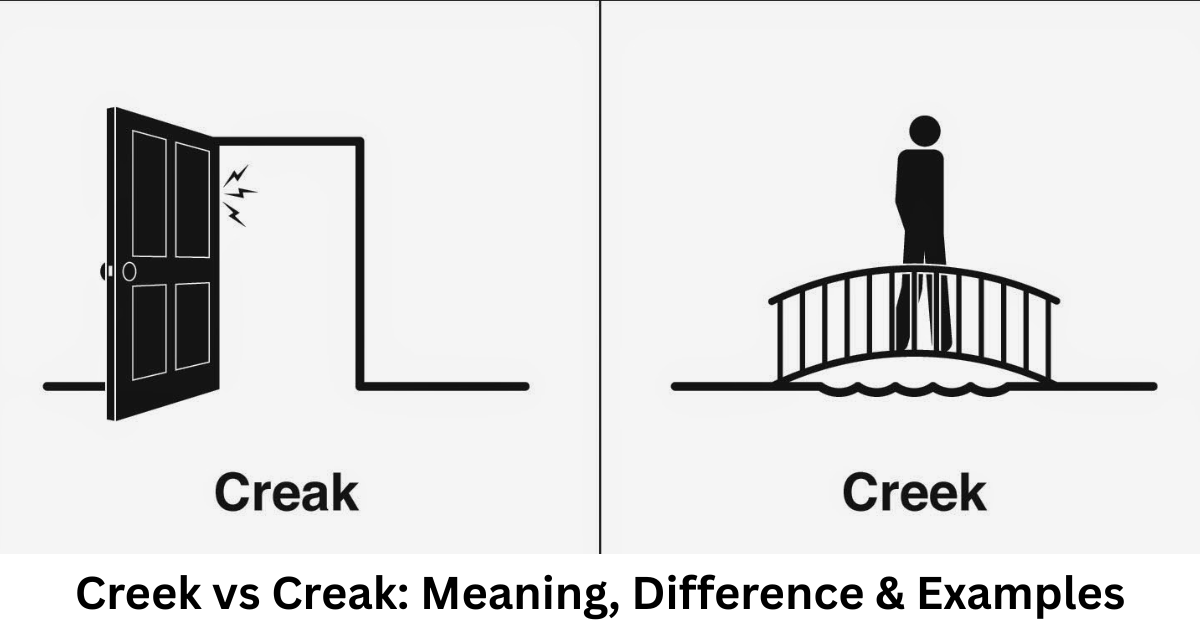
English can be tricky, especially when two words sound almost identical but mean completely different things. One such confusing pair is creek vs creak. At first glance, they look similar, and when spoken, they even sound alike—but their meanings are worlds apart.
If you’ve ever mixed them up in writing or wondered why English does this to us, you’re not alone. In this guide, we’ll break down the confusion in a simple, practical way so you never hesitate again.
Creek vs Creak: Why People Get Confused
The confusion around creek vs creak mainly comes from pronunciation and spelling similarity. Both words are short, contain similar letters, and are commonly used in everyday language—but they belong to completely different categories.
- One is related to nature (water bodies)
- The other is related to sound (noise of something old or stiff)
Once you understand their meanings, the confusion disappears instantly.
What Does “Creek” Mean?
A creek refers to a small natural stream of water. It is usually smaller than a river and often found in rural or forested areas.
Examples of “creek” in sentences:
- The children played near the shallow creek.
- We crossed a small creek during our hike.
- Fish are often found in clean mountain creeks.
In simple terms, think of creek as flowing water in nature.
What Does “Creak” Mean?
A creak is a sound. It usually describes a slow, sharp, or squeaky noise made when something old, heavy, or dry moves.
Examples of “creak” in sentences:
- The door began to creak as it opened.
- I heard the floorboards creak at night.
- The old chair creaks whenever someone sits on it.
So, creak is all about sound, not water.
Creek vs Creak: Key Differences Explained
To make it even easier, here’s a simple breakdown:
- Creek
- A natural water stream
- Found outdoors
- Related to geography and nature
- Creak
- A sound or noise
- Often linked with old objects
- Related to movement and sound
A quick way to remember:
- Creek = water flows
- Creak = wood or door makes noise
Common Mistakes People Make
Many learners mix up these words in writing, especially in exams or casual messages. Here are the most common errors:
- Writing “creak” instead of “creek” when talking about water
- Confusing pronunciation while speaking
- Assuming both words are interchangeable
The truth is, they are not related at all—only similar in spelling.
Easy Memory Trick to Remember Creek vs Creak
If you struggle with creek vs creak, use this simple trick:
- Creek has “ee” → think of water flowing smoothly like eyes seeing a river
- Creak has “ea” → think of an old wooden door saying “eaaak”
This association helps your brain lock the difference instantly.
FAQs
1. What is the main difference between creek vs creak?
The main difference is meaning: creek is a small stream of water, while creak is a squeaky sound.
2. Is a creek a river?
No, a creek is smaller than a river. It is usually a narrow stream.
3. Why does wood creak?
Wood creaks due to friction, dryness, or pressure when it moves or is under weight.
4. Are creek and creak pronounced the same?
They sound very similar, which is why people often confuse them, but they are not identical in meaning.
5. How can I avoid confusing creek vs creak?
Focus on context: water = creek, sound = creak.
Conclusion
Understanding creek vs creak is simple once you break it down: one belongs to nature and water, the other belongs to sound and movement. Although they look and sound similar, their meanings are completely different.
With a little practice and memory tricks, you’ll never mix them up again. Keep noticing them in reading and writing, and the difference will become second nature.
If you found this helpful, keep exploring more English word pairs to sharpen your language skills even further.