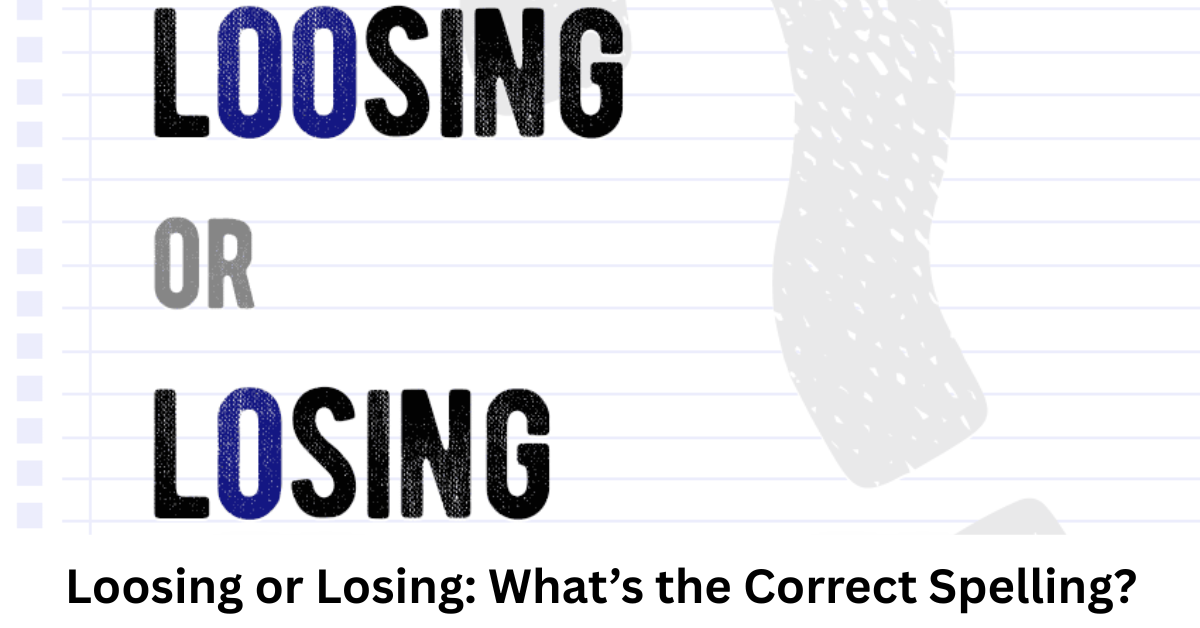
It’s a tiny spelling difference—but it causes a lot of confusion. Is it loosing or losing? If you’ve ever paused mid-sentence wondering which one is correct, you’re not alone. These two words look similar, sound almost identical, and are often mistakenly swapped.
In this article, we’ll break down loosing or losing, explain their meanings, show real examples, and give you simple tricks to remember the correct usage. By the end, you’ll never second-guess yourself again.
Understanding the Difference Between Loosing and Losing
What Does “Losing” Mean?
“Losing” is the word you’re probably looking for most of the time. It comes from the verb lose, which means:
- To misplace something
- To fail to win
- To no longer have something
Examples:
- I am losing my keys again.
- Our team is losing the match.
- She is losing confidence.
In everyday conversation, “losing” is far more common.
What Does “Loosing” Mean?
“Loosing” comes from the verb loose, which means to release, untie, or set free.
Examples:
- He is loosing the ropes from the boat.
- The soldiers were loosing arrows.
This word is rare in modern usage and usually appears in formal or historical contexts.
Loosing or Losing: The Key Difference
Let’s simplify it:
- Losing = Not winning, misplacing, or no longer having
- Loosing = Releasing or setting free
If you’re talking about failure, mistakes, or misplacing something, the correct choice is almost always losing.
Why People Confuse “Loosing” and “Losing”
There are a few reasons this mistake is so common:
- Both words sound similar when spoken
- The extra “o” in “loosing” is easy to overlook
- Autocorrect doesn’t always catch it
- Many people assume “loosing” is just a variation of “losing”
But remember: they are not interchangeable.
Easy Trick to Remember the Correct Word
Here’s a simple memory hack:
“Lose” has one ‘o’, so “losing” also has one ‘o’.
If you’re talking about failure or misplacing something, stick with one “o”.
Common Mistakes and Corrections
Let’s fix some everyday errors:
- I am loosing my patience.(in correct)
I am losing my patience.(correct) - She is loosing the game.(in correct)
She is losing the game.(correct) - We are loosing time.(in correct)
We are losing time.(correct)
In all these cases, “losing” is correct.
When Should You Actually Use “Loosing”?
Although rare, “loosing” is correct in specific situations:
- When something is being released
- When something is being untied
- In poetic or historical writing
Example:
- The archer was loosing arrows at the target.
If your sentence doesn’t involve releasing something, you probably don’t need “loosing”.
Quick Comparison Table
| Word | Meaning | Usage Frequency |
|---|---|---|
| Losing | Not winning or misplacing | Very common |
| Loosing | Releasing or setting free | Rare |
FAQs
1. Is it loosing or losing in most cases?
In most everyday situations, losing is the correct word.
2. Is “loosing” ever correct?
Yes, but only when it means releasing or setting something free.
3. Why do people write “loosing” instead of “losing”?
It’s usually a spelling mistake caused by similar pronunciation and confusion.
4. How can I avoid this mistake?
Remember: “lose” = one ‘o’, so “losing” also has one ‘o’.
5. Is “loosing” used in modern English?
It’s rarely used and mostly appears in formal or literary contexts.
Conclusion
The confusion around loosing or losing is common—but easy to fix once you understand the difference. “Losing” is the word you’ll use in almost every situation, whether you’re talking about failure, misplacing something, or missing out. “Loosing,” on the other hand, is a niche term used for releasing or freeing something.
The next time you hesitate, just remember the one “o” rule—and you’ll get it right every time.
If you found this helpful, try applying it in your writing today. Small corrections like this can make a big difference in how polished and professional your language feels.