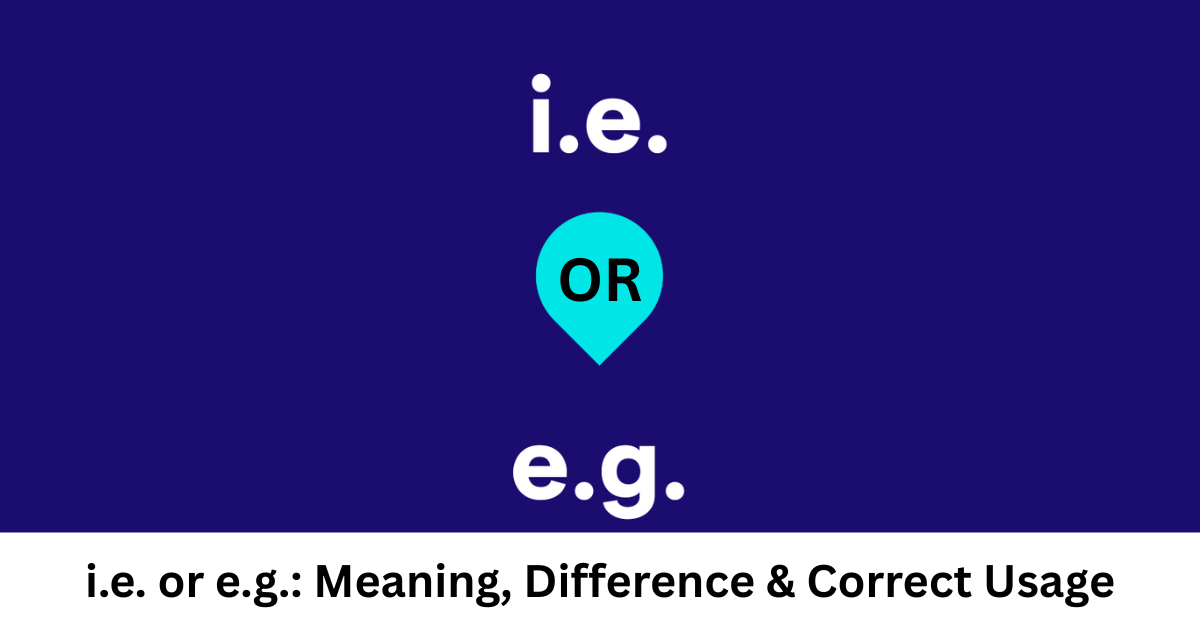
Many people pause while writing when deciding between i.e. or e.g. They look similar, come from Latin, and are often confused in emails, essays, and professional writing. But they do not mean the same thing.
Understanding the difference can instantly improve your grammar, clarity, and confidence. In this guide, you’ll learn what each abbreviation means, when to use it, simple memory tricks, and examples that make everything easy to remember.
What Do i.e. and e.g. Mean?
These two abbreviations come from Latin phrases still used in modern English writing.
- i.e. stands for id est, meaning that is or in other words
- e.g. stands for exempli gratia, meaning for example
Even though they look alike, their purposes are different.
Quick Summary
| Abbreviation | Meaning | Use |
|---|---|---|
| i.e. | That is | Restate or clarify |
| e.g. | For example | Give examples |
When to Use i.e.
Use i.e. when you want to explain something more clearly or restate it in another way.
Examples
- She works remotely, i.e., from home full-time.
- We meet on the first weekday, i.e., Monday this month.
- He enjoys one hobby, i.e., painting landscapes.
Think of it as saying: let me clarify.
When to Use e.g.
Use e.g. when you want to list examples, not a complete list.
Examples
- Bring summer clothes, e.g., T-shirts and shorts.
- I enjoy outdoor sports, e.g., hiking and cycling.
- Add calming plants, e.g., aloe vera or snake plant.
Think of it as saying: for instance.
Easy Memory Trick for i.e. or e.g.
A simple way to remember:
- i.e. = in essence (clarification)
- e.g. = examples given (examples)
This trick helps many writers choose correctly in seconds.
Common Mistakes to Avoid
1. Using e.g. for Definitions
Incorrect: The capital of France, e.g., Paris.
Correct: The capital of France, i.e., Paris.
(Paris is the exact answer, not one example.)
2. Using i.e. for a List of Examples
Incorrect: Healthy snacks, i.e., almonds and fruit.
Correct: Healthy snacks, e.g., almonds and fruit.
(Those are examples, not the full definition.)
3. Overusing Them
In casual writing, plain English often sounds better.
Instead of:
- Submit documents, i.e., passport and ID.
Try:
- Submit documents, that is, passport and ID.
Punctuation Rules
Style guides differ slightly, but common usage includes commas after them.
Examples:
- The event starts early, i.e., at 8 a.m.
- Pack essentials, e.g., water and snacks.
In British English, punctuation may vary. Consistency matters most.
i.e. or e.g. in Academic and Professional Writing
These abbreviations are common in:
- Essays
- Reports
- Emails
- Research papers
- Business communication
They save space and keep writing concise when used correctly.
Should You Use Them in Casual Writing?
Yes, but only when your audience understands them. In blogs, social captions, or friendly messages, writing full phrases like for example or that is can feel more natural.
FAQs
What is the main difference between i.e. and e.g.?
One clarifies meaning, while the other introduces examples.
Is i.e. the same as “for example”?
No. It means “that is” or “in other words.”
Can I use e.g. in formal writing?
Yes. It is widely accepted in academic and professional contexts.
Do I need commas after them?
Usually yes, especially in American English.
Which is better in simple writing?
Often full phrases like “for example” or “that is” are easier for readers.
Conclusion
Knowing the difference between i.e. or e.g. is a small grammar skill that creates a big impact. One is used to clarify, while the other gives examples. Once you understand that distinction, your writing becomes sharper and more professional.
Next time you hesitate, remember: clarify with one, illustrate with the other.