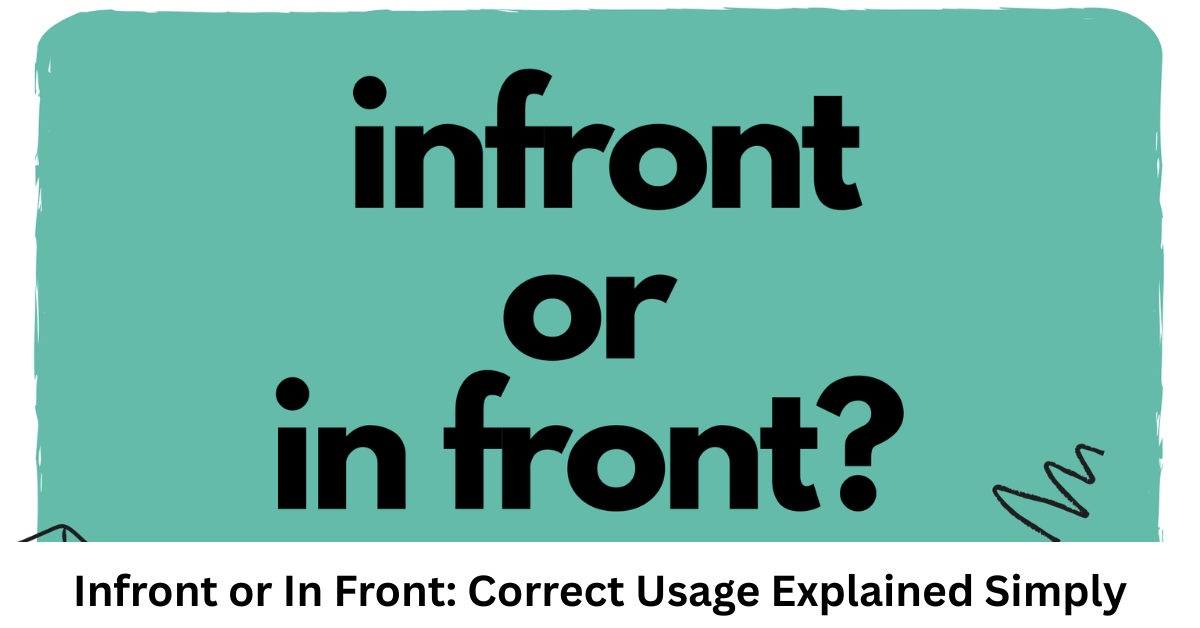
If you have ever paused while writing and wondered whether it is infront or in front, you are definitely not alone. Many English learners and even native speakers get confused by this small but important spacing issue.
However, understanding the correct form is quite simple once you break it down. In this article, we will clearly explain the grammar rules, common mistakes, and real-life examples so you never hesitate again. Moreover, you will learn how to use the phrase naturally in both writing and conversation.
Let’s clear up the confusion around infront or in front once and for all.
Infront or In Front: Which One is Correct?
The correct form is “in front” (always written as two separate words).
On the other hand, “infront” is not considered correct in standard English grammar. Although it may appear in informal writing or typing mistakes, it is not accepted in formal communication.
To put it simply:
- Correct: in front
- Incorrect: infront
Therefore, whenever you are writing emails, essays, or professional content, always use the two-word version.
What Does “In Front” Mean?
The phrase in front is used to describe position or placement.
Meaning:
It refers to something located ahead of or facing another object or person.
Example:
- The car is parked in front of the house.
- She stood in front of the mirror.
In addition, it can also be used in abstract contexts, such as being ahead in a line or situation.
Why People Get Confused Between Infront or In Front
Interestingly, the confusion happens because spoken English does not clearly show spacing. As a result, many people assume it is one word.
Moreover, social media texting habits often remove spaces for speed, which leads to incorrect spelling like “infront.”
Here are a few common reasons:
- Fast typing on mobile devices
- Lack of grammar awareness
- Influence of informal writing styles
However, in formal English, spacing matters a lot for clarity.
Grammar Rule Behind “In Front”
To understand it better, let’s break it down:
- “In” = preposition showing position
- “Front” = noun meaning forward position
When combined, they form a prepositional phrase: in front
Since both words serve different grammatical roles, they are not merged into one word.
Therefore, writing infront or in front correctly always depends on remembering this rule.
Common Mistakes with “In Front”
Even though the rule is simple, mistakes still happen frequently. Here are some examples:
Incorrect Usage:
- He stood infront of the class.
- The dog is sleeping infront the door.
Correct Usage:
- He stood in front of the class.
- The dog is sleeping in front of the door.
Additionally, many learners forget the preposition “of,” which is equally important in sentence structure.
Easy Examples to Understand Usage
To make it clearer, here are some natural sentences:
- The teacher stood in front of the board.
- There is a garden in front of my house.
- She placed the book in front of her laptop.
- The crowd gathered in front of the stage.
These examples show how flexible the phrase can be in everyday English.
Tips to Remember the Correct Form
If you still get confused between infront or in front, these tips will help:
- Always remember it is two separate words
- Think of “in + front” as location words
- Read sentences out loud to check natural flow
- Avoid merging words in formal writing
Furthermore, practicing sentences daily can help you build strong memory retention.
Why Correct Usage Matters
Using proper grammar is not just about rules; it also improves clarity and professionalism. For instance, in academic writing or job applications, small errors can create a negative impression.
Therefore, using in front correctly ensures:
- Better communication
- Professional writing quality
- Improved English fluency
In addition, it shows attention to detail, which is always appreciated.
FAQs
1. Is “infront” a correct English word?
No, “infront” is not grammatically correct in standard English.
2. What is the correct spelling: infront or in front?
The correct form is “in front,” written as two words.
3. Can “in front” be used in formal writing?
Yes, it is widely used in both formal and informal contexts.
4. Why do people write “infront”?
Mostly due to typing habits, lack of grammar knowledge, or informal texting.
5. Is “in front of” the same as “in front”?
“In front of” is a complete phrase used to specify position relative to something.
Conclusion
To sum up, the correct form is always in front, not infront or in front as a combined word. Although the mistake is common, it is easy to fix once you understand the grammar rule behind it.
So, next time you write, remember the simple structure and use it confidently in your sentences. With practice, this small correction will become completely natural in your writing style