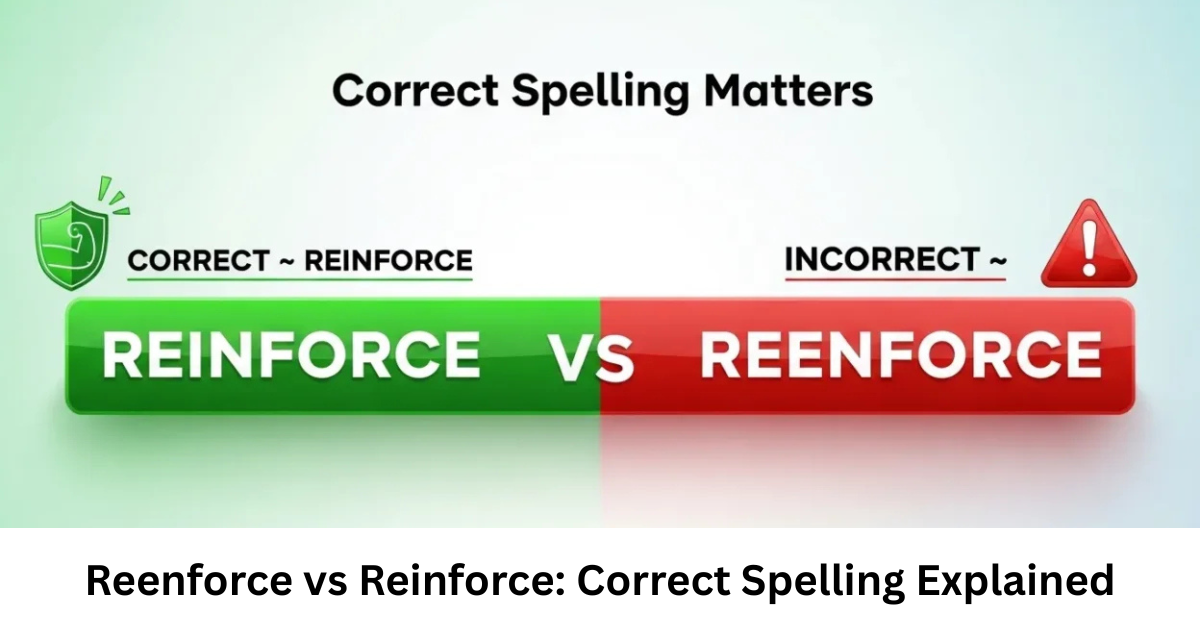
Have you ever paused while writing and wondered whether to use reenforce vs reinforce? You are not alone. Many writers, students, and professionals get confused by these similar-looking words. At first glance, both seem possible, but only one is widely accepted in modern English.
In this guide, we’ll break down the difference, explain the correct spelling, show examples, and help you avoid mistakes in future writing.
What Does Reinforce Mean?
Reinforce is the correct and standard spelling in modern English. It means to strengthen, support, or make something stronger.
It can be used in both literal and figurative ways.
Examples of Reinforce
- Steel bars reinforce the concrete wall.
- Positive feedback can reinforce good habits.
- Teachers often reinforce lessons through repetition.
- The company added staff to reinforce customer support.
In each example, the word means adding strength, support, or emphasis.
Is Reenforce a Real Word?
Technically, reenforce is an old or outdated variant spelling that appeared in historical texts centuries ago. However, it is no longer considered standard English.
Today, using reenforce may look like a spelling error to most readers, editors, and search engines.
Why It Causes Confusion
The confusion often happens because:
- People think “re-” plus “enforce” should create reenforce
- It resembles other words with double vowels
- Older texts sometimes used alternate spellings
Still, in modern writing, reinforce is the preferred form.
Reenforce vs Reinforce: Key Difference
| Word | Status | Meaning | Use Today |
|---|---|---|---|
| Reenforce | Archaic / obsolete variant | Strengthen | Rarely used |
| Reinforce | Standard modern spelling | Strengthen or support | Correct choice |
If you are writing essays, emails, blogs, reports, or business content, choose reinforce.
When to Use Reinforce in Sentences
Use this word when talking about strengthening something physically, mentally, emotionally, or structurally.
Common Uses
1. Construction and Engineering
- Builders reinforce beams with steel.
- The bridge was reinforced after inspection.
2. Education and Learning
- Practice helps reinforce memory.
- Teachers reinforce concepts through examples.
3. Behavior and Psychology
- Rewards reinforce positive behavior.
4. Communication
- Repeating your message can reinforce trust.
Why Reinforce Is the Accepted Spelling
Language evolves over time. Many old spellings disappear as dictionaries standardize words. Reinforce became the accepted spelling because it aligned with common usage and pronunciation.
Modern dictionaries, style guides, and grammar tools recognize reinforce, not reenforce.
Easy Trick to Remember
Think of the word rein as in guiding or controlling, plus force.
Reinforce = add force or strength
This memory trick can help you choose the right spelling quickly.
Common Mistakes to Avoid
When writing, avoid these errors:
- Writing reenforce in formal documents
- Assuming both spellings are equally correct
- Using outdated spellings in academic work
- Letting autocorrect mistakes slip through proofreading
Synonyms for Reinforce
If you want variety in your writing, try these alternatives:
- Strengthen
- Support
- Fortify
- Boost
- Confirm
- Back up
- Stabilize
Choose the synonym based on context.
FAQs
Is reenforce correct?
It is an old variant spelling, but it is not standard modern English. Use reinforce instead.
Why do people write reenforce?
It often happens due to spelling confusion or misunderstanding of prefixes.
Is reinforce used in academic writing?
Yes, it is common in essays, research papers, and professional communication.
Can reinforce mean repeat?
Yes, sometimes repeating information helps strengthen understanding, so it can carry that meaning.
How do I remember the correct spelling?
Use reinforce with “ei” after the letter R.
Conclusion
When comparing reenforce vs reinforce, the answer is clear: reinforce is the correct spelling for modern English. While reenforce exists historically, it is outdated and rarely appropriate today.
If you want clear, polished writing, stick with reinforce in all professional, academic, and everyday communication. Keep this guide handy whenever spelling doubts appear, and your writing will stay sharp and accurate.