English is full of words that sound similar but carry completely different meanings. One pair that often confuses writers and speakers is broach vs brooch. Although these words are pronounced almost the same, they refer to entirely different things. Using the wrong one can change the meaning of a sentence and make your writing look less polished.
In this guide, you’ll learn the meaning of each term, how to use them correctly, common mistakes to avoid, and simple tricks to remember the difference. Whether you’re writing professionally, studying English, or simply improving your vocabulary, understanding these two words can help you communicate more clearly.
Understanding the Meaning of Broach
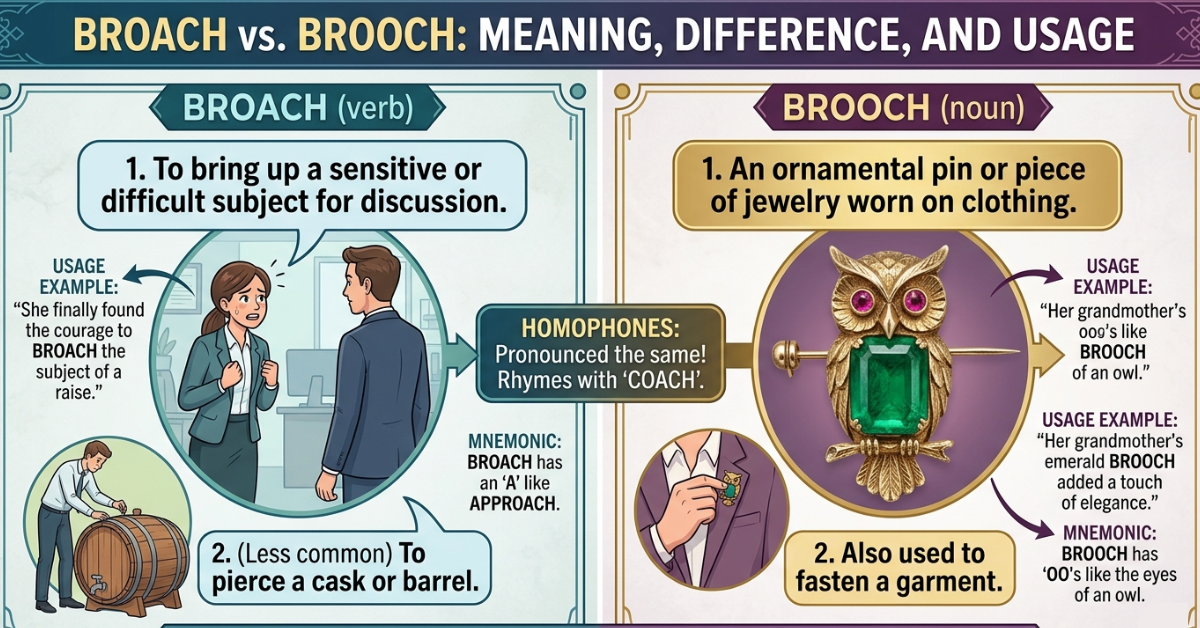
The word broach is mainly used as a verb. It means to introduce or bring up a topic for discussion, especially one that may be sensitive or difficult.
Definition of Broach
Broach (verb): To mention or introduce a subject for discussion.
Examples of Broach in Sentences
- She decided to broach the topic of salary during the interview.
- I wasn’t sure how to broach the conversation about moving abroad.
- He carefully broached the issue with his manager.
In some specialized industries, the word can also refer to a cutting tool or drilling process, but in everyday English, it most commonly relates to starting a conversation.
Understanding the Meaning of Brooch
A brooch is a noun. It refers to a decorative piece of jewelry that is attached to clothing with a pin.
Definition of Brooch
Brooch (noun): An ornamental jewelry pin worn on clothing.
Examples of Brooch in Sentences
- Her grandmother gave her a vintage pearl brooch.
- The gold brooch matched her dress perfectly.
- Antique brooches are often collected for their craftsmanship.
Brooches have been popular fashion accessories for centuries and are commonly worn on coats, scarves, dresses, and blazers.
Broach vs Brooch: Key Difference
The easiest way to understand the difference is this:
| Word | Part of Speech | Meaning |
| Broach | Verb | To introduce a topic |
| Brooch | Noun | A decorative jewelry pin |
Even though they sound alike, their functions in a sentence are completely different.
Pronunciation: Why People Confuse These Words
One reason people mix these words up is because they are pronounced very similarly.
- Broach: sounds like “brohch”
- Brooch: also sounds like “brohch”
Because English spelling can be unpredictable, many people accidentally use the wrong spelling in writing.
How to Remember the Difference
Here are a few simple memory tricks:
Remember “Broach” for Discussion
Think of “approach.”
When you approach a topic, you bring it up in conversation.
Remember “Brooch” for Jewelry
The double “o” in brooch can remind you of something round or decorative, like jewelry.
These small associations can make it easier to choose the correct spelling quickly.
Common Mistakes People Make
Many writers accidentally swap these words because spellcheck tools may not always catch the mistake. Here are some examples of incorrect and correct usage.
Incorrect Usage
- She wore a beautiful broach on her coat.
- I want to brooch an important subject.
Correct Usage
- She wore a beautiful brooch on her coat.
- I want to broach an important subject.
Paying attention to whether you are talking about jewelry or conversation can help avoid these errors.
When to Use Broach in Professional Writing
The word “broach” is especially common in workplaces, meetings, and formal communication.
Situations Where Broach Fits Naturally
- Discussing concerns with a manager
- Introducing sensitive subjects
- Starting negotiations
- Mentioning difficult topics diplomatically
Example Phrases
- broach the subject
- broach an issue
- broach a conversation
- broach the matter carefully
These phrases are widely used in both spoken and written English.
When to Use Brooch in Fashion and Jewelry Contexts
“Brooch” appears most often in discussions about clothing, accessories, antiques, or fashion history.
Types of Brooches
- Floral brooches
- Vintage brooches
- Gemstone brooches
- Enamel brooches
- Gold or silver brooches
Fashion enthusiasts and collectors often use this term when describing elegant or antique accessories.
Origin of the Words
Understanding word origins can also make the meanings easier to remember.
Origin of Broach
The word comes from Old French and originally referred to piercing or opening something. Over time, it evolved into the idea of “opening” a discussion.
Origin of Brooch
This word also has French roots and has long been associated with decorative pins and ornaments used in fashion.
Although their histories are related, their meanings developed differently over time.
Quick Comparison List
Here’s a simple recap:
Use “Broach” When You Mean:
- Starting a conversation
- Introducing a topic
- Mentioning a sensitive issue
Use “Brooch” When You Mean:
- A decorative pin
- Jewelry worn on clothing
- A fashion accessory
Why Word Choice Matters
Using the correct word improves clarity and professionalism. Confusing similar-sounding words can distract readers and weaken your writing credibility.
Whether you’re writing emails, articles, essays, or social media posts, choosing the right spelling shows attention to detail and strong language skills.
FAQs
Is broach and brooch pronounced the same?
Yes, both words are usually pronounced the same way, which is why many people confuse them.
What does broach mean in a sentence?
It means to introduce or raise a topic for discussion.
Example: “She broached the issue carefully.”
What is a brooch used for?
A brooch is worn as a decorative accessory on clothing.
Can broach be used as a noun?
Yes, but it is uncommon in everyday English. It may refer to a cutting tool in technical fields.
Why do people confuse broach and brooch?
They sound almost identical but have different spellings and meanings.
Is a brooch still fashionable?
Yes, brooches remain popular in vintage fashion, formal wear, and modern accessory trends.
Conclusion
Understanding the difference between broach vs brooch is simpler once you know their meanings and uses. One refers to introducing a topic into conversation, while the other describes a decorative piece of jewelry. Despite their similar pronunciation, they belong in completely different contexts.
The next time you write about a difficult discussion or a stylish accessory, you’ll know exactly which word to choose. Expanding your vocabulary with distinctions like these can make your communication more accurate, polished, and confident.