If you’ve ever paused while writing and wondered whether to use Ring vs Wring, you’re not alone. These two words look similar but carry completely different meanings, and mixing them up can change the sense of a sentence entirely. In this guide, we’ll break down Ring vs Wring in a simple, practical way so you can use them confidently in everyday English.
Understanding Ring vs Wring is especially important in writing, texting, and professional communication because even a small spelling difference can lead to confusion.
What Does “Ring” Mean?
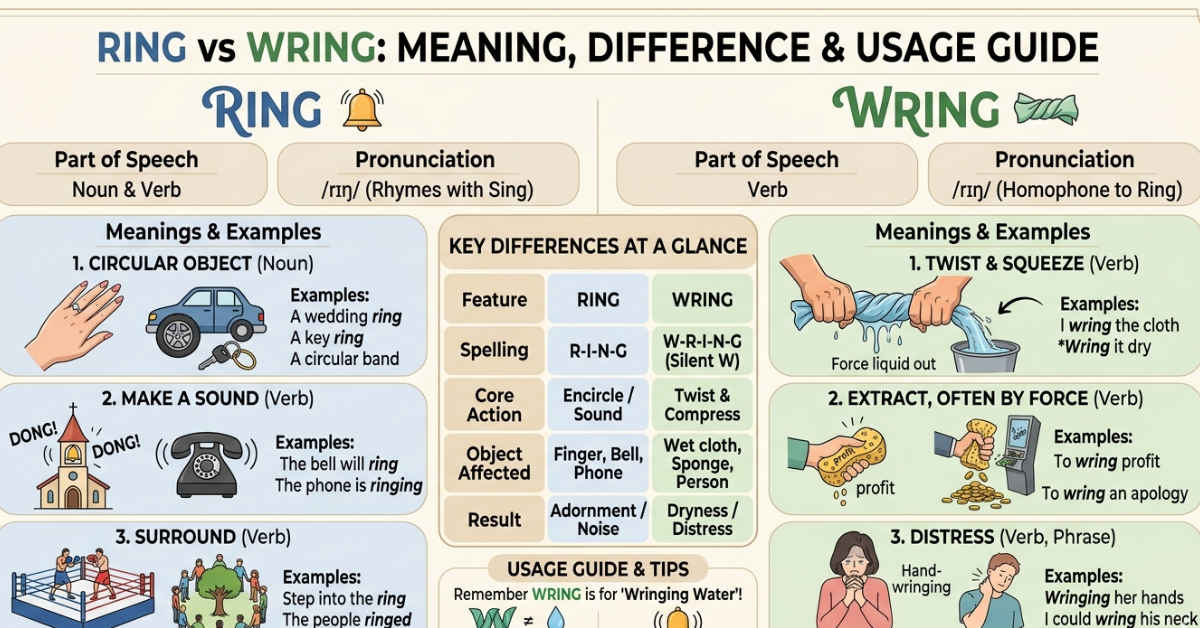
The word ring is commonly used in multiple contexts, and it usually refers to sound or circular objects.
Common meanings of “ring”:
- To make a sound (like a phone ringing)
- A circular object (like a wedding ring)
- To call someone by phone
- To surround something (e.g., mountains ring the valley)
Examples:
- My phone will ring in a few seconds.
- She wore a beautiful gold ring.
- I will ring you later today.
In simple terms, “ring” is mostly associated with sound, communication, or shape.
What Does “Wring” Mean?
Now let’s look at wring, which is far less common but very specific in meaning. It usually refers to twisting or squeezing something forcefully.
Common meanings of “wring”:
- To twist and squeeze liquid out of something
- To extract or force something out
- To express strong emotion (figuratively)
Examples:
- She wrung the water out of her wet clothes.
- He tried to wring information from the witness.
- Don’t wring the towel too hard.
Unlike “ring,” this word is physical and action-based, often involving pressure or force.
Key Difference Between Ring vs Wring
The confusion between these two words is common because they sound similar but function very differently.
Simple breakdown:
- Ring = sound, phone call, circle
- Wring = twist, squeeze, extract
Easy way to remember:
- If it involves sound or a circle → ring
- If it involves twisting or squeezing → wring
Ring vs Wring in Everyday Writing
Using the wrong word can completely change your meaning, so context matters a lot.
Correct usage:
- The bell will ring at 8 AM.
- She wringed (correct form: wrung) the cloth dry.
Common mistake:
- I will wring you tonight. (incorrect)
- I will ring you tonight. (correct)
This shows how one letter changes the entire meaning.
Grammar Tip: Verb Forms Matter
Another tricky part of Ring vs Wring is their past tense forms:
- Ring → rang → rung
- Wring → wrung → wrung
Example:
- She rang the bell yesterday.
- She wrung out the towel yesterday.
These irregular forms often confuse learners, so memorizing them helps a lot.
Why People Confuse Ring vs Wring
There are a few reasons why this mix-up happens:
- They sound similar in pronunciation
- They differ by only one letter
- Both are verbs in common usage
- Fast typing or autocorrect errors
But once you understand the meaning, it becomes much easier to separate them.
Quick Memory Tricks
Here are some simple ways to never confuse them again:
- Ring = phone rings → think sound
- Wring = twist → think squeezing a cloth
- Associate “w” in wring with “water” being squeezed out
- Associate ring with “circle” or “alarm bell”
FAQs About Ring vs Wring
1. What is the main difference between Ring vs Wring?
The main difference is meaning: “ring” refers to sound or circular objects, while “wring” means to twist or squeeze.
2. Is wring a common English word?
It is less common in daily speech but still used in writing and formal contexts.
3. Can ring and wring be used interchangeably?
No, they have completely different meanings and cannot replace each other.
4. What is the past tense of wring?
The past tense of wring is “wrung.”
5. How can I remember Ring vs Wring easily?
Think of “ring” as sound (phone ringing) and “wring” as squeezing water from clothes.
Conclusion
Understanding Ring vs Wring is a small but important step toward clearer English communication. While they may look similar, their meanings are completely different—one relates to sound or circular objects, and the other involves twisting or squeezing.
By practicing examples and remembering simple memory tricks, you can easily avoid mistakes and improve your writing accuracy. Keep practicing, and soon the difference between Ring vs Wring will feel completely natural.