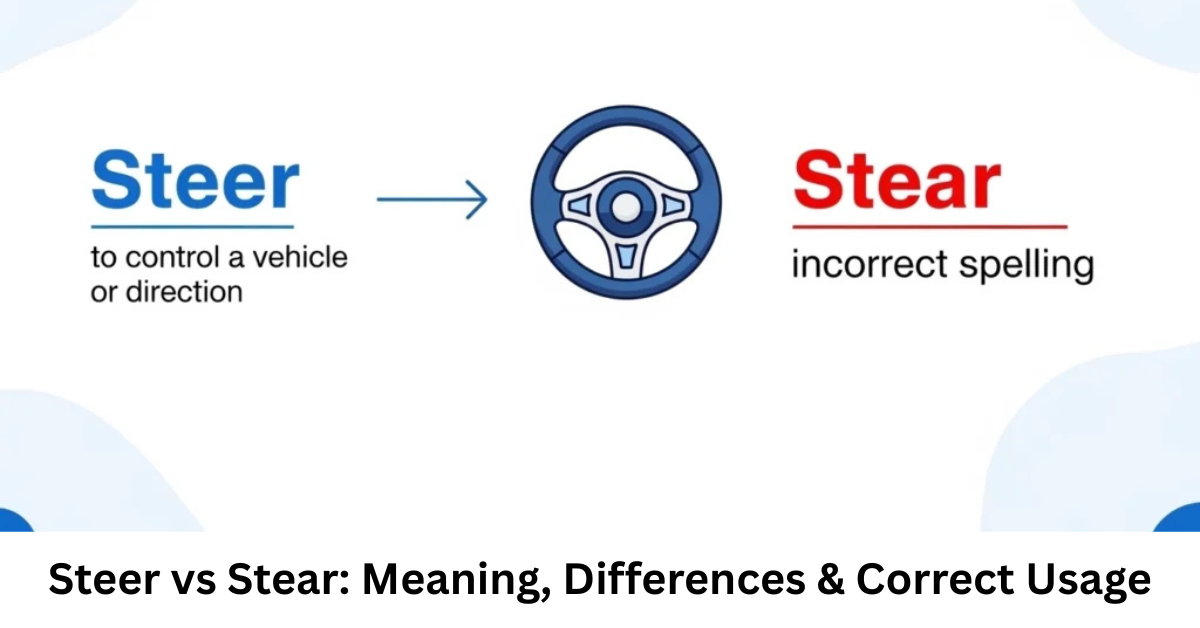
When it comes to confusing English spellings, steer vs stear is one of those pairs that often trips people up. You may have seen both versions online or in casual writing, but only one is actually correct.
In this article, we’ll break down the meaning, correct usage, and common mistakes so you never mix them up again. If you’ve ever paused while writing and wondered which form is right, this guide is for you.
What Does “Steer” Mean?
The word “steer” is the correct and widely accepted English word. It has multiple meanings depending on context.
1. To control direction
This is the most common use.
- Example: She learned how to steer the car carefully.
2. To guide or influence
It can also mean guiding someone or something.
- Example: He tried to steer the conversation away from politics.
3. As a noun (young male cattle)
In farming or animal terminology:
- Example: The farmer raised a steer on his land.
So, whenever you use steer, you’re using a valid English word with real meanings in both everyday and technical language.
Is “Stear” a Real Word?
Here’s the simple answer: “stear” is not a correct English word in standard usage.
Most of the time, when people type or search for “stear,” they actually mean steer but make a spelling mistake. It’s a common typo caused by:
- Fast typing on mobile devices
- Confusion with similar-sounding words
- Autocorrect errors
- Lack of familiarity with English spelling rules
Unlike steer, the term “stear” does not have an accepted definition in modern English dictionaries.
Steer vs Stear: Key Differences
To make things crystal clear, let’s compare them directly.
Spelling
- Correct: steer
- Incorrect: stear
Meaning
- steer: to guide, control, or direct
- stear: no recognized meaning
Usage
- steer: used in writing, speaking, and professional communication
- stear: should not be used in formal writing
Search Intent
Most people searching steer vs stear are actually trying to confirm spelling accuracy—not meaning differences.
Why People Get Confused
English is full of silent letters, irregular spellings, and similar-looking words. That’s why confusion happens.
Here are the most common reasons:
1. Sound-based spelling
When spoken quickly, “steer” and “stare” or even “stear” can sound similar.
2. Typing errors
On smartphones, switching letters like “e” and “a” is very easy.
3. Lack of exposure
If someone doesn’t read English often, they may not recognize the correct spelling.
4. Auto-correction mistakes
Sometimes keyboards “correct” words incorrectly, reinforcing wrong spelling habits.
Examples of Correct Usage of Steer
To help you fully understand how to use it, here are real-life examples:
- The captain steered the ship through the storm.
- She steered her career toward interior design.
- He had to steer the project in a new direction.
- Learning to steer requires practice and patience.
Each example shows how flexible the word is in everyday language.
Common Misconceptions About Stear
Many learners think “stear” might be:
- A British spelling variation
- A technical or scientific term
- A slang word
But none of these are true. In all standard English contexts, steer is the only correct spelling.
If you see “stear” online, it is almost always a typing or spelling error.
How to Remember the Correct Spelling
Here are some simple memory tricks:
1. Think of “steering wheel”
Cars use steering wheels, not “stearing wheels.”
2. Break it down
Steer = “stee” + “er” (like deer, beer)
3. Associate with direction
You steer something to guide it in the right direction—just like life decisions.
Quick Grammar Tip
Whenever you’re unsure, ask yourself:
“Am I talking about guiding or controlling something?”
If yes, then the correct word is always steer.
FAQs about Steer vs Stear
1. Is “stear” ever correct in English?
No, “stear” is not a correct English word. It is considered a spelling mistake.
2. What is the correct spelling: steer or stear?
The correct spelling is steer, which means to guide or control direction.
3. Why do people search steer vs stear?
Most people are confused about spelling and want to confirm which version is correct.
4. Can steer be used as a noun?
Yes, “steer” can also refer to a young male cow in agricultural contexts.
5. How can I avoid spelling mistakes like stear?
Practice reading, use spell-check tools, and remember common root words like “steering.”
Conclusion
To wrap it up, the confusion between steer vs stear is very common, but the answer is simple. Only steer is correct, while “stear” is just a spelling mistake.
Understanding this small difference can improve your writing clarity and help you avoid common English errors. Whether you’re writing essays, captions, or professional content, always stick with the correct spelling—steer.
If you want to improve your grammar further, keep practicing with real examples and pay attention to commonly confused words.