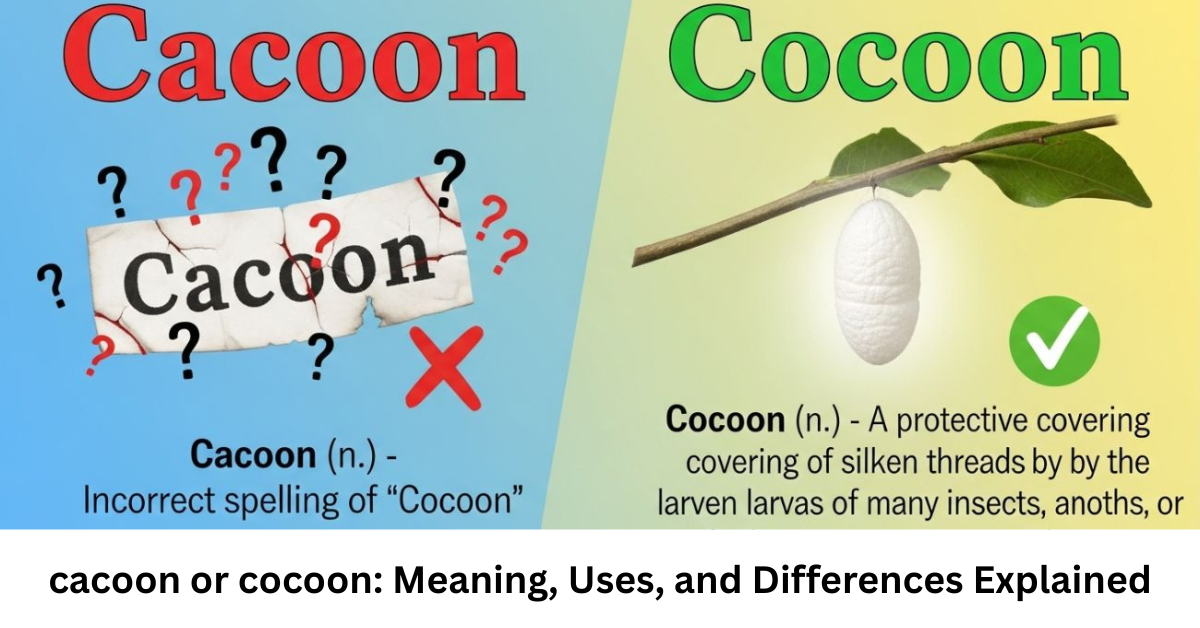
The concept of cacoon or cocoon is often misunderstood due to spelling confusion and limited awareness of its biological role. In simple terms, a cocoon is a protective covering created by certain insects during their transformation stage, especially moths.
When people search for cacoon or cocoon, they usually want to understand what it is, why it exists, and how it works in nature. This natural structure plays a powerful role in protection, growth, and transformation, making it one of the most fascinating processes in biology.
cacoon or cocoon Meaning and Natural Origin
The term refers to a silky protective casing formed by insect larvae during metamorphosis. Although “cacoon” is a common misspelling, the correct biological term is cocoon.
A few key points include:
- It is created during the insect life cycle
- Mainly found in moths and some butterflies
- Made from natural silk produced by the insect
- Acts as a shield during transformation
This stage ensures the insect safely develops into its adult form without external threats.
cacoon or cocoon Structure in Nature and Function
The structure of a cocoon is more advanced than it appears. It is carefully spun using silk fibers secreted by the larva.
Inside this natural shell:
- The larva becomes inactive
- Cellular transformation takes place
- The body reorganizes into adult form
This stage is essential for survival, making the cocoon a natural protective system designed for change and growth.
Cocoon Uses in Science and Nature
The cocoon is not just a biological structure—it also has scientific and practical importance.
Natural role:
- Protects insects during metamorphosis
- Supports life cycle completion
- Maintains ecological balance
Human applications:
- Silk production from silkworm cocoons
- Inspiration for protective materials in engineering
- Research in biomimicry and material science
Scientists often study cocoons to develop strong yet lightweight materials inspired by nature.
Cacoon or Cocoon Spelling Difference Explained
One of the most common confusions is the spelling difference between cacoon or cocoon. The correct form is “cocoon,” while “cacoon” is simply a mistaken version used in informal writing.
Reasons for confusion include:
- Similar pronunciation in spoken language
- Typing errors and informal usage
- Lack of scientific familiarity
Despite the spelling variation, both refer to the same natural structure.
Symbolic Meaning of Cocoon in Life and Growth
Beyond biology, a cocoon is widely used as a metaphor for personal transformation. It represents:
- Growth through challenges
- Inner development
- Emotional or mental healing
Just like an insect emerges stronger after the cocoon stage, humans also go through phases of change before becoming stronger versions of themselves.
Frequently Asked Questions (FAQs)
1. What is cacoon or cocoon in biology?
It is a protective silk structure made by insect larvae during metamorphosis.
2. Is cacoon or cocoon the correct spelling?
The correct spelling is cocoon; “cacoon” is a common error.
3. What is the purpose of a cocoon?
It protects the insect while it transforms into its adult stage.
4. What materials make up a cocoon?
It is made from silk produced naturally by the insect larva.
5. Why is the cocoon important in nature?
It ensures safe development and survival of many insect species.
Conclusion
Understanding cacoon or cocoon helps us appreciate how nature designs protection and transformation in the most efficient way. From its biological role to its symbolic meaning, the cocoon represents change, safety, and growth.
Whether you view it scientifically or metaphorically, this natural structure reminds us that transformation often happens quietly before something beautiful emerges.